Showing posts with label Danube. Show all posts

Wednesday, October 11, 2023

Weltenburg Abbey

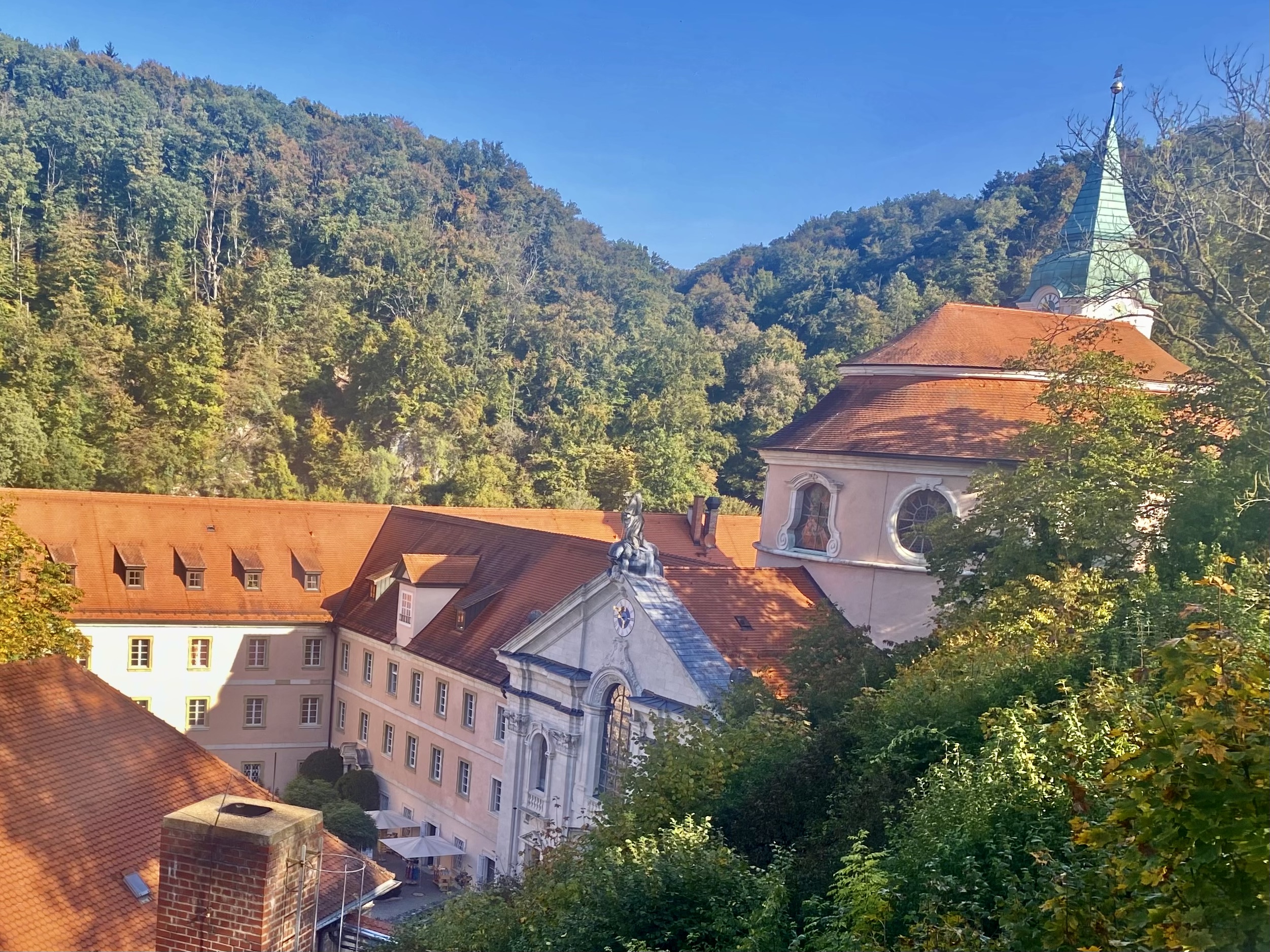
Florian recommended that I check out the Weltenberg Abbey, half an hour southwest of Regensburg.  "Why not?" I thought.  He never steers me wrong when it comes to German travel and it's only a little bit out of the way to Schwangau, my final destination.


The Danube Gorge setting appealed to me more than the idea of a monastic brewery, one of the oldest in the world.  


It's also a jumping-off spot for boat tours.  I wished I'd had the time, but not with a 4:55 p.m. reservation at Neuschwanstein, three hours south near the Austrian border.


Water-level marks on the abbey wall confirmed my suspicion that the Danube, like the Rhine, has been stricken by drought.  The marks go back as far as 1785, when the river surged almost as high as the top of the window.


Benedictine monks have been growing hops in the fields above the abbey since 1050. Practice makes perfect; they have won the World Beer Cup for their dunkel (dark) beer three times since the turn of this century.


Stations of the Cross, painted in the 20th century, led me to the Shrine of Our Lady on the Frauenberg Hill, tucked away behind some trees.


Sunlight flooded the 18th century Rococo interior.


Dozens of devotional works, including a needlepoint of the Virgin Mary were locked behind the shrine's interior gate. 


I was back on the road by 10:30 a.m. with more than two hours of sightseeing already under my belt.  Go go go when you're solo!

Tuesday, October 10, 2023

Regensburg Blight

College drinking seems pretty remote when you're as old as I am, but for the second time this year it has interfered with my enjoyment of a city.  First, Coimbra; now Regensburg, Bavaria's fourth largest city. Orange-attired students determined to get shit-faced overran the place.  When I later asked the desk clerk at my chic hotel what was going on, he said they were celebrating the beginning of their semester.  "Students make up 1/3 of our population," he reported.  That's 50,000 kids.


I first noticed the loud revelry while eating the best dinner of my trip near the Steinerne Brücke or Old Stone Bridge.  When I started filming a woman participating in a beer relay, one of her friends approached and demanded that I stop.  "We're just having a little fun," he explained.  "It doesn't need to embarrass anyone on the internet."  "Well, maybe you shouldn't be doing it in public," I snapped.


But I seemed to be the only person bothered by it.


Regensburg had been making a good impression as I walked from the hotel to the restaurant.  Scaffolding partially obscured the Gothic cathedral at the city center.


The biggest medieval city north of the Alps, Regensburg was designated a World Heritage Site by UNESCO in 2006, in part because of its significance during the Holy Roman Empire. The Imperial Diet met here so often in the 17th and 18th centuries that it became known as the Perpetual Diet of Regensburg.


The Steinerne Brücke reminded me of the Charles Bridge in Prague, although it was built two centuries earlier.  I had seen signs for the Czech Republic's capital, about 150 miles northeast, on the autobahn.  


To escape the bacchanalia, I crossed the river to Stadtamhof, a tranquil residential neighborhood.


Despite all the chirping, I didn't see a single bird.


The warm weather held through the evening.  Crossing the bridge back into the city, I could see the impact of drought on the Danube.


I'm pretty sure water would cover the area where these people were watching the sunset.


Here's an interesting take on pretzels and brats.


More traditional German imagery decorated this building.


A small crowed attended a pro-Israel rally outside of the Rathaus.  Not speaking German was a real disadvantage for the only time.


I'm guessing these drunken men had been ordered to run around the fountain in their underwear.  They didn't object to being photographed.


This evangelical church has an interesting history that goes back more than five centuries. After the death in 1519 of Maximilian I, a Holy Roman Emperor who had "protected" the empire's Jewish population in the same way that organized crime extorts money from small businesses, the city council tore down the synagogue that stood here and began building a Catholic pilgrimage church to curry favor with the new emperor.  But the Reformation intervened before it could be completed.  The entire city council converted to Lutheranism and voted to make their new house of worship a Protestant church instead, despite its resemblance to a cathedral.


Walhalla

Valhalla has always loomed in my imagination, less because of its origins in Norse mythology as the hall where the heroic and chosen go to await battle instructions than the location of the beautiful cemetery in Westchester where the Hons bury their dead.  It's also a magnificent structure in Bavaria (spelled with a "W" rather than a "V") that looks a lot like a newer Acropolis.

The neoclassical structure sits above the Danube, not far from Regensburg.  In the summer, you can take a tour boat to a dock at the base and climb up to see it.  


Walhalla is the centerpiece of a campaign by Ludwig I to inspire pride among German speakers in the wake of the Napoleonic wars when the country's modern borders had not yet been established.  If so, the monument probably would have been built on the more central Rhine river.  


Like the inlaid marble floor indicates, it was completed on October 18, 1842, after more than a decade of construction.


I couldn't quite catch the splendor of the cavernous, skylit interior designed by Leo von Klenze, the court architect.


More than 130 busts of famous German speakers, nearly all men, adorn the walls.  They include scientists, composers, artists, religious figures and even a member of the Nazi resistance.  It's interesting to note that Ludwig's royal descendants were no fans of Hitler.


Ludwig chose nearly 75% of the 130 people who have been honored with busts.  Nicholas Copernicus was sculpted and installed first.

Martin Luther didn't make the first cut because it took Ludwig five years to overcome his Catholic bias and suspicions of the reformer. 

In addition, there are 64 plaques embedded beneath the ceiling that memorialize German speakers whose likenesses are unknown or unverified, including Charlemagne, whom some historians have called the first Holy Roman Emperor.  


Whether the individuals are represented with busts or plaques, Ludwig honored only those who had been dead at least a decade to provide some sense of objectivity. I photographed everyone whose name I recognized.  Composers comprise the majority by far.

Ludwig van Beethoven
Richard Wagner
Peter Paul Rubens is the handsomest.


Since 1966, the German people have been responsible for nominating new additions--as well as paying for the busts--who must have been dead for at least two decades by decree of the Bavarian government, which also makes the final selection.  Twenty-one-year-old Sophie Scholl, added in 2003, represents the Nazi resistance.  She and her 24-year-old brother, Hans, were beheaded 61 years earlier in Munich for distributing anti-war leaflets. I'm proud to stand with Sophie now, but wonder if I would have had her courage.


Physicist Max Planck, a Nobel Prize-winner best known for developing quantum theory, made his debut just last year.