Porto's relatively new metro whisked me from my hotel across town to Campanha to catch my morning train south.
Trust me, Porto's rush hour was a lot less chaotic than boarding the Lisbon-bound train where finding my seat among hundreds of tourists with luggage and even a couple of e-bikes was a higher priority than capturing the three-hour journey on my i-Phone.
Navigating Lisbon's much older and busier metro was more challenging--especially since Google maps didn't indicate a transfer was required to get from Oriente to Entre Campos--but the size and variety of the tiled murals was stunning. Where does a 40-foot tall hare run? Anywhere he wants to!
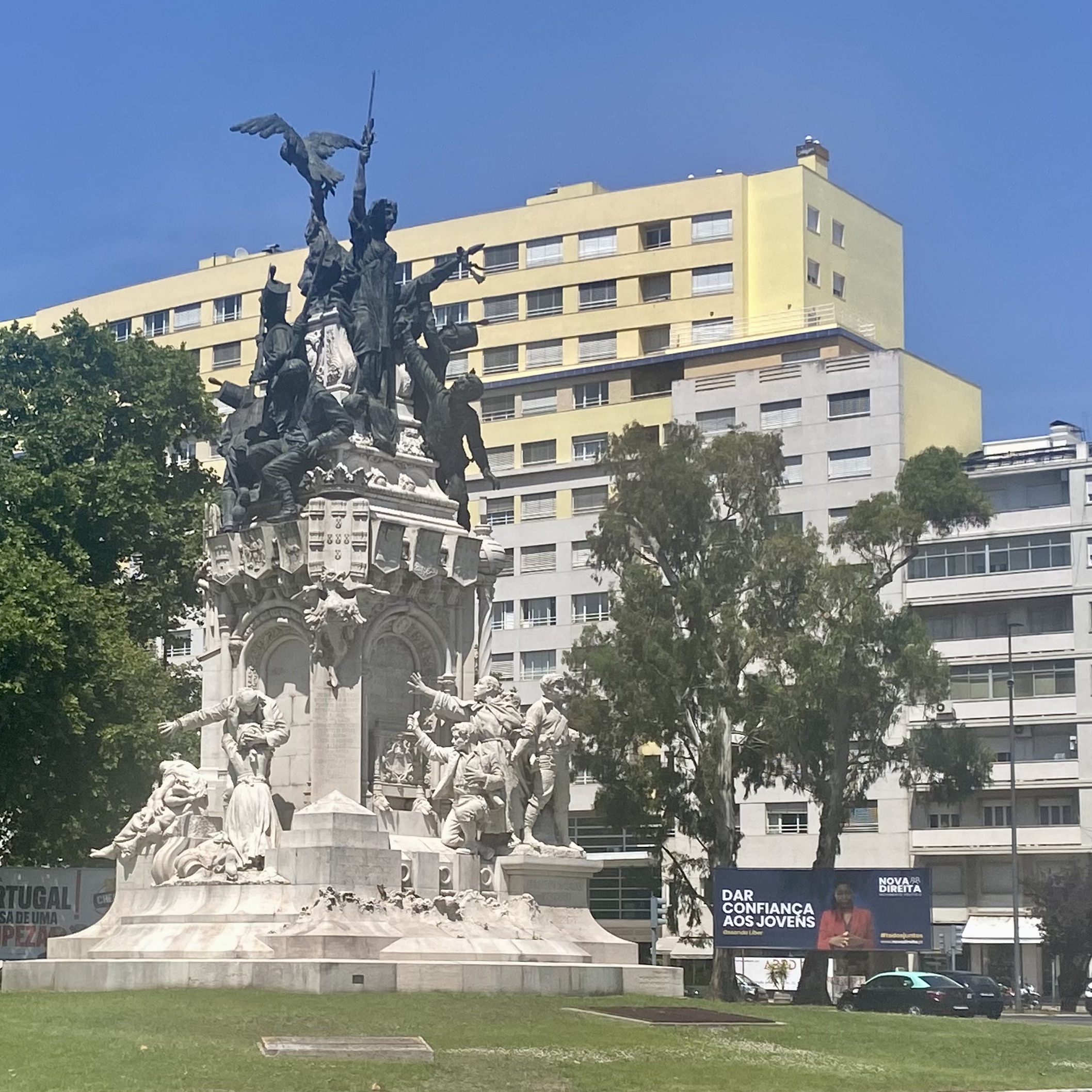
Another monument honoring Portugal's Heroes of the Peninsula War greeted me outside my NH Hotel. Despite the event's historical significance, an employee at a local tourist office had never heard of it.
With several hours to kill before meeting Chris and his friend Janet for dinner--they had just flown into town after ten days of hiking in the remote but well-scrubbed Azores--I explored Campo Grande Park.
A pedestrian overpass caught my eye.
Upon closer inspection, I thought Audrey would love these cat tiles.
Perhaps bread crumbs is a better description. They led me directly to a museum celebrating the work of Rafael Bordalo Pinheiro, a 19th-century caricaturist and ceramicist who is considered the father of Portuguese comics. He influenced Carla Felipe, whose work I had seen the day before.
Rafael Bordalo Pinheiro (1846-1905)
In 1875 Pinheiro introduced Zé Povinho, his most enduring character and a kind of Portuguese everyman who enabled him to spoof the country's politics. In this cartoon, government officials have secured Zé Povinho's vote by bribing him with food and wine.
Pinheiro, who owned a ceramics factory with his brother, gave Zé Povinho three dimensions, too. From a modern perspective, it's tempting to think of him as a whistle blower.
Food figures prominently in both Pinheiro's illustrations and ceramics. From his girth, it's clear he enjoyed eating, too.
Unfortunately neither the family cat (Peaches, whose image does appear on an eyeglasses cleaner fabric sold at the museum) nor the frog tiles are available, although you can buy a grasshopper he designed for $98.
Outside the museum, his silhouette chases swallows which the company produces in a variety of styles.
I couldn't decide if the ceramics that decorate the entrance to a nearby McDonald's paid homage to Pinhiero or not.
My route back to the hotel passed the campus of the University of Lisbon where I was asked to stop taking video of what looked like a rather tame undergraduate hazing ceremony.
Janet, a foodie, had booked us a reservation at Zunzum, a gastropub not far from where the cruise ships dock on the Tagus River. No stars but it's in the online Michelin guide. The appetizers photographed better and satisfied more than the entrees.
I couldn't resist the acorn-fed black pork. Too bad it wasn't served hot enough.
The bougainvillea looked familiar as I walked through a beautiful neighborhood en route to the mouth of the Douro River where Portuguese explorers returned from their explorations in sailing vessels half a millennium ago.
An interesting but unmarked land sculpture caught my eye.
Does your pooch need a rinse after frolicking on the beach?
Sculpture, basketball courts and industrial detritus line the river walk, much as they do along the Hudson on New York's West Side.
Is that an unhappy nun across the street?
Locals fish, sun and swim from these docks.
The Arrábida Bridge, completed in the early 1950s, relieved traffic congestion on the Dom Luis I bridge, originally constructed to carry horses and wagons.
I turned the corner at this Art Deco building to walk back up the hill to the Crystal Palace Gardens.
I never did get around to hopping on board a tram.
It turned out that the 19th-century palace, modeled after the one in London, had been replaced long ago with the Superbock Arena. Still, the hike was worth the views.
Signs warn visitors to the park that the peacocks, which have the run of the place, can be aggressive. My battery died before I could take more than a couple of photos.
A quick re-charge at the hotel before returning to Mercado Bon Successo for dinner enabled me document that Portugal hasn't altogether reckoned with its past as a colonial power, at least not in this Porto ice cream shop.
Carla Filipe must be among the most creative artists working in the world if her prodigious work exhibited at the Serralves is any indication. Some might call this pen and ink chicken scratch, but not me. Of the three exhibits I saw, this one was the most compelling.
Filipe's sweet spot, which she expresses in multiple media, seems to be the nexus among politics, pop culture and personal experience. No plastic shopping bags for her.
Her bilingualism is evident with many of her cartoon-like drawings, captioned in both Portuguese and English.
"I need a job I need love" (2005)
It's hard to tell how seriously to take her geopolitics.
"Atlas" (2005)
I'm guessing some of her work is satirical. It reminds me of inexpensively produced agitprop that you might have found on a college campus in the 60s, although she wasn't born until 1973, near the end of Portugal's political dictatorship.
Filipe must have been politically precocious to revile Margaret Thatcher, whose nanny state coincided with her early adolescence. Did she misspell the right-wing prime minister's name wrong deliberately?
Our similarity in musical taste contributed to my appreciation of her relentlessly contemporary work.