Monday, April 15, 2019

Montgomery


We continued what Christine dubbed our "Civil Rights Tour" at the church where Dr. Martin Luther King, Jr. led the congregation from 1954 to 1960.  Alabama's Capitol and the area surrounding it were eerily deserted.


Footprints in the adjacent crosswalk commemorate nonviolent marches from Selma to Montgomery in the Sixties that led to passage of the Voting Rights Act.  

In 2013, the US Supreme Court struck down provisions of the act that monitored its implementation on the grounds that they were no longer were needed.  Chief Justice Roberts should explain that to Stacey Abrams, the 2018 Democratic candidate for governor of Georgia.  Her narrow loss to the white Republican candidate, who also happened to be Georgia's Secretary of State, was likely due to suppression of the African American vote by his office.  

"Plus ça change, plus c'est la même chose."  The more things change the more they stay the same.


Google offered no insight about what these crosses, planted in the lawn directly across from the Capitol, signify.  A vagrant tour hustler said they represented the increasing number of annual homicides in the city; Christine thought they might be associated with a pro-life event she'd seen advertised.  Their symbolism seemed fraught in any case, given the context.


Maya Lin designed the nearby Civil Rights Memorial.  It seems utterly genteel in comparison to the National Memorial for Peace and Justice.


Water washes over a granite block engraved with the names of Civil Rights martyrs and the movement's significant events.  Clearly, given the current climate, the struggle continues.


The engravings are similar to those found on the Viet Nam Veterans Memorial, also designed by Lin.


Gut Punch

Despite the pastoral entrance, the National Memorial for Peace and Justice in Montgomery, the centerpiece of our road trip, delivered an extraordinary gut punch.


Statues of enslaved African Americans in chains sculpted by Kwame Akoto-Bamfo plunge visitors into the horrors of the not-so-distant past.


Half the memorial is hidden from view on a rise.


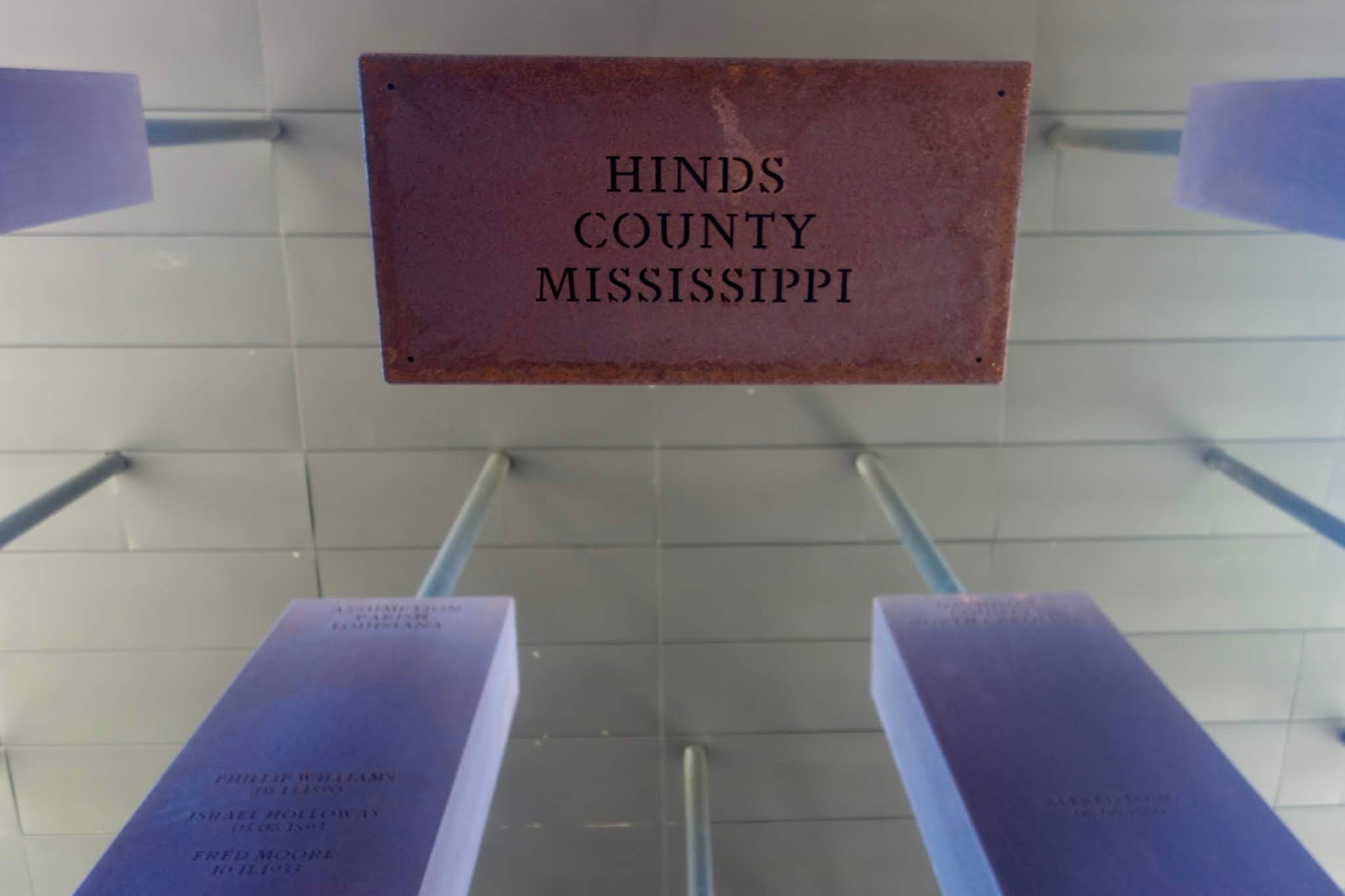
Eight hundred monuments, each about the size of a man, comprise the memorial.  They're inscribed at the top with the names of counties throughout America--some as far north as Maryland--where the Equal Justice Initiative has documented lynchings.  Individual victims' names--signifying more than 4,000 black necks broken--are listed beneath.


As you walk deeper inside, you gradually find yourself standing under the monuments, hanging from above as if noosed human beings.  County names appear on the bottom, too, reminding you how pervasive the practice was.


The "offenses" of the lynching victims, mostly men, beggar belief.


In aggregate, the monuments indict, powerfully.  "Our country's national crime is lynching," observed Ida. B. Wells, an early Civil Rights activist who was freed by the Emancipation Proclamation during the Civil War.


A water wall memorializes anonymous victims.


The language of Toni Morrison exhorts as it scalds.


The perfect symmetry of the memorial's design belies the racial terror it commemorates.


Each monument has a double, arrayed like coffins a short distance away.  The Equal Justice Initiative has invited counties to "reclaim" these monuments and erect them locally in an effort to acknowledge the past and achieve some kind of reconciliation.  Monroe and Montgomery counties are among the hundreds who have yet to do so.  The home of To Kill A Mockingbird alone lynched 17 African Americans.


It came as a bittersweet relief that my birthplace, El Paso, was not included among the Texas counties.  The same can't be said of the Florida county where I likely will die:  two men lynched less than a century ago.


A special grove of young trees on the site is named after Ida Wells.


A sculpture by Dana King pays tribute to the women who sustained the Montgomery bus boycott, which lasted a little more than a year in the mid 1950s.  It led to a Supreme Court decision that desegregated public transportation in the Deep South.


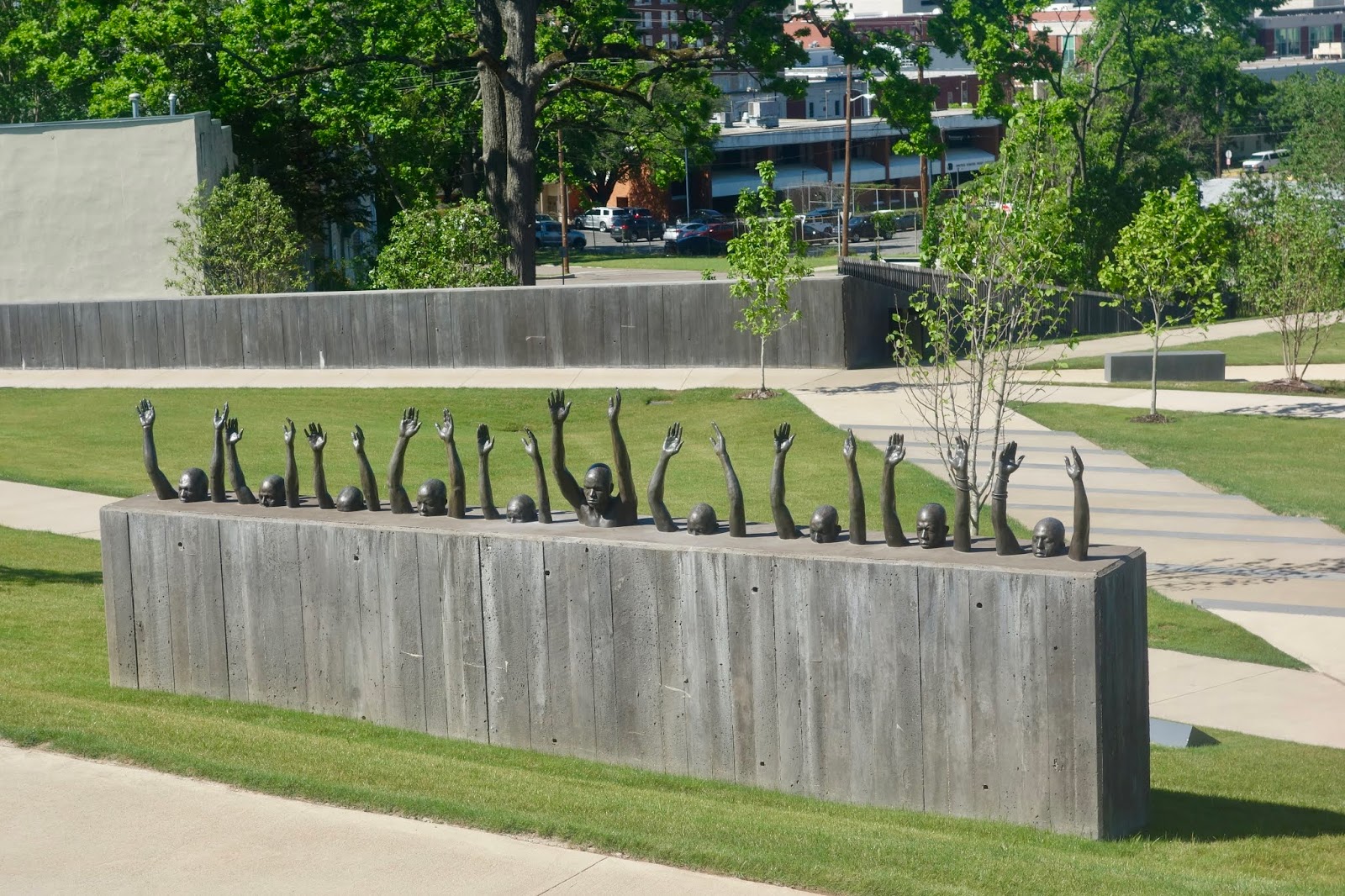
Another sculpture by Hank Willis Thomas, set against the backdrop of the Montgomery skyline, reminds visitors that the struggle for justice continues.


A map depicting the density of racial terror in Alabama hangs in the visitor's center across the street.


The center also displays earth obtained from beneath the lynchings in glass jars.


Misbegotten Literary Pilgrimage

Our drive to Monroeville, birthplace of Truman Capote and Harper Lee, took us past the Holman Correctional Facility, the most violent prison in America where 200 men occupy death row.  Chilly, suddenly overcast weather, cut short our planned walking tour.  These two English majors also had great difficulty finding the house where Truman Capote visited the cousin he made famous in "A Thanksgiving Visitor."  It's a barely marked crumble of bricks, surrounded by depressed businesses.


The next morning we killed time at a colorful eyesore before town's primary attraction opened.  


Gaudily painted lawn ornaments capture the area's conflicted history.


To be fair, they're greatly outnumbered by elephants that signal support for the Crimson Tide, the University of Alabama's football team.


You won't find a prettier town square on a perfect spring morning.


Images of mockingbirds appear more commonly than the birds themselves.  Here's one on the facade of Lee Motors, whose website nevertheless studiously avoids any mention of the town's favorite daughter.  Call it literary prestige by association.


The Monroe County Museum occupies the former courthouse, immortalized by Lee.  The clocks actually work.


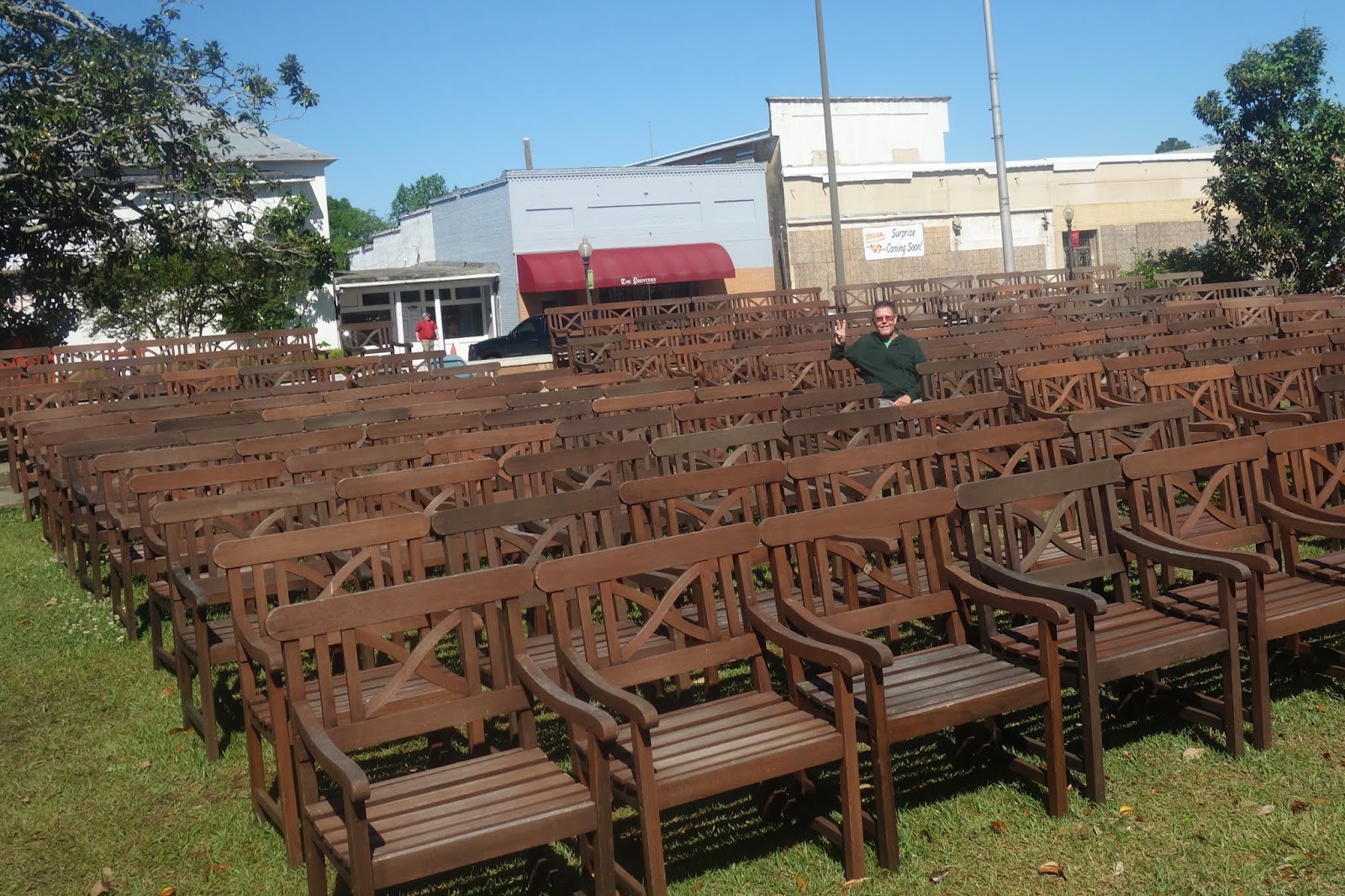
On weekends, visitors can watch outdoor performances of "To Kill A Mockingbird."


In Hollywood's adaptation of Lee's beloved novel, set designers re-created the court room almost exactly.  Stepping into it is the only reason to visit the terrible museum.  Too bad the photo of me pledging to "tell the whole truth and nothing but the truth didn't come out."  I'll tell it here instead.


Here sat the not-so-imaginary jurors who wrongly convicted Tom Robinson of rape. I took this photo from the "colored section" in the balcony where Scout, Jem and Dill watched the trial.


A quilt hanging near the entrance depicts Capote with cousin Sook on an incongruous panel.


The museum counts a local teenager's scrapbook among its few archival items.  There's also no mention of Lee's death more than three years ago, nor any reference to one of the biggest hits on Broadway this season, a new adaptation of her 59-year-old novel.  Not even a playbill!


But don't miss this pathetic re-creation in a room of its own.


If I sound like a snob it's because of the way I was treated when I dared to draw a significant error to the attention of the administrative staff.  A wall panel in the room dedicated to Capote claims that he published his last novel, Music for Chameleons, in 1958 even though a prior paragraph on the SAME panel notes that Breakfast at Tiffany's appeared in 1960.  Chameleons wasn't published until 1980 and it isn't even a novel!  

"Yes, we're aware," sniffed the same guy above his half glasses before dismissing me.   Earlier, he gave us attitude when we asked where to find the rock commemorating Atticus Finch.  I signed the visitor's register with a pissy vengeance.


We left the museum with the distinct feeling that it existed only as tourist draw for an otherwise empty town.  The size of the gift shop and variety of tchtokes it stocked reinforced this impression.  And if you're looking for the Atticus Finch rock, you'll find it behind the museum, not in front as indicated in the walking tour map.


Sunday, April 14, 2019

Palm Sunday

En route to Monroeville, Alabama we detoured to Stockton, an hour north of Mobile, to say hello to Christine's friend Faith.  She lived for many years on her own in Oaxaca, Mexico before health problems forced her return to the U.S.


Her son is the evangelical pastor at the beautiful Presbyterian Church across the street.


White Beaches

Shortly after leaving Tallahassee, an emergency weather bulletin interrupted NPR.  We parked briefly under a freeway overpass before proceeding through blinding rain.  By the time we arrived for brunch in Pensacola 90 minutes later, the skies had cleared.


The waiter at the Fish House told us the beaches are Florida's whitest.   I wasn't sure if he meant the sand or the people.


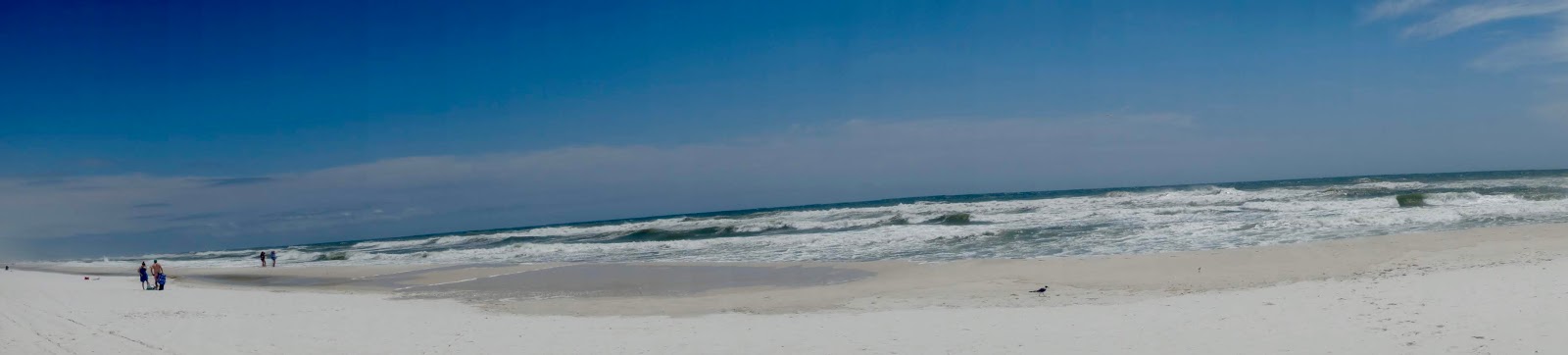
Heavy surf roiled the Gulf.


The neighborhood houses looked mostly like short-term rentals, empty after Spring Break.