You wouldn't necessarily expect a renowned research library to embrace an artist who cuts up books with a power saw to make sculpture. But Robert The pulls more than one trigger with a WTF?-work that should also fire up Americans who defend the Second Amendment to the U.S. Constitution with the same fervor that they embrace evangelical Christianity.
"Holy Bible: King James Version" (1995)
It's included in "Declaring America: 1776 and Beyond," a commemoration of the nation's semiquincentennial that leaves the patriotic chest thumping to the MAGA crowd. I left the quirky exhibit wondering if the New York Public Library received any federal funding. It does, but very little, so my former employer may be less vulnerable to extortion than my alma mater or the Smithsonian. That's a good thing, because the curators understand that being American means different things to different people. California-born Kara Walker's lineage of violence and oppression informs "African/American" (1998)
No doubt, economic insecurity shaped David Hammons, one of ten children in Detroit raised by a single Black mother before moving to California. Fond of mixed metaphors, he created a potent one for deprived neighborhoods, filling a honey jar with red, green and black jelly beans, the colors of the Pan African flag. Marcus Garvey, the early 20th-century father of Pan-Africanism, believed that people his color could never achieve equality in the United States unless they pursued their capitalism separately which, by the time Hammons created this work, must have seemed like utter folly.
"Marcus Garvey Vitamins" (ca 1983)
But in this futuristic print, Kerry James Marshall, who moved from his birthplace in Alabama to California as part of the Great Migration, clearly believes that achieving financial success doesn't necessarily mean giving up your identity or your past. African influences are apparent in this family's furnishings and attire, and the "dark continent" faces the viewer In the globe hologram floating above the coffee table.
"Keeping the Culture" (2011)
Two Silent Generation artists from the New York metropolitan area bucked their cohort with elongated critiques of democracy. Barbara Kruger's feminism is evident in a 1986 print series that declares "We Will No Longer Be Seen and Not Heard." Five years later, Vito Acconci envisioned "Wav(er)ing Flag" as a public art installation in St. Louis with neon lights to make partying conventioneers stop and think about the meaning of the words they pledged by rote, hands over hearts, as school children. It works even on the much smaller scale of the library's walls.
Edward Snowden helped expose the level of federal government secrecy and citizen surveillance conducted in the wake of 9/11. His leak of classified material included the release of more than 400 code words used by the National Security Agency. Massachusetts-born baby boomer Annie Bisset, using an ancient Japanese way of making woodcuts, illustrates 26 as an ironic alphabet primer for kids. The activities they conceal are far less whimsical than names suggest.
I usually find the work of Glenn Ligon, a gay African American from the Bronx, a little too conceptual, but these lithographs illustrate the journey from chattel to artist in a uniquely personal way. Inspired by ads that used names, ages, and physical characteristics to identify and reclaim people who had escaped enslavement, Ligon asked ten of his friends to describe him instead.
"Runaways" (1993)
Their responses subtly convey the differences between owning and knowing.
RAN AWAY, Glenn. Medium height, 5'8", male. Closely-cut hair, almost shaved. Mild looking, with oval shaped, black-rimmed glasses that are somewhat conservative. Thinly-striped black-and-white short-sleeved T-shirt, blue jeans. Silver watch and African-looking bracelet on arm. His face is somewhat wider on bottom near the jaw. Full-lipped. He's black. Very warm and sincere, mild-mannered and laughs often.
RAN AWAY, Glenn. He is black. He has very short hair and eye glasses. He has quite light skin tone (faded bronze). Not tall. No noticeable accent. Wearing a plum-colored shirt, long-sleeved, and shorts. Very casual and stylish in appearance. He is wearing a bead bracelet (stones - a mixture of black-and-white). He has big hands and fingers. When he walks his feet cross each other a little bit. When he talks, he usually has a big smile towards you, yet he faces you from a slightly different angle. He looks at you from the corner of his eyes. His voice is very calm.
The Jim Crow era made the journey from chattel to artist a very long and arduous one. Nearly seven decades after the passage of the 13th Amendment--which finally banned slavery--African Americans still had to fear lynching in addition to suffering discrimination. It took the Scottsboro Boys to expose the systemic racism of the American legal system, particularly in the segregated South where pre-trial vigilantism remained common. According to the NAACP, nearly 5,000 people--72% of them Black--were lynched from 1882 to 1968, though the practice continued sporadically until 1981.
Hugo Gellert, an immigrant from Hungary, illustrated this poster for International Labor Defense, a legal arm of the Communist Party (the "red" arm grips a hammer to drive a spike through the skeletal hand of capitalism, represented by a dollar-sign ring, about to clutch the Scottsboro Boys who are a comradely red!). For a less politically-charged but even more powerful visual representation of this American atrocity, visit the National Memorial for Peace and Justice in Montgomery, Alabama.
"Spike Lynch Terror" Poster (1934)
I spent another half an hour keeping cool in the enormous Salomon Reading Room which was restored to its original function as a place to hang the library's art in 1986, three years after I left. Many of the all-white and mostly male portraits lining the walls belonged to the library's founders and reflected their 19th-century tastes. Two others, of "heritage Americans" who could not be more disparate, caught my fancy. One could never tell a lie
Our differences, not our bloodlines, make us American and our history, like our art, should reflect both the good and the bad. Cheers to NYPL for recognizing that when our government increasingly refuses to do so!
According to an exhaustive biography of Andy Warhol, Drella began stalking Truman Capote as soon as he moved to New York City, eventually befriending the cherubic wunderkind's mother and illustrating this gothic, coming-of-age novel without permission in a fawning bid to seek attention. The gorgeous prose reads like a lyrical fever-dream journal (attempted molestation on a ferris wheel by a female midget!), populated with ghosts, enormous snakes and several Southern caricatures (a tomboy based on Harper Lee ) but the summer-long story barely hangs together. Still, Other Voices, Other Rooms does yield this highly resonant nugget for an inchoate fairy, perhaps the first affirmation (albeit veiled) of homosexuality in American literature:
The brain may take advice, but not the heart, and love, having no geography, knows no boundaries: weight and sink it deep, no matter, it will rise and find the surface: and why not? any love is natural and beautiful that lies within a person's nature; only hypocrites would hold a man responsible for what he loves, emotional illiterates and those of righteous envy, who, in their agitated concern, mistake so frequently the arrow pointing to heaven for the one that leads to hell.
Sorry, Andy, In Cold Blood is more my cup of tea.
Our drive to Monroeville, birthplace of Truman Capote and Harper Lee, took us past the Holman Correctional Facility, the most violent prison in America where 200 men occupy death row. Chilly, suddenly overcast weather, cut short our planned walking tour. These two English majors also had great difficulty finding the house where Truman Capote visited the cousin he made famous in "A Thanksgiving Visitor." It's a barely marked crumble of bricks, surrounded by depressed businesses.
The next morning we killed time at a colorful eyesore before town's primary attraction opened.
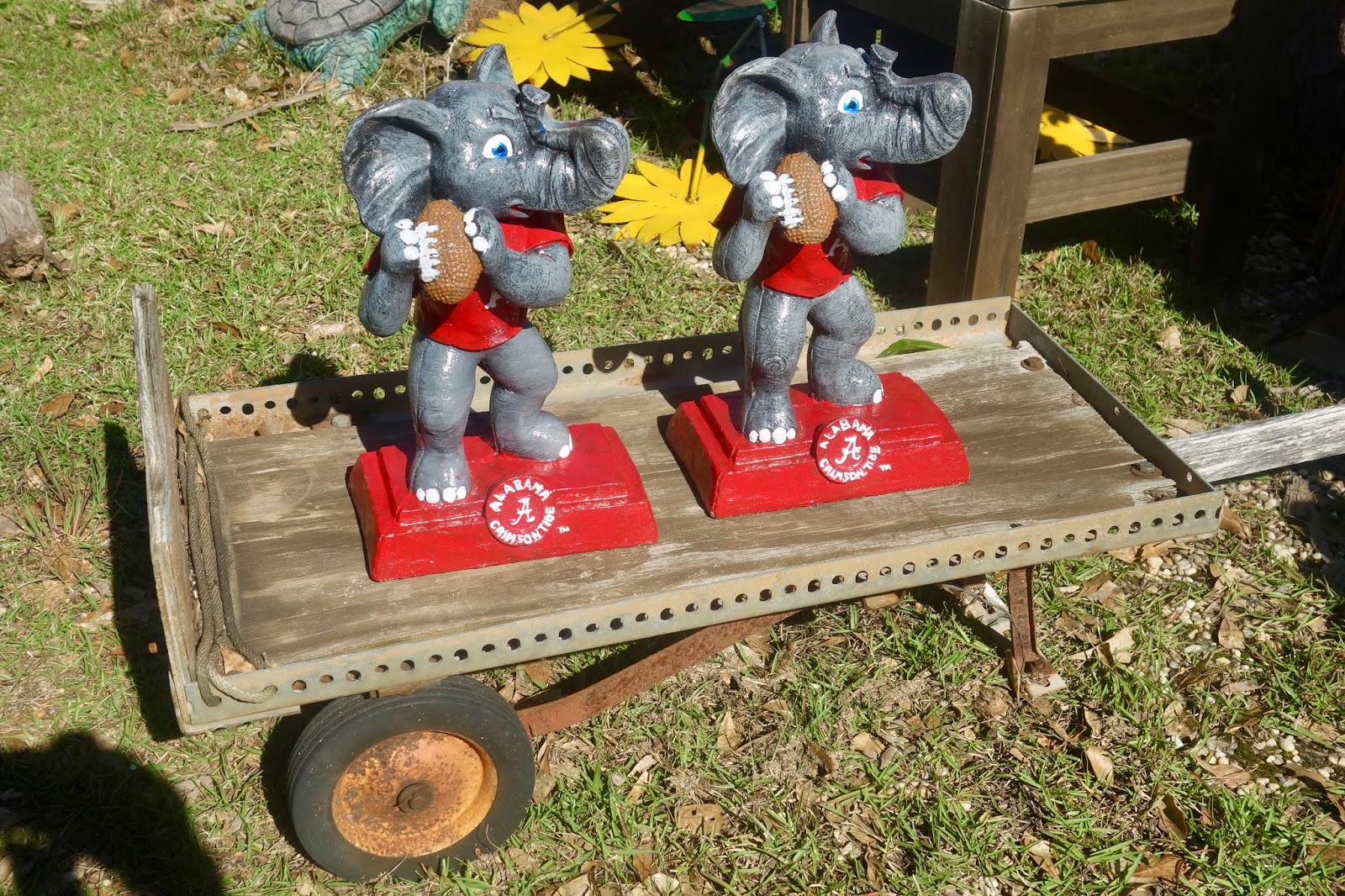
Gaudily painted lawn ornaments capture the area's conflicted history.
To be fair, they're greatly outnumbered by elephants that signal support for the Crimson Tide, the University of Alabama's football team.
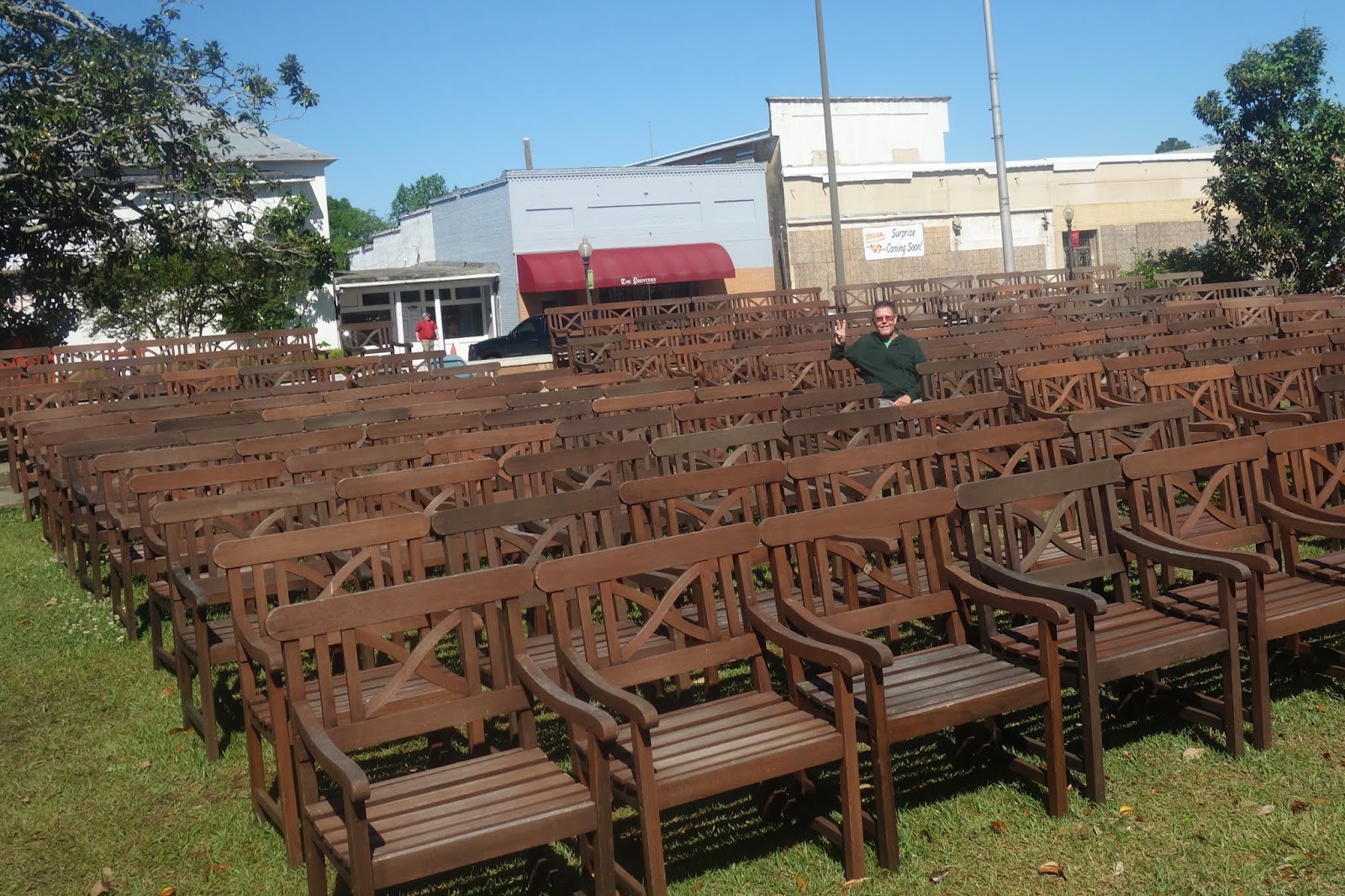
You won't find a prettier town square on a perfect spring morning.
Images of mockingbirds appear more commonly than the birds themselves. Here's one on the facade of Lee Motors, whose website nevertheless studiously avoids any mention of the town's favorite daughter. Call it literary prestige by association.
The Monroe County Museum occupies the former courthouse, immortalized by Lee. The clocks actually work.
In Hollywood's adaptation of Lee's beloved novel, set designers re-created the court room almost exactly. Stepping into it is the only reason to visit the terrible museum. Too bad the photo of me pledging to "tell the whole truth and nothing but the truth didn't come out." I'll tell it here instead.
Here sat the not-so-imaginary jurors who wrongly convicted Tom Robinson of rape. I took this photo from the "colored section" in the balcony where Scout, Jem and Dill watched the trial.
A quilt hanging near the entrance depicts Capote with cousin Sook on an incongruous panel.
The museum counts a local teenager's scrapbook among its few archival items. There's also no mention of Lee's death more than three years ago, nor any reference to one of the biggest hits on Broadway this season, a new adaptation of her 59-year-old novel. Not even a playbill!
But don't miss this pathetic re-creation in a room of its own.
If I sound like a snob it's because of the way I was treated when I dared to draw a significant error to the attention of the administrative staff. A wall panel in the room dedicated to Capote claims that he published his last novel, Music for Chameleons, in 1958 even though a prior paragraph on the SAME panel notes that Breakfast at Tiffany's appeared in 1960. Chameleons wasn't published until 1980 and it isn't even a novel!
"Yes, we're aware," sniffed the same guy above his half glasses before dismissing me. Earlier, he gave us attitude when we asked where to find the rock commemorating Atticus Finch. I signed the visitor's register with a pissy vengeance.
We left the museum with the distinct feeling that it existed only as tourist draw for an otherwise empty town. The size of the gift shop and variety of tchtokes it stocked reinforced this impression. And if you're looking for the Atticus Finch rock, you'll find it behind the museum, not in front as indicated in the walking tour map.
I thought about skipping the Andy Warhol retrospective at the Whitney. After all, I'd recently made a pilgrimage to see his hometown museum.
Soooooooooo glad I didn't make that mistake. It's truly wonderful to see how the curators have traced the arc of his career. And appetite. When Burger King used this footage for a 2019 Super Bowl ad (#EatLikeAndy), they exposed him to his biggest live audience yet, just shy of 32 years after his death.
The room devoted to his commissioned portraits is my favorite, mostly because they were mostly new to me. Did the Queen of Soul ever look more regal?
Truman Capote on top (as if!), Henry Geldzahler and Ross Bleckner below.
Keith Haring on the left.
He and Andy collaborated, too.
Here's Jon Gould, Andy's last boyfriend and so closeted that he forbade Drella from writing about their relationship in his diaries. Gould, swinging from a lamppost while listening to "Flashdance," once tried to pick me up in Central Park. I'll bet he hated this fey portrait. I do.
Camouflage is as good a metaphor for Andy's prophetic talent as any. It hid in plain sight from the beginning.
A delirious combination: cow wallpaper and floral screen prints.
I want strobe lights to illuminate this room while I twirl.
Like this guy.
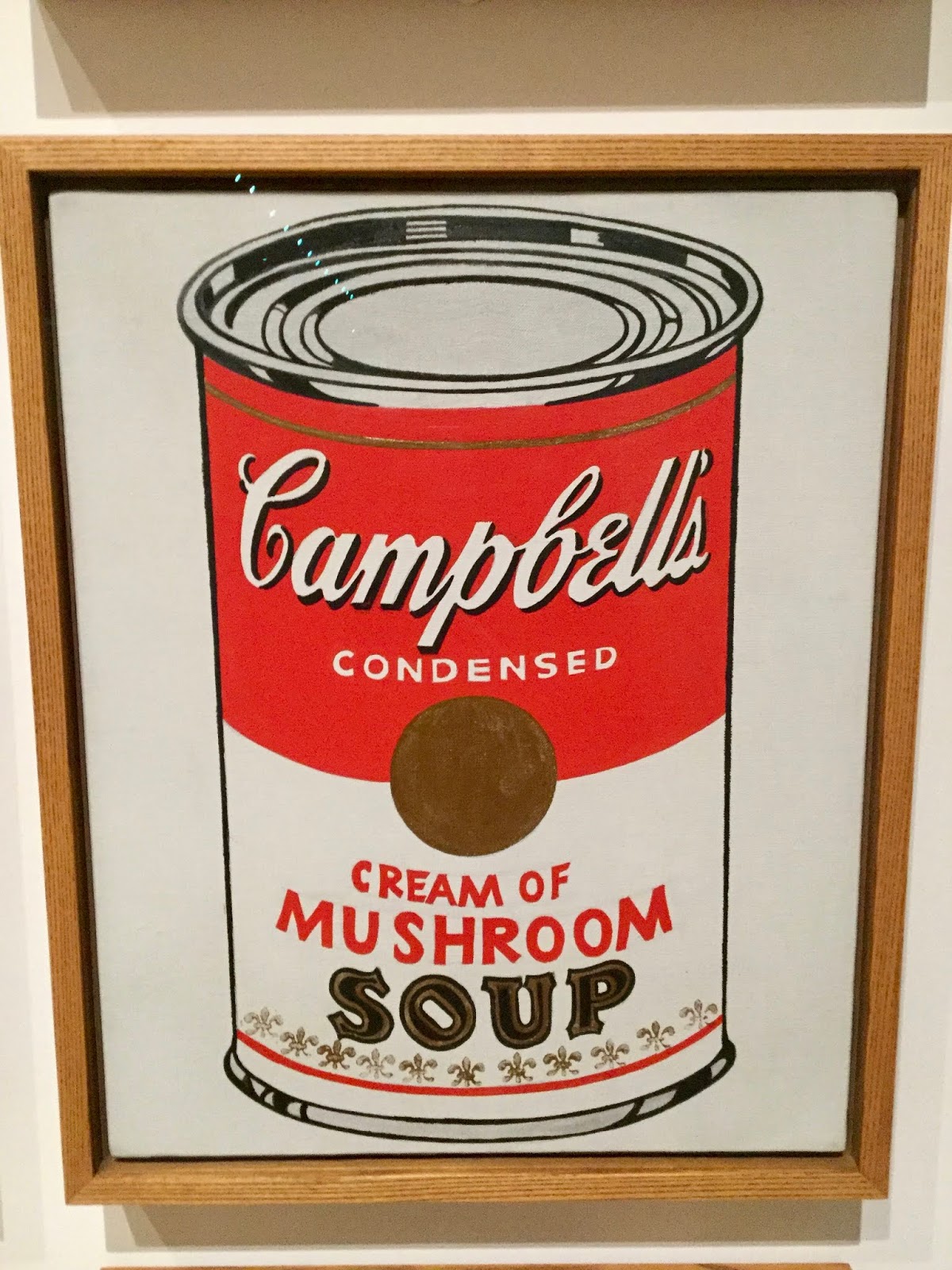
Andy's career-defining soup cans were supposed to be sold singly after he debuted them in LA during the early 60s. But when the gallery owner realized they would be worth more together, he negotiated to buy back the ones that had sold. Smart move.
Mom used to make a delicious pot roast with this critical ingredient.
To this day, I arrange commercial products on my shelves so that art faces front.
Andy drew shoes for Bonwit Teller, a long gone department store. He also imagined celebrity footwear.
Christine Jorgensen, the first trans person to enter my consciousness. I think theirs may be the only pair. Witty, no?
Elvis Presley.
Other commercial clients included CBS News. I wonder if Andy had ever seen somebody shoot up before illustrating this advertisement for a show about heroin addiction?
A pencil sketch of James Dean with his overturned Porsche.
Plastic surgeon ad or art?
Things go better the more you drink.
Before Liz became a Joan Rivers punchline.
Has any image contributed more to Marilyn's posthumous fame?
This was one of the first movie stills I ever bought. It adorns a storage footlocker along with Buster Keaton, Marilyn, Judy Garland, the Tin Man, the Cowardly Lion and the Scarecrow.
Talk about sexy!
Elvis shooting a gun. You don't get much more American than that.
It took a lot of patience to combine these Screen Tests.
Andy even had a political consciousness of sorts. He silkscreened these images from the Civil Rights era.
I first saw one of his electric chairs at the Tate Gallery. Its stark simplicity shocks.
Jackies' tragic day, tripled.
Sissy seems so wrong for this cover, her freckles a casualty of the wanton air brush.