Showing posts with label Mexico City. Show all posts

Tuesday, March 7, 2023

The Last Supper

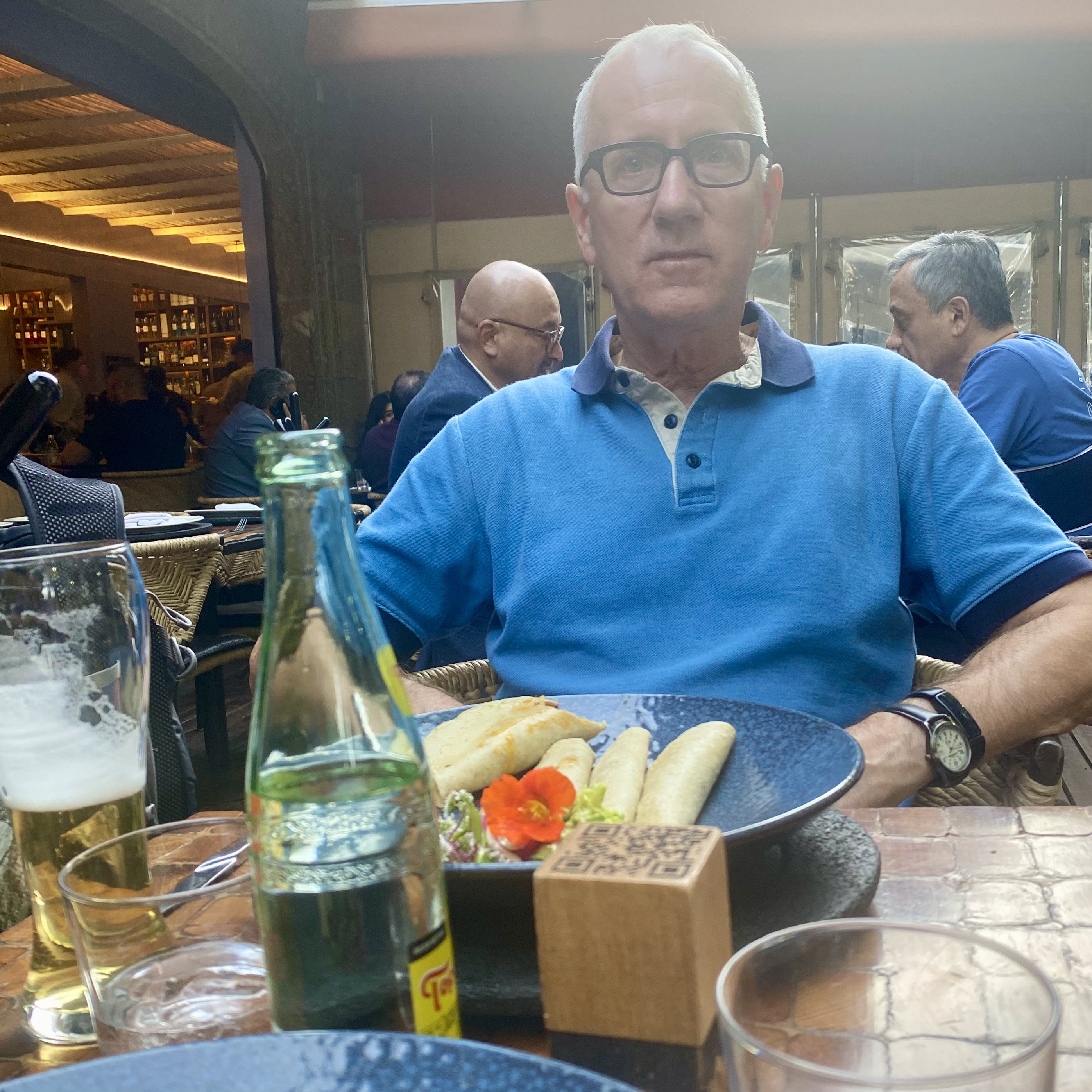
Chris cancelled our lunch reservation at Los Danzantes for obvious reasons but La Casa Azul (and a 24-hour fast) restored my appetite so I suggested we try the restaurant for dinner.  The only waiter who spoke English had pink hair.  We sat outside on a perfect late afternoon.


The restaurant was about a 15-minute walk from La Casa Azul.  There seemed to be as many souvenir vendors as we had seen in Centro Historico


Coyoacán is definitely a neighborhood where you want to linger.


Especially if you like colonial architecture and gorgeously landscaped parks.


Coyoacán means "place of coyotes" in Nahuatl, a Mesoamerican languages dating from the seventh century.  Nearly two million people in Mexico and the U.S. still speak it.  We could see this fountain from our table.


The squash soup was probably a good bet.


The cauliflower tacos decidedly were not.  The after-effects of the delicious meal effectively ended my Mexico trip a day early.  I sacrificed a pre-paid, early morning guided tour of the Museum of Anthropology and Chapultepec Castle, one of only two royal palaces in North America ever inhabited by monarchs.  Next time I'll refuse the ice cubes with my agua con gas!


More Mexico City:

Monday, March 6, 2023

Mestizo To Me

 I'll bet you didn't know that only St. Peter's Church in Rome attracts more Virgin Mary worshippers than Mexico City's Basilica of Our Lady of the Guadalupe.  So many, in fact, that you must board an escalator in the new basilica to keep the line moving beneath the altar that enshrines her portrait!


Every December 12 as many as nine million pilgrims crowd the religious complex on Tepeyac Hill which includes both the new and old basilicas, and several other churches.

These young American men are among the eleven million other Catholics who make the pilgrimage at other times of the year.  Only the especially devout do it on their knees.

Temple and Convent of Las Capuchinas

Capilla del Pocito
Alicia, our Teotihuacan guide, warned us that the old basilica is sinking.  "Don't worry if you feel off balance, it's not your sickness," she said.  Risk-averse Chris was more worried about the imminent collapse of the church, built at the end of the 16th century.


Alicia explained that the Virgin Mary statues in Our Lady of the Guadalupe tend to have darker complexions than those in other churches, reflecting the skin tones of local Catholics.


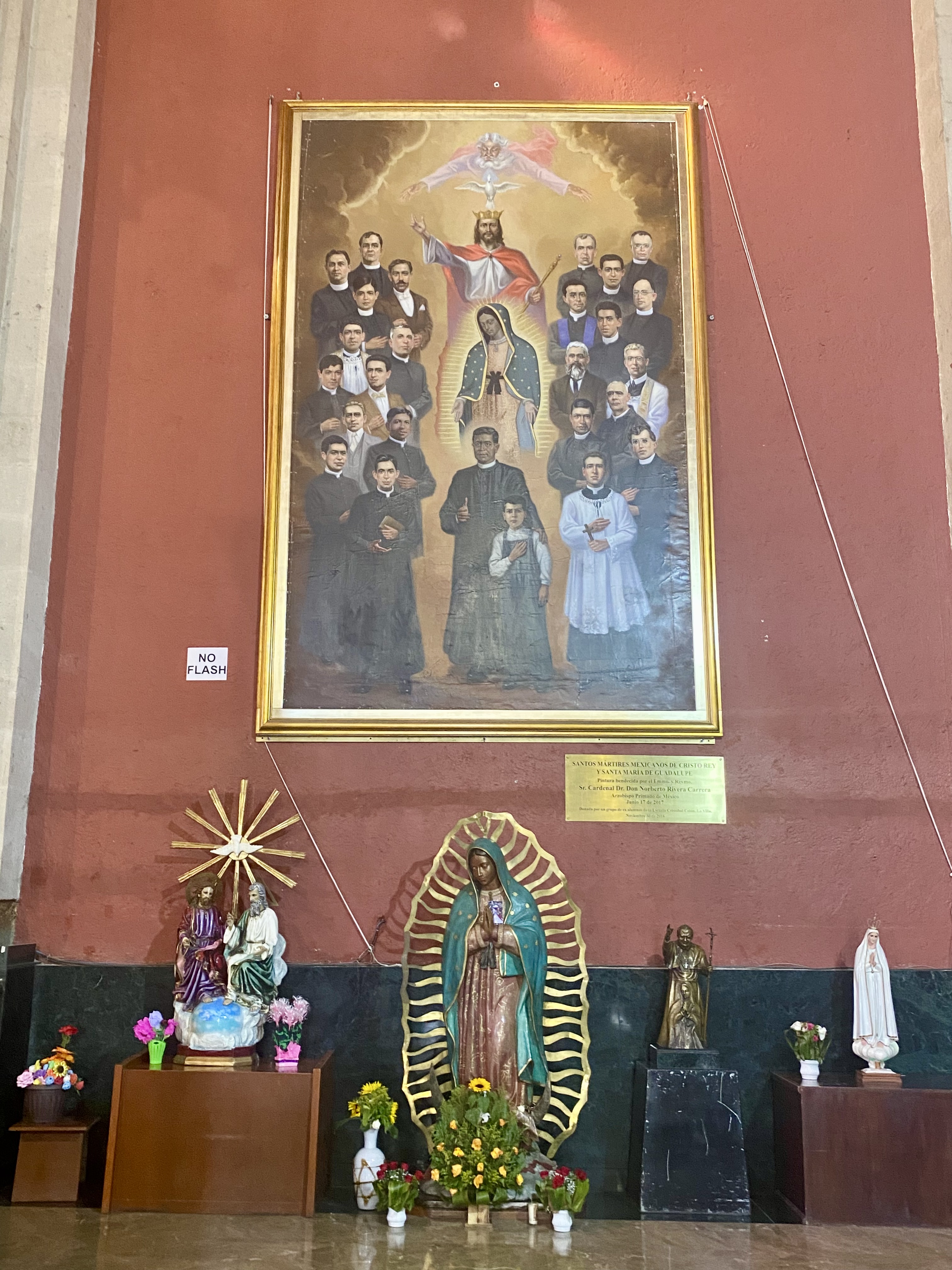
It might be persuasively argued that Spain's most significant accomplishment in Mexico--other than the introduction of its language--was the Catholicization of the country.  This painting, hanging in the old basilica, depicts the conversion of indigenous people.


The light was wrong for photographing the new basilica--it looks like an undistinguished (if level) mega church--but at least one stained glass panel on the entrance doors alluded to the nation's pagan roots.


The bright color choices seem local, too.


. . . as did the look of the saints in bronze relief.


  It all seemed very mestizo to me.


Teotihuacan

"You're aware of the irony of the situation?" Chris questioned shortly after our guide took this photo in front of the Pyramid of the Sun.  I was.  In 1969, his father's gastrointestinal problems had forced his family to turn back from Teotihuacan no sooner than they had arrived.  So I wasn't about to let Montezuma's Revenge on me get in the way of his long-delayed visit.

Alicia, our capable and fit guide, picked us up promptly at 9 a.m. in front of our Airbnb. For much of the 40-minute drive to the site, past densely populated neighborhoods that crept up mountainsides so steep that residents use free cable cars to access their homes, I quizzed her about Mexican history.  "Would it be accurate to say that you harbor some affection for Porfirio Diaz?" I finally asked.  "Yes, he built the most beautiful parts of our city."  Her views on Benito Juarez were much less positive.  "He was mean," she insisted and she dismissed Francisco Madero, who succeeded Diaz as president after the Mexican Revolution, as ineffectual.  Conclusion:  guuuuuuurl loves a strong man!

Our tour began in the blazing sun at the Temple of the Feathered Serpent, once the political and religious center of Mesoamerica's largest city with a population of 125,000 at its peak.  The remains of 200 human sacrifices were buried here.


By the time I ascended these oversize steps, I feared I might be joining them.   Something was wrong but I initially attributed my faintness to the altitude.


Before launching into a lengthy explanation of Mesoamerican mythology, Alicia informed us that almost everything we would be seeing at Teotichuan other than this section had been reconstructed in the early 20th century.  


Surprisingly, Chris, who diligently avoids the sun, decided to walk 1.5 miles along the Avenue of the Dead to the Pyramid of the Sun (at right), about half as tall as the Great Pyramid of Giza and about 200 years younger than Christ.  I demurred, suddenly aware that proximity to a restroom would dictate the course of my day.  Chris later said he used the opportunity to have a chat with his 14-year-old self.    It reminded me of the disappointment I experienced at a slightly younger age when a fight between my parents prevented me from seeing the Leaning Tower of Pisa.


Alicia drove me to a palace.


With acutely diminished powers of concentration, I feigned interest in the iconography depicted on these faded frescoes, later juiced by the vivid setting on my photo software.

We met Chris at the museum near the Pyramid of the Sun.  After a quick trip to the bathroom, where I paid 20 pesos for ten sheets of toilet paper, the human sacrifice remains momentarilyshocked me out of my torpor.

An enormous picture window looming above a scale model of Teotichuan reminded me that I recently had seen the ancient city imagined in fantastic detail by Scott Gentling, an unheralded American artist, at the Amon Carter Museum in Fort Worth.

This fabric representation of the Aztec calendar caught my eye because the baked, absolutely dry environment was nearly colorless. 


Needless to say, I barely had the energy to stand in front of the Pyramid of the Sun which leads me to deconstruct the reality behind this photo:  I'm as sick as a dog, the pyramid is fake and since the covid 19 pandemic, tourists are no longer permitted to climb it.  So look elsewhere for your FOMO!


The reconstructed walls were remarkably detailed.


Can you see how the Pyramid of the Sun echoes the mountain behind it?  Can you imagine knowing that once you got to the top you were going to be sacrificed to the gods with your heart likely pulled from your chest cavity?


The Pyramid of the Moon doesn't look that much different.


After taking a quick peek at Palacio Quetzalpapálotl, Chris took Alicia to lunch inside a nearby cave restaurant she recommended.  Completely wiped out, I curled up in the back seat of her mini van and slept.  But Chris got to fulfill his childhood dream!  I'm still waiting to see the Leaning Tower and the Blue Grotto, another Italian travel disappointment of more recent vintage.


Sunday, March 5, 2023

Sunday in the Park

Even if the Monumento a la Revolución hadn't stimulated a new obsession with Mexican history, Diego Rivera would have with "Dream of a Sunday Afternoon in Alameda Park," in which he--as a ten-year old boy--and Frida Kahlo stand front and center, alongside La Calavera Catrina and Jose Guadalupe Posada, his artistic mentor.


The fifty-foot long fresco, once housed in a hotel destroyed by the massive 1985 earthquake and rescued by Rivera's daughter with his second wife (he had four, including Frida, to whom he was married twice), it depicts 400 years of Mexican political history, left to right, from the Spanish conquest to the Porfiriato, and the 1910 revolution.  


There's liberal Juarez again, clutching the country's first constitution, with the unbuilt Parliament building behind him, standing much taller than Empress Carlota and Emperor Maximillian, a pair of European nobles who were invited by conservatives to reign over Mexico in 1864.  Bad move for the House of Hapsburg:  three years later, a firing squad executed Maximillian (an execution depicted by Edouard Manet) and Carlota fled to Paris, where she lived another six decades, much of it in madness.  You can't make this stuff up! 

Or leave Mexico City without being awed by the incredible talent of Rivera, sculpted here by Antonio Castellanos.

Afterward we headed to Alameda Park itself, detouring briefly to see the Basilica of San Hipolito, a 16th century baroque church built upon the site of a battle between the Aztecs and the Spanish,  The colonialists were led by a Black conquistador who also just happens to have been the first documented person of African descent to have visited what became the United States.


Mass on a Sunday afternoon was standing room only.


Thanks to Netflix and Atlas Obscura, we also tracked down this rather sad brass plaque--featuring two nude men--commemorating the Dance of the Forty One during the Porfiriato.


Mexican families have been spending their Sundays in Alameda Park since 1592.  It's the oldest park in the Americas.

Porfirio Díaz commissioned this monument to honor the centenary of Benito Juarez's birth in 1906.   His own presidency would last only another four years.


It's very hard for me to understand my lack of curiosity about this great leader given the fact that I visited the city named for him many times when I lived in El Paso.  Shame on me--call this an atonement selfie!


Just behind the monument a dozen or so women were knitting a project they call "Blood of My Blood," to call attention to the hundreds of Mexicans who vanish without a trace every year.


They planned to pressure the government into investigating these crimes by exhibiting their creation during International Women's Day the following Wednesday in the Plaza de la Constitucion.  The massive event threatened to shut down the Centro Historico.

We ended our afternoon at the Palace of Fine Arts at the eastern end of Alameda Park.

Mexico's most famous muralists decorated the walls of the stunning Art Deco interior.


For the second time that day we were blown away by another vibrant Diego Rivera masterwork.  It stretches across one end of the upper floor and has a fascinating provenance.

The Rockefeller family commissioned "Man at the Crossroads" to adorn the lobby wall of 30 Rock.


But Nelson Rockefeller, apocryphally rumored by some to be the titular model, balked when Rivera featured Vladimir Lenin in a fresco that would be associated with America's grandest capitalist temple.  Rockefeller had the mural removed, although he and Rivera remained friends.


Rivera reconstituted the fresco in Mexico City's Palace of Fine Arts which opened in 1934.  He changed the title to "Man Controller of the Universe" and added comrades Karl Marx, Friedrich Engels and Leon Trotsky.  I gotta tell ya, they look like bit players to me!


It's hard to image a performing arts institution in the U.S. giving José Clemente Orozco license to create a mural as intense as "Katharsis."

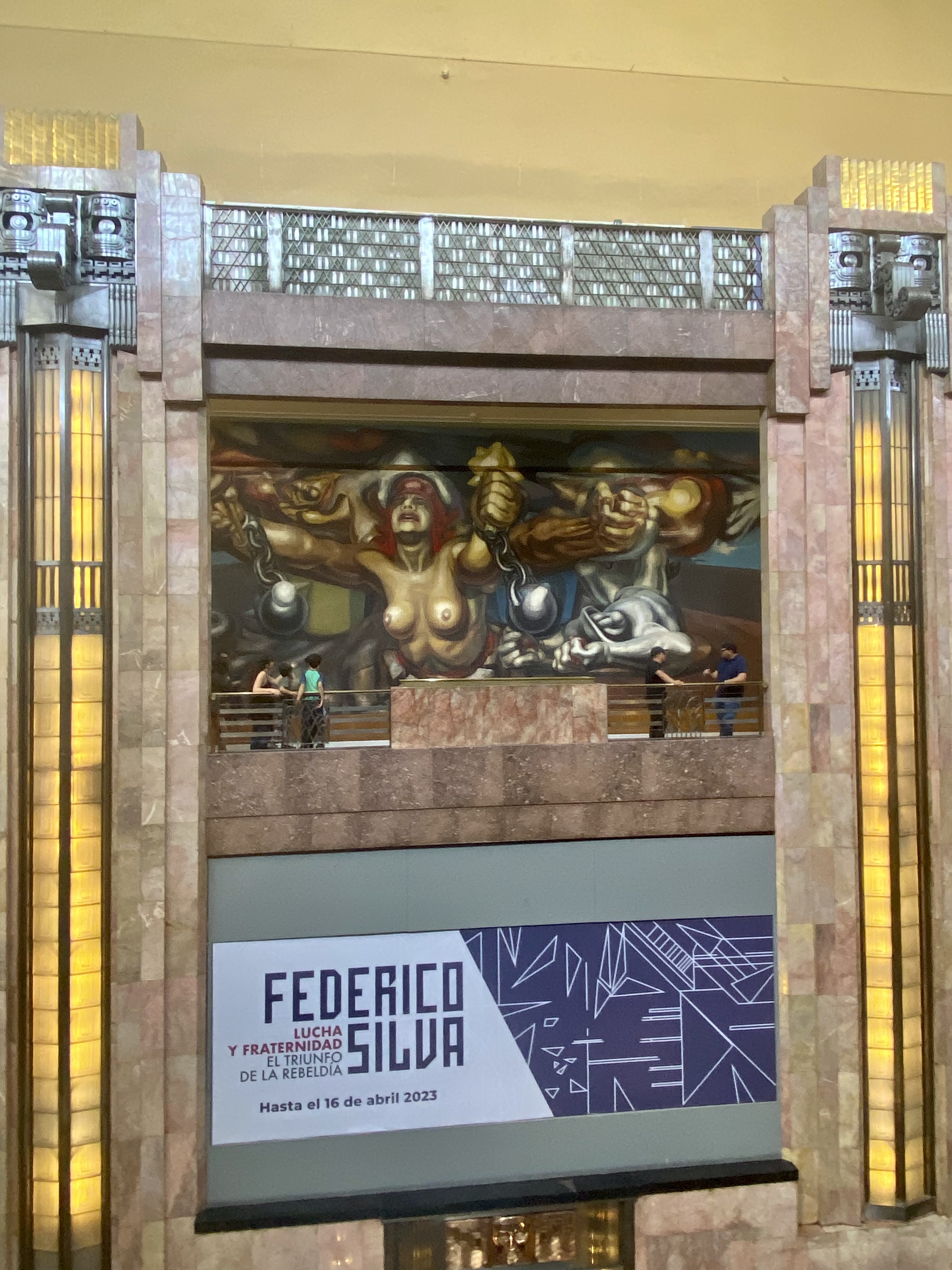
But even it pales beside the frescoes that firebrand David Alfaro Siquerios painted.

In "New Democracy" Siquerios celebrates the victory of democracy over totalitarianism.


Here, in an inspiring bit of propaganda intended to evoke pride among Mexico's indigenous citizens, Siquerios glorifies Cuauhtémoc, the last Aztec emperor, as a fierce, armored warrior.  Check out his club!


But in this grotesque depiction of the conquest of Mesoamerica, Siquerios illustrates extreme Spanish cruelty.  The colonialists are burning the feet of of Cuauhtémoc and one of his allies.


It's hard not to think of this attack dog as the artist himself, a committed Stalinist who plotted to assassinate Leon Trotsky four centuries later.  We criticize our own shortcomings in others.


Rivera's social commentary, even in frescoes like these inspired by Mexican carnivals, relies more on allegory and is just as trenchant, if less bloodthirsty.


We exited the palace exhilarated, beneath this beautiful window grill.


More Mexico City: