Two thirds of the terrific triple header at the Morgan Library's free Friday nights left me feeling that this summer has been a lot like an extended Old Home Week at New York City's museums.
Contact sheets seem like an odd focus for an exhibit--even with magnifying glasses provided--until you realize they represent Peter Hujar's long-shot analog attempt at achieving posterity.
The 110 sheets on view represent less than two percent of those in the library's collection. Hujar found escape from a Dickensian childhood peering through a camera lens at the age of 13. Three years later he left home, eventually falling in with an arty crowd that included Paul Thek who was about to make a big splash in the art world, something that never happened for Hujar. Portraits in Life and Death, his shot at the big time, misfired in 1976 even though it, and Thek's most acclaimed works, shared the same macabre inspiration: Sicilian catacombs.
Paul Thek, Coral Gables, Florida (ca. 1956)
It isn't hard to see why Andy Warhol shot "Screen Tests" of the young lovers, adding both to a reel he called "The Thirteen Most Beautiful Boys," but the couple kept their distance from the Factory scene. Hujar, who had trained as a commercial photographer, took a master class from Richard Avedon, eventually developing a style that used shadow as evocatively as his teacher employed saturated light.
By 1967 Hujar decided he was done working for other people and established his own home studio on the Lower East Side. He primarily focused on portrait photography. Many members of the downtown queer community posed for him, including Jackie Curtis, then a Warhol "superstar" and later Ethyl Eichelberger, a performance artist who made a name for himself playing some of history's most famous women. Some say Curtis annotated Hujar's contact sheet herself, aspirationally.
Hujar and another of his boyfriends, Jim Fouratt witnessed the Stonewall rebellion together. Although Hujar didn't document catch the event on film, Fouratt, an organizer who later co-founded Danceteria, engaged him to shoot the first recruiting poster for the Gay Liberation Front. He's second from the right, and still alive.
Hujar often encouraged his subjects to turn his camera on him, believing it loosened them up for his own work. Unlike Avedon and Robert Mapplethorpe--whom he disdained for his emphasis on the superficial--he wanted to dig deeper and reveal what made people tick.
His portrait sessions often took place during conversations that could last hours. Filmmaker Ira Sachs made a movie about one of them called Peter Hujar's Daybased on a book by a close friend he had photographed. Her tape recorder became the audio equivalent of his camera. Lucky for us and him, too. Nearly 40 years after his death in 1987, it introduced him to a generation more inclined to recognize his artistic integrity.
Candy Darling, another Warhol "superstar" (and no fool when it came to self-presentation), summoned him to her room at Cabrini Hospital, where she was being treated for lymphoma. He captured her deathbed glamor as if she were a real Hollywood icon posing for George Hurrell. Death isn't always an evergreen buzzkill.
Candy Darling, Cabrini Health Care Center (1973)
As this as this exhibit amply demonstrates, the perfect photo could be elusive when cameras didn't come with delete buttons Yet the preservation of his contact sheets and negatives, which are held by the Peter Hujar Archive, comprehensively maps an artistic journey with all its detours, hits and misses. Ironically, as a result of his chosen medium, Hujar's reputation has now eclipsed Paul Thek's, so much of whose truly unique work was ephemeral.
John Waters (1975)
A more insouciant photo of John Waters made it into Portraits in Life and Death.
In 1969, Elektra Records hired Hujar to shoot Iggy Pop who was about to release his debut recording with The Stooges. I would love to have been a fly on wall for that overexposed session which nevertheless captures the protopunk's feral appeal . . . and big basket.
Hujar found Marsha P. Johnson, a Stonewall participant, at the Christopher Street Pier on Easter Sunday in 1976. For the most part, he was much better at photographing people in his studio than outdoors. I could have been one of the less muscular guys on bikes, although the piers on the Upper West Side were my usual stomping grounds.
His soulful portraits of animals outdoors were another story, perhaps because he had lived on his Ukrainian grandparents' farm as a child.
"Butch & Buster" (1978)
Pets often got the studio treatment.
Bouche Walker (Reggie's Dog) (II) (1978)
In 1980, Hujar formed an intense bond with David Wojnarowicz, 20 years his junior, who became his sometime lover, collaborator and driver.
David Wojnarowicz #1 (1981)
Together they explored the New York metropolitan area at the peak of its industrial decline, with dumps a favorite stopping point. Neither lived long enough to experience the city's regeneration, although it's likely the smoking ban and gentrification of their neighborhood would have appalled them.
Canal Street Pier, 1983
Hujar is better known today than he ever was during his lifetime. Nearly 30 years after his death from AIDS, one of his photos appeared on the cover of A Little Life, a novel which has sold more than 2.5 million copies worldwide. Would he have cared that his image signals pain instead of pleasure?
Tarot cards, hand-made, began as a trick-taking game for well-to-do Italians during the Renaissance. Woodblock printing brought tarot to the masses and spread it beyond Italy. Players could purchase DIY sheets like these, color them and apply more substantial backing before trying to trump their opponents.
Dorothy lannone brought her deck--by far my favorite--into the realm of everyday life and added an explicitly sexual element. Each of these colorful cards from her "(Ta)Rot Pack" (1968-69) definitely struck a chord.
Betye Saar, who died in July at the age of 99, called this mixed-media etching "House of Tarot." You'd never know from looking at it that her oeuvre is best known for critiquing anti-Black racism. Perhaps I'm being a bit sexist, but it seems to me from the number of women at the exhibit and the preponderance of female artists, tarot is more a girl thing.
Half a century after the fact, I'll admit that I bought Self-Portrait in a Convex Mirror, my first (and only) hardcover book of poetry, because I thought its author was sexy. In the jacket photo, John Ashbery had a clone mustache; this picture was taken ten years before the hot poet won the Pulitzer Prize, the National Book Award and the National Book Critics Circle Award for his breakout work. Ashbery exuded serene confidence even then.
John Ashbery, Water Mill by John Jonas Gruen (1965)
Turns out he had an early affinity for surrealistic collage which became a kind of model for his poetry. He made this one at Harvard. If I'd understood Self-Portrait wasn't supposed to make narrative sense, perhaps I would have tried harder to finish it. Ogden Nash was more my speed, although I did once commit the first stanza of "The Love Song of J. Arthur Prufock" to memory while walking Smokey in the mornings, figuring that if Mom could quote Shakespeare, her son should have a similar parlor trick.
Late for School (1948)
Ashbery, also an esteemed art critic, ran with a pretty cool crowd. Several very talented friends made him gifts of their drawings.
I particularly like this one. Ashbery dubbed Red Grooms "the Canaletto of Canal Street" and extolled his talent for making art popular. His references to painters make a lot more sense to me than they did in 1975. I've now seen works by Canaletto in Dresden, Edinburgh and Venice.
Ashbery's husband, David Kermani, donated some 25 works on paper to the Morgan after the poet's death in 2017. Larry Rivers caught the couple, who lived together nearly 50 years in Chelsea and Hudson, New York, in graphite and colored pencil.
"David & John" (1977)
As soon as I got back to 47 Pianos I took this photo of drawing given to me on my 40th birthday. Ted drew flowers growing in a rusty pan on the deck of the Muller Cottage. It still makes me very, very happy.
What it advertises. A few leaded panes, old beams,
Fur, pleated muslin, a coral ring run together
In a movement supporting the face, which swims
Toward and away like the hand
Except that it is in repose. It is what is
Sequestered. Vasari says, "Francesco one day set himself
To take his own portrait, looking at himself for that purpose
In a convex mirror, such as is used by barbers . . .
Or maybe not. I just checked out what Thom Gunn, another hot poet a couple of years younger than Ashbery, said about about his more successful rival's work in his collected letters:
Since you brought up John Ashbery, and since I passed a vague judgment on him in my last letter, I thought I would take him up again. I quickly put him down. Totally incomprehensible. And you don’t even feel like wanting to know what he means. (January 1970)
* * * * *
Just been reading Ashbery‘s latest book, April Galleons. Now I don’t suppose he ever has any difficulty in placing his poems in an order: even passages within poems could be changed around. But it is difficult to object to a poet who can write the line,“ Isn’t that your son‘s tibia in the pilaf?“ And the book does make me laugh a lot. (June 1989)
* * * * *
I’m looking out my window now and seeing the leaves being blown on the wind like pages from the calendar in a 1940s Hollywood movie – gee, do you think I could write a John Ashbery poem after all? (November 1989)
Haters gotta hate! And if the two men were to be judged by the quality of their friends, Ashbery would win hands down again.
David Wojnarowicz has fascinated me ever since I picked up Memories That Smell Like Gasoline, an illustrated book he published in 1992. We explored many of the same places in New York City during the previous decade. Parts of it read like my journal. I also read Cynthia Carr's biography which does a deep dive into the art scene on the Lower East Side in the 80s. But neither gave me the full appreciation for his talent that David Wojnarowicz: History Keeps Me Awake at Night, an exhibition that recently closed at the Whitney did.
As far as we've come with marriage equality--a right that may not have thrilled Wojnarowicz, a true sexual outlaw--this cri de couer accompanying his childhood image still rings true. Read it!
It also explains the impetus behind this disturbing self-portrait, directed after his HIV diagnosis.
A slide show does an excellent job of documenting the decaying scene in the West Side Piers, long before many of the artists who used its walls as their canvas migrated into pop-up galleries on the other side of town.
Wojnarowicz photographed many of his friends wearing this Rimbaud mask in different locations around the city.
Jean Genet also influenced him.
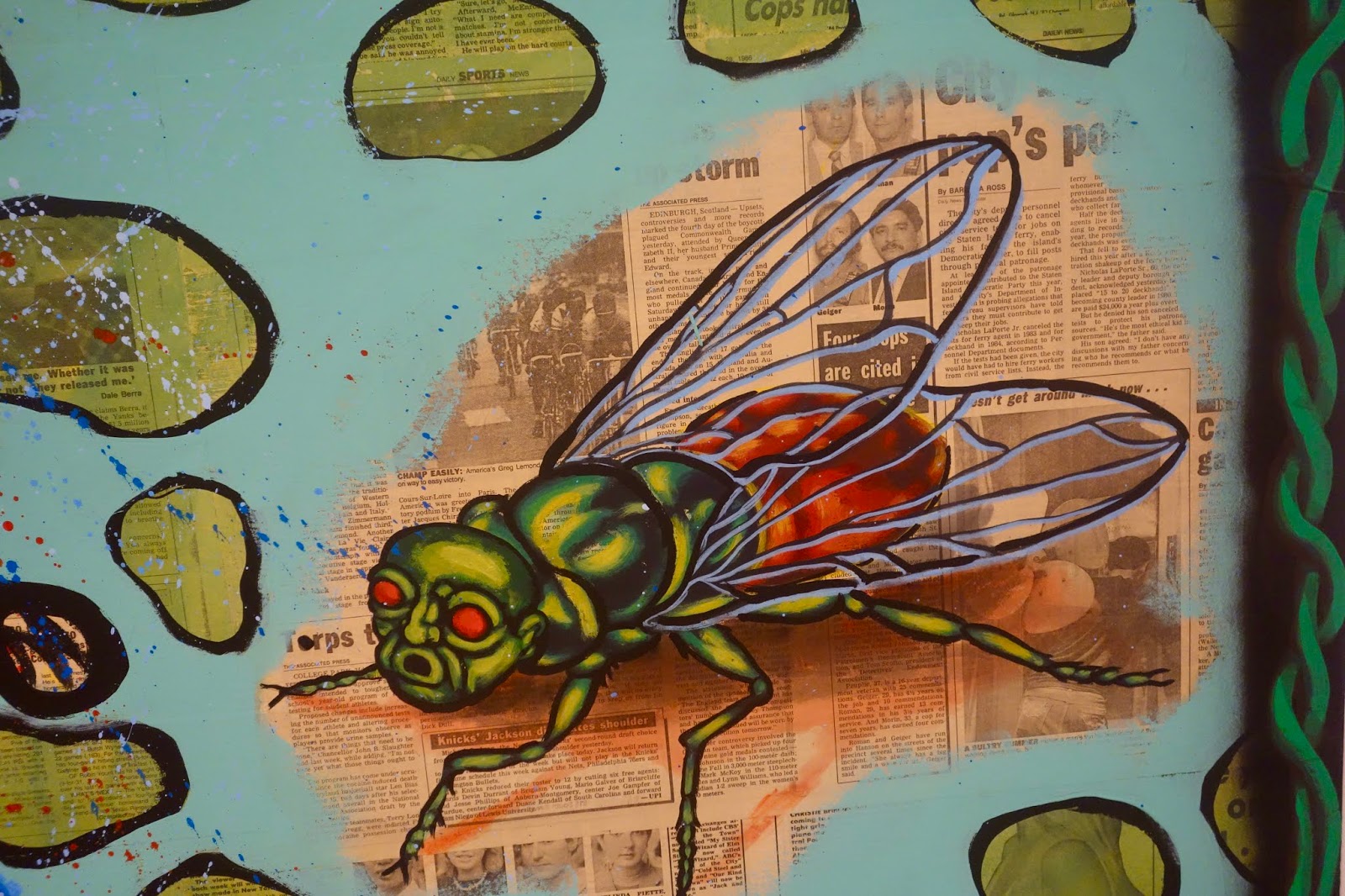
Wojnarowicz, impoverished all his life, couldn't afford to be picky about his choice of materials. In addition to the street, he used maps (once as ubiquitous as Google!), newspapers, supermarket posters and garbage can tops. It didn't stifle his creativity a damn bit.
Nor did he ever conceal his sexual orientation. Here's a detail from "Fuck You Faggot Fucker," a 1984 collage.
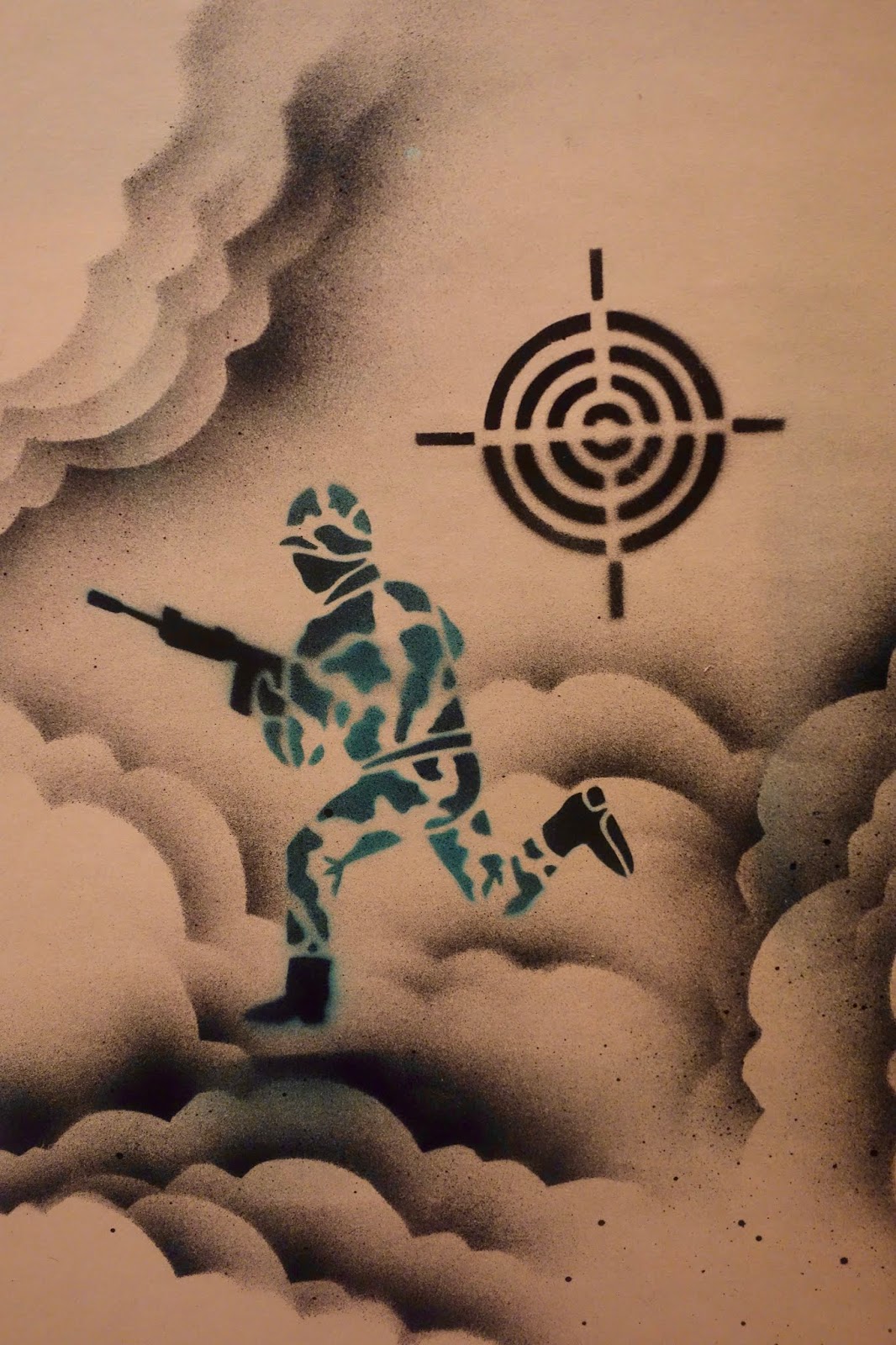
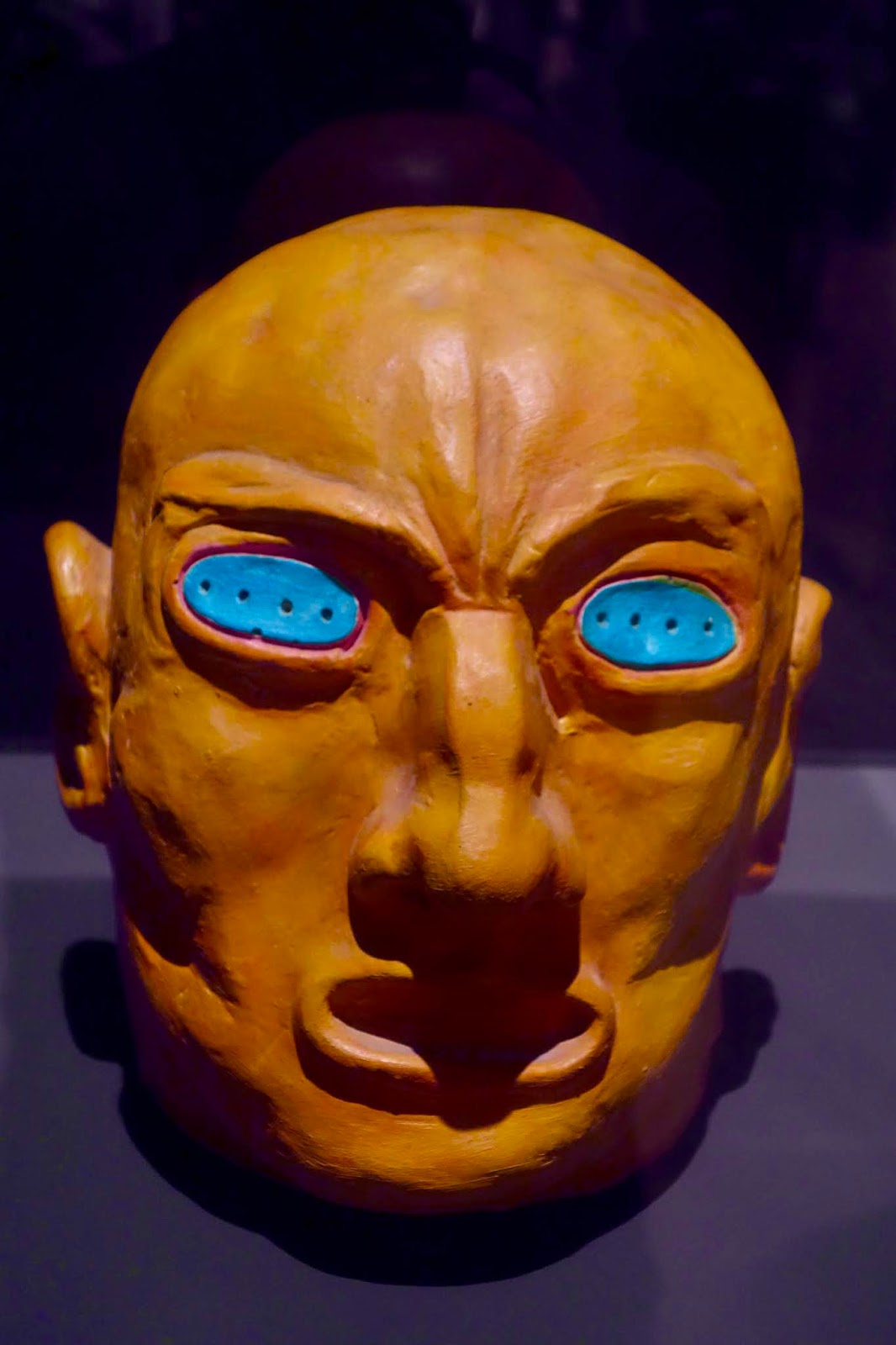
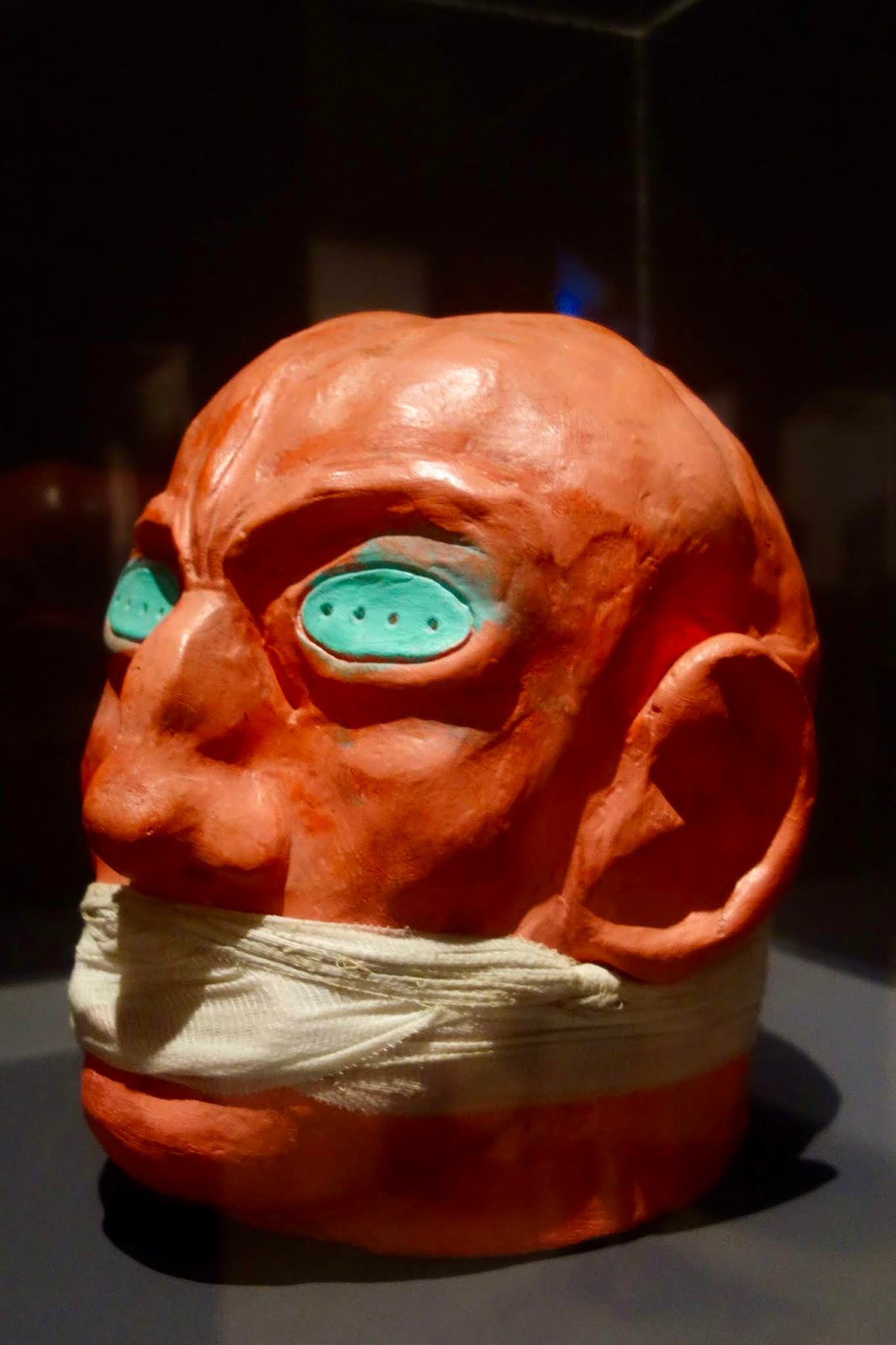
These plaster heads were among the 23 he decorated and exhibited at Civilian Warfare in 1984.
Nobody silenced Wojnarowicz. You can still hear his rage, almost 30 years after his death.
Wojnarowicz hooked up with photographer Peter Hujar, who soon became his artistic mentor and insisted that he paint.
It's hard not to connect this untitled work to Hujar. AIDS killed both men.
Wojnarowicz's paintings we're unfamiliar to me. As far as I'm concerned, they cement his legacy as an important 20th century artist.
"Wind," part of a series he created about the four elements, includes his only painted self-portrait.
"Water" leaves nothing to the imagination about his sexual orientation.
Some of his work, especially the flower paintings, recalls another renegade, Robert Mapplethorpe, albeit with more pointed messaging.
Wojnarowicz also reminds us there were despicable politicians long before Donald Trump and Mitch McConnell. Here's what Jesse Helms, for example, had to say about people with HIV: "The government should spend less money on people with AIDS because they got sick as a result of deliberate, disgusting, revolting conduct."
If the appreciative crowds at the museum are any indication, Wojnarowicz had the last laugh.