Showing posts with label swimming. Show all posts

Saturday, January 10, 2026

Seen

Last spring, I discovered Lake Lytal Aquatic Center in West Palm Beach.  It provided a great alternative to open water swimming while recovering from a partial knee replacement. For less than $4 with the senior discount I had a lane to myself, with no surf or jellyfish worries.


This year I bought a monthly pass upon arrival at the Folly in early December.  "Use it at least eight times to get the full value of the discount," the young attendant told me.  In yet another sign of aging, I quickly realized I was more relaxed going to the pool than swimming in the ocean, especially after experiencing a mild jellyfish sting on Christmas Day.  Most of the other midday swimmers are my age or older.

During Florian's visit we got into a discussion of the pool's size after he Googled Lake Lytal. "It's Olympic-size, like Columbia," I insisted, "but two or three times as wide.  He disagreed, infuriating me because that had been my understanding ever since I began swimming there regularly, after returning from Australia in 1984.  Someone had told me that 72 lengths equalled a mile which I calculated was 1850 strokes so that I could ensure my ocean swims were consistent, regardless of the current.

"Artificial intelligence says that Lake Lytal IS Olympic-size, 50 meters by 25 yards," Florian read out loud.  When he lived in New Jersey, I'd given him my ID card to swipe himself in at Columbia several times.

"That's ridiculous," I replied, making another mental note regarding the inadequacy of AI.  "Why would a pool's dimensions mix meters and yards?"

Coincidentally, the first time I swam after his departure, the lanes had been reconfigured, reducing their number but increasing their length.  When I asked a lifeguard why, he explained that college swimming season was about to begin.  

"But I count my strokes," I protested.  "How can I make sure that I'm swimming the same distance?"

"Not a problem," he answered.  "The pool is 50 meters by 25 yards, which means you can swim half as many lengths, give or take."

Oops.  I remembered something Lois had said about my father.  "Hon's not always right, but he's always SURE!!!!"  That apple did not fall far from the tree at all.

But I'm nothing if not adaptable, although it took a swim or two to come up with a new stroke pattern--I alternate between breast and side strokes, right and left--that equalled 3/4 of a mile.  After turning 71, I reduced my workout by 25% as a birthday present due to increasing exhaustion afterward.

All this by way of background.  In short, I've been a dedicated swimmer for decades, so the switch from ocean to pool swimming in Florida, and the lane reconfiguration were big deals in my life if of little interest to anyone else.

So imagine my reaction when I showed up my first Saturday morning at Lake Lytal and the woman at the admission desk warned me that a lane might not be available until noon due to college practice.  I went inside anyway and noticed a swimmer with Columbia branded across the rear of his Speedo, but it didn't really register because I was too busy scanning the pool for an available lane.

Then, as I was hurriedly stripping down to claim the sole empty one, a bearded man in his mid-40s approached me.

"Hey, don't you swim at Columbia?" he asked.

"Yeah," I said.

"Like, I mean EVERY day?"

"Not everyday, but often, when I'm in New York.  Why do you ask?"

"I'm the assistant swimming coach at Columbia.  When you walked in, I asked the head coach if it was you and he said 'It's got to be!'"

My reaction was euphoric to say the least.  We chatted briefly; he explained that Columbia's swimming team used Lake Lytal or another facility on Singer Island for three weeks every year during winter break.  Who knew?  And what were the chances we'd cross paths?

The coach also disabused me of the notion that Columbia's pool was Olympic-size.  "That's one of the reasons the guys love to train down here.  Besides the weather, of course," he said with a faint accent.  When I asked where he was from originally--probably another sign of my age--he identified himself as Brazilian.  He also told me the team had been improving in Ivy League competitions, which often closed the pool to alumni swimmers on weekends.

As soon as I completed my adrenalin-fueled swim, dripping wet, I called Tom, my first roommate at Columbia, figuring he of all people would appreciated the randomness of the encounter.  But as a former Olympic fencer, he focused more on my dedication to swimming as the thing that led to their recognition than the elation I was feeling as a result.  "Maybe there's an organization for alumni swimmers, like the Rusty Blades for fencers.  They raise a lot of money for the team."

"I'm unaware of any such organization and completely uninterested in joining if there is one," I replied, as intimidated and bored by team sports as I always have been

But Chris got it immediately when I returned to the Folly, more excited than I've been all season and happy enough to have a rare cocktail before dinner that night.

"We're so used to being invisible," he observed, "that it feels great to be seen."

More Swimming


Monday, January 29, 2024

Sting

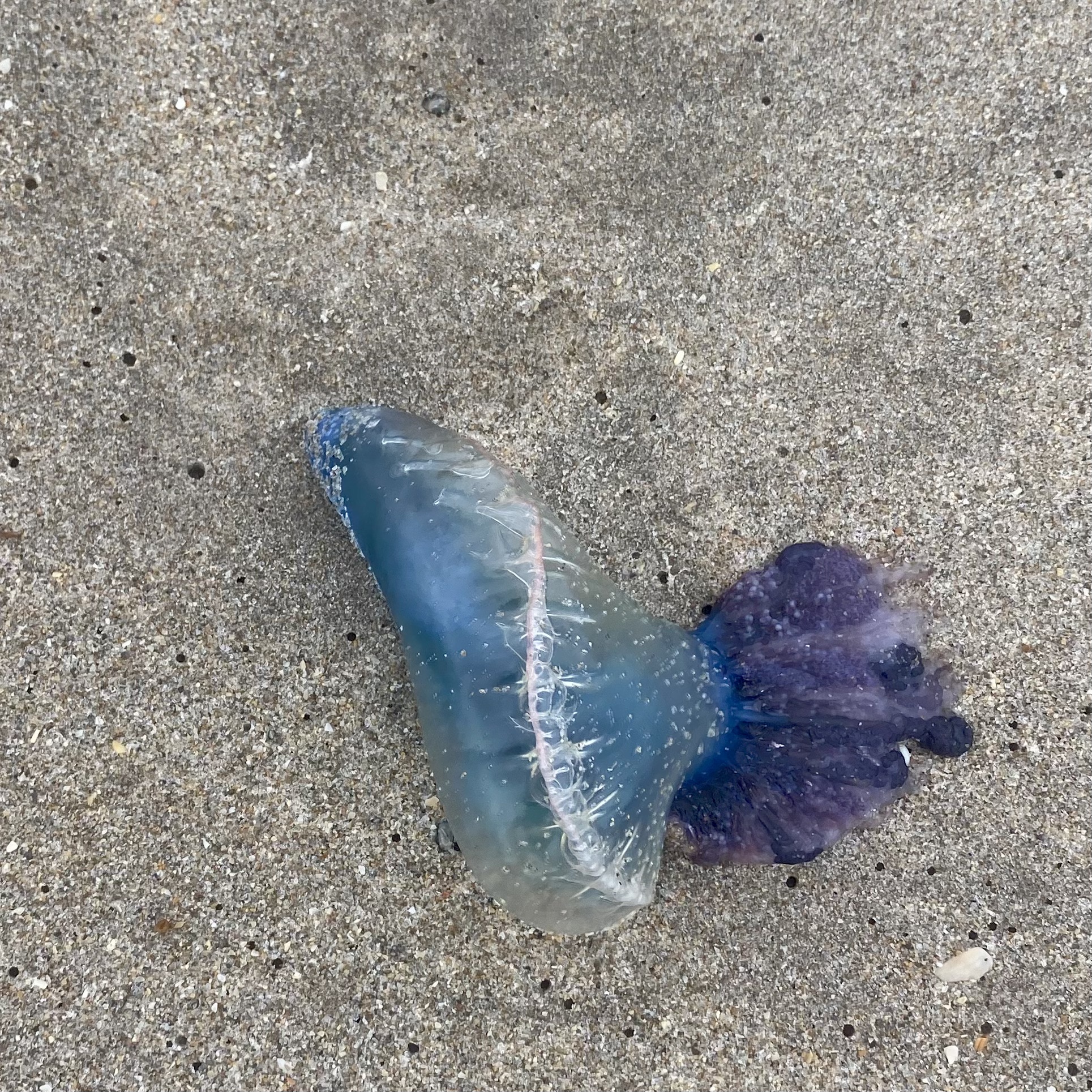
An armada of Portuguese Man o' War blew up on the shore at Palm Beach, interfering with my compulsion to exercise and prompting a reverie.  These jellyfish cousins, which recall the majestic ships colonizing explorers sailed from Europe during the Age of Discovery, are a central preoccupation of my snowbird life in subtropical Florida.  


Swimming became part of my exercise routine more than four decades ago in Sydney.  I'll admit, the Australian eye candy was a strong motivator, but the habit stuck.  Upon return to the U.S. in 1984,  I began swimming a mile--72 laps--in the Olympic size pool at Columbia's Dodge Fitness Center: Speedos and Barracuda goggles became my lunchtime look three times a week except when the gym closed between semesters.  

Summering on Fire Island introduced me to open water swimming in 1988, an activity that fosters absolute respect for the ocean, sustained contemplation and sleep-inducing exhaustion.  The surf could be challenging but I learned to plunge past the breakers to relatively calm waters, always keeping parallel to the shore to protect against being swept away by riptides.  Strong, unpredictable currents can significantly impede progress, so I count my strokes, based on a calculation derived from the Columbia pool, to ensure a consistent workout.  1,850 strokes--split among breast, and left and right side--equals a mile.  At 35, it took 49 minutes; age has increased my current time in the water to nearly an hour.

After swimming the length of the Pines, I walked back on the beach in the opposite direction, hoping my goggles would identify me as Poseidon.   Beach-blanket bitchery soon put an end to that delusion.  I overheard one tanned and muscled hunk ask another "Why is that guy wearing a dog collar?" 

1989
Open water swimming season usually didn't begin until around Independence Day when the water temperature had warmed to the low 70s.  Soon, the arrival of small, ridged, translucent discs made the Atlantic feel like a big vat of bubble tea.  For a couple of weeks, their gentle touch made me flinch with apprehension.  But from August to mid-September, I felt as one with the natural world, occasionally being chased through aquamarine bliss by darting arrows of reflected light.  A local fisherman identified them as pilot fish.  "They probably think you're a whale."  You can call me Moby Dick.
 

During a visit to South Beach in April 1994, I attempted my first ocean swim in Florida's much warmer waters, emerging unrefreshed.  But by the time I bought a retirement home in Lake Worth Beach, I found the less-than-bracing temperature much more appealing. New discouragements including, once, a shark, became apparent.  After completing one of my first swims past a long line of oceanfront condos, I noticed no one else was in the water on a crowded beach where my friend Christine sat, looking a little bit shaken.  "Didn't you hear the lifeguard whistling?" she demanded.  I hadn't.  She pointed to a red flag imprinted with the outline of a shark.

Lifeguards, on duty from 9 a.m. to 5 p.m., use chalk boards to provide daily updates on beach conditions beneath red, purple, yellow and green flags.  I quickly realized that if I always waited for green flags, swimming would become an infrequent activity.  Yellow and purple flags flew most often, the latter indicating dangerous marine life, including Man o' War and common jellyfish.  Encountering the latter would be more yucky than painful.


At first, I assumed the lifeguards visually inspected the beach for the distinctive presence of Man o' War  and abided by their warnings.  But after seeing no small blue sails on multiple occasions, I asked a lifeguard how he and his colleagues made their determination.  "Mostly wind direction," he answered.  "Southeasterly winds blow them in off the ocean."


Still, fear of the unknown lingered.  Oddly enough, the pandemic helped me overcome it. City officials closed the beach for much of April 2020.  No flags flew.  To avoid detection, I began swimming just before dawn.  I eventually got stung but mildly enough that I didn't get out of the water.  Once I did, the burning sensation on my forearm mostly had subsided. On a one-to-ten scale, I would rate it about a six.

By the time the beach re-opened, the flags had faded into overprotective-mother (or fear-of-litigation) territory.  Of course that's when I experienced my first bad sting.  Half my face felt like it was on fire for more than an hour but I finished swimming because I reasoned it wouldn't burn any less out of water.  The venom raised welts on my upper body, too, shockingly visible in the bathroom mirror.


Contact with the tentacles, not the sails (which propel the siphonophorae), causes the sting.  Much thinner than twine, they can be several feet long, increasing the potential for incapacitating prey and painfully drifting across people. And not only swimmers:  just ask anyone who's ever stepped on one barefoot.  


They really are marvels of nature but I spend far too much time obsessing about them.


To swim or not to swim:  that is the question.