Showing posts with label Vermeer. Show all posts

Thursday, December 18, 2025

Brighter Rembrandt

Everything in the Palm Beaches looks just a little brighter in December, even Rembrandt! He had yet to turn 30 when he painted this assured self-portrait.  The kid knew he was going places.
 
"Self Portrait with Shaded Eyes" (1634)
The Leiden Collection loaned it and many others to the Norton Museum of Art.  Florian suggested we go when he and Arko were visiting the Folly. 


Rembrandt is usually a little too dark for me--I much preferred the Van Gogh Museum to the Rijksmuseum when I visited Amsterdam more than 25 years ago.  But after immersing myself in the Italian Renaissance last fall, works by the leading artists of the Dutch Golden Age were refreshing, like a cold tonic after a warm bath.  

"Minerva in Her Study" (1635)
This portrait of a politician and in-law is attributed to Rembrandt's workshop because he farmed out painting the intricate lace work.  This kind of assistance only became controversial when Andy Warhol called it a Factory (that's "Fabriek" in Dutch).

Portrait of Antonie Coopal by Rembrandt's Workshop (1635)
His patrons were more likely to be from the mercantile class, as Calvinists frowned on religious scenes.  The Dutch East India Company had a lot more power than the Vatican in the Netherlands; this woman was married to its "Councilor General Extraordinary." Making her collar must have been as difficult as painting it.

Portrait of Petronella Buys (close-up, 1635)
Rembrandt didn't only solicit commissions.  He sold portraits like this, featuring a model almost as enigmatic as the "Mona Lisa," on the open market, too.

"Young Girl in a Gold-Trimmed Cloak" (1632)
But age interested him just as much as youth.  He depicted it with skill and dignity even in his twenties.  This canvas, his tiniest, isn't much bigger than a playing card.

"Bust of a Bearded Old Man" (1633)

"Study of a Woman in a White Cap" (ca 1640)
"Portrait of an Old Man (Possibly a Rabbi" (ca 1645)
"Portrait of a Seated Woman with Her Hands Clasped" (1660)
Oh yeah, there was a Vermeer in the exhibit, too.  Although he never achieved the renown of Rembrandt during his lifetime, the scarcity of his work (only 34 paintings worldwide are attributed to his hand) has given him much greater mystique.

"Young Woman Seated at a Virginal" (ca 1670-75)
Other works in the exhibit by less familiar artists depicting everyday life nearly four centuries ago provide a welcome reminder about the simple pleasures that bind humanity when so much contemporary background noise suggests that few of us have anything in common.

"Young Man Reading" by Jacob Van Loo (ca 1650)
"Prayer Before the Meal" by Jan Steen (1660)
"Elegant Lady Writing at Her Desk" by Gabriel Metsu (ca 1662-64)
"Hunter Getting Dressed after Bathing"
by Gabriel Metsu (ca 1654 - 1656)
The modernist prints I liked best in another gallery, however, do emphasize the political (not that there's anything wrong with that when I see eye-to-eye with the artist!) Twentieth-century social realism has to be the most empathetic school of art.  José Clemente Orozco, like Ben Shahn, depicted the worldwide impact of the soul-shattering Depression.

"Unemployed" (1932)
This work by Reginald Marsh is almost as shocking as one I had seen just a couple of weeks earlier at the New York Public Library.  A woman's grabby date from hell looks like he badly needs a lesson in consent.

"Couple on a Roller Coaster" (1946)
Bernard Perlin couldn't fight for his country during World War II because of his sexual orientation but drawings like this one got him a gig illustrating government propaganda. Fortune and Life magazines also hired him to document American society.  Perlin summered in the Pines long before I did.

"Dead Man on Subway" (1942)
I never would have guessed Picasso as the artist of this etching but its themes--poverty and blindness--are characteristic of his Blue Period.

"The Frugal Repast" (1904)
With one exception, the museum's sculpture collection offered some comic relief.  I neglected to identify this colorful papier-mâché work.


I found my peeps outdoors--grinning fools!

"Moonrise" Sculptures by Ugo Rondinone (2006)

"Separated" (2021)
James hadn't been published when I saw a Charles Ray retrospective at the Metropolitan Museum of Art several years ago which also included "Huck and Jim."  Their impact is equally disorienting for different reasons.

(2014)
Taking its cue from the Whitney Museum of American Art, the Norton concealed the nude statue of perhaps America's most famous couple behind hedges.  It was supposed to be the centerpiece of a fountain in front of the Whitney's new building but the museum got cold feet.  Nevertheless, Jim stands tall and alert

. . . while Huck looks elsewhere, oblivious to his surroundings.

Sunday, February 27, 2022

Artistic Tanning

Street painters returned to Lake Worth for the first time since the 2020's sweet invasion.  I gave top prize to this rooster.  Ignore the blue straw and look at the incredible detail and patterned background.


The weekend festival swells the city's population by 100,000 gawkers, including as many as 600 artists from all over the country.


The festival's covid guidance (with apologies to Leonardo) was so last week but it reminded me of a fit woman I'd seen the afternoon before.  She wore a fuchsia baseball cap and a matching t-shirt that proclaimed "Socialism Distance"  which, unlike the "Let's Go Brandon" sweatshirts I saw in Sunday's crowd, at least made me laugh.


In 2020, Saturday night rain washed away a lot of painstaking effort but this year the weather fully cooperated.


Thom accused this non-binary artist of getting behind on his work because he took too long choosing an outfit, the top half of an itty bitsy teeny weenie yellow polka dot bikini.


Several works paid tribute to more famous artists.  Chris would have appreciated seeing Mucha in his Florida 'hood.


Frida Kahlo put in an appearance, too.


Vermeer was having a moment.


Not that anyone was heeding his advice!


Young street painters dominated. They generally didn't protect themselves from the sun as much as the old timers.


I didn't have the heart to tell this kid that most people referred to the singer he depicted as Johnny Cash, not John.


Local merchants sponsor many of the painters.  Can you tell what this restaurant serves?


Although it looked as if fewer artists participated this year, the quality of their work speaks for itself.


Sunday, November 6, 2016

Queening Is A Dangerous Business!

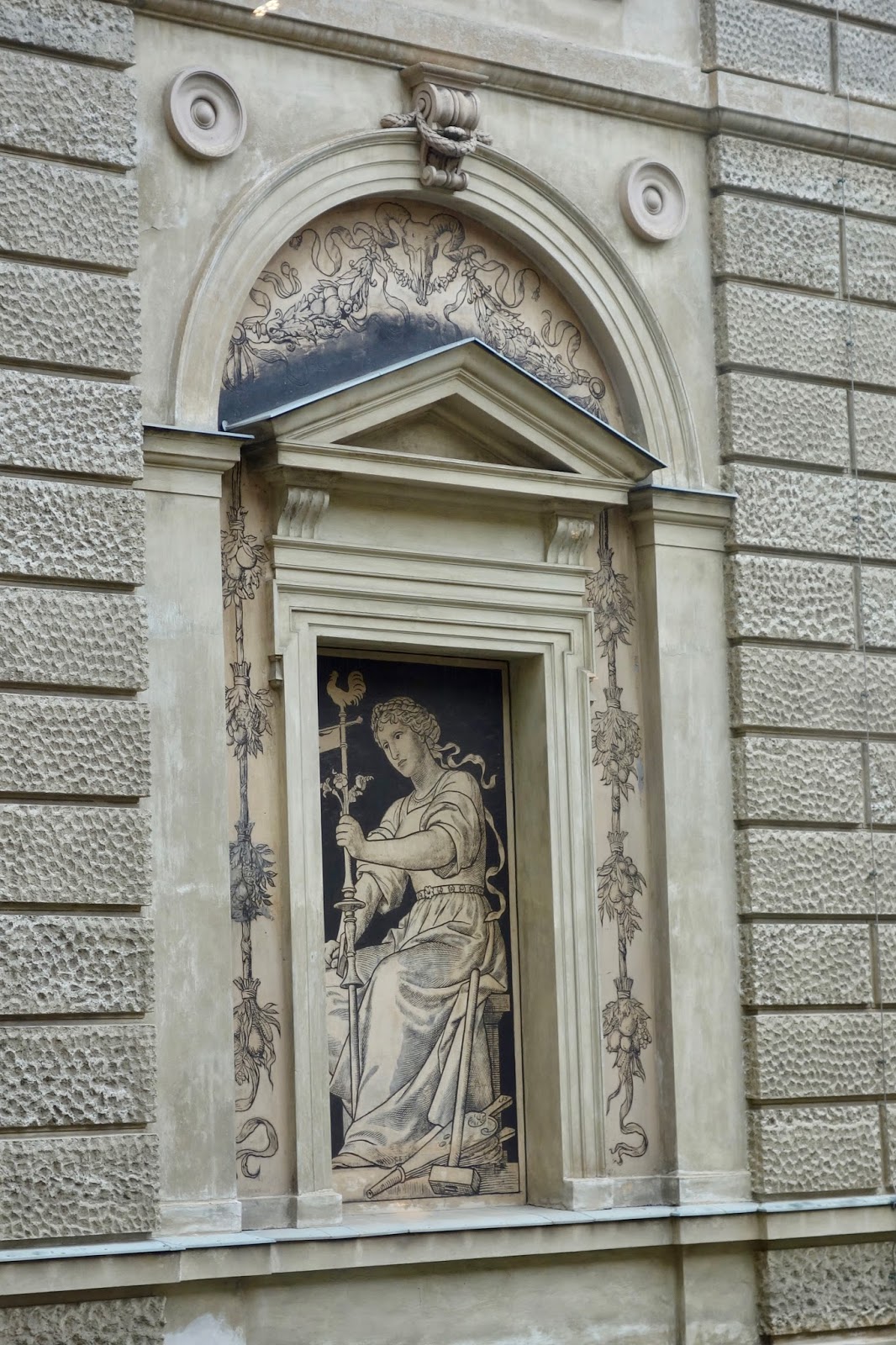
The Imperial Palace houses the Kunst Historisches Museum.  New York's Metropolitan Museum of Art seem a little puny in comparison.  Even the interior windows frame art!


Several sculptures honor Franz Joseph, the emperor who united Austria and Hungary.  More about the woman, Sissi, behind the move tomorrow.


Gustav Klimt painted the insets depicting different periods of art above the grand staircase.  Egyptian is seen here.


The collection and galleries, several devoted to a single artist, are huge.


I couldn't wait to see the Pieter Bruegel room.  Nobody does detail or the daily life of peasants better than this 16th century Northern European painter.  Note to the Upper Belvedere:  the Kunst Historiches Museum doesn't need a selfie room because it permits photos of much older masterpieces.  Go figure!


One painting depicts children playing more than 80 games.  Here are just a few:


He painted the "Tower of Babel," too.


Chris wanted to check out the Vermeer.  Only 34 paintings are attributed to his hand.


Only Thom would notice how Caravaggio painted fingernails (see the glint on the thumb?). He was determined to find a manicure before leaving Vienna.


Would you believe Rubens painted this Medusa?  It's so frightening, I really did almost turn to stone.


Our visit put faces to the names of queens who have interested me of late.  Like Marie Theresa, the only female Hapsburg empress and mother to 16 children


. . . including Marie Antoinette, who barely made it to the party (she was #15)!  After touring much of the Imperial Palace, it isn't difficult to understand where she got her sense of entitlement and why she lost her head as a result.


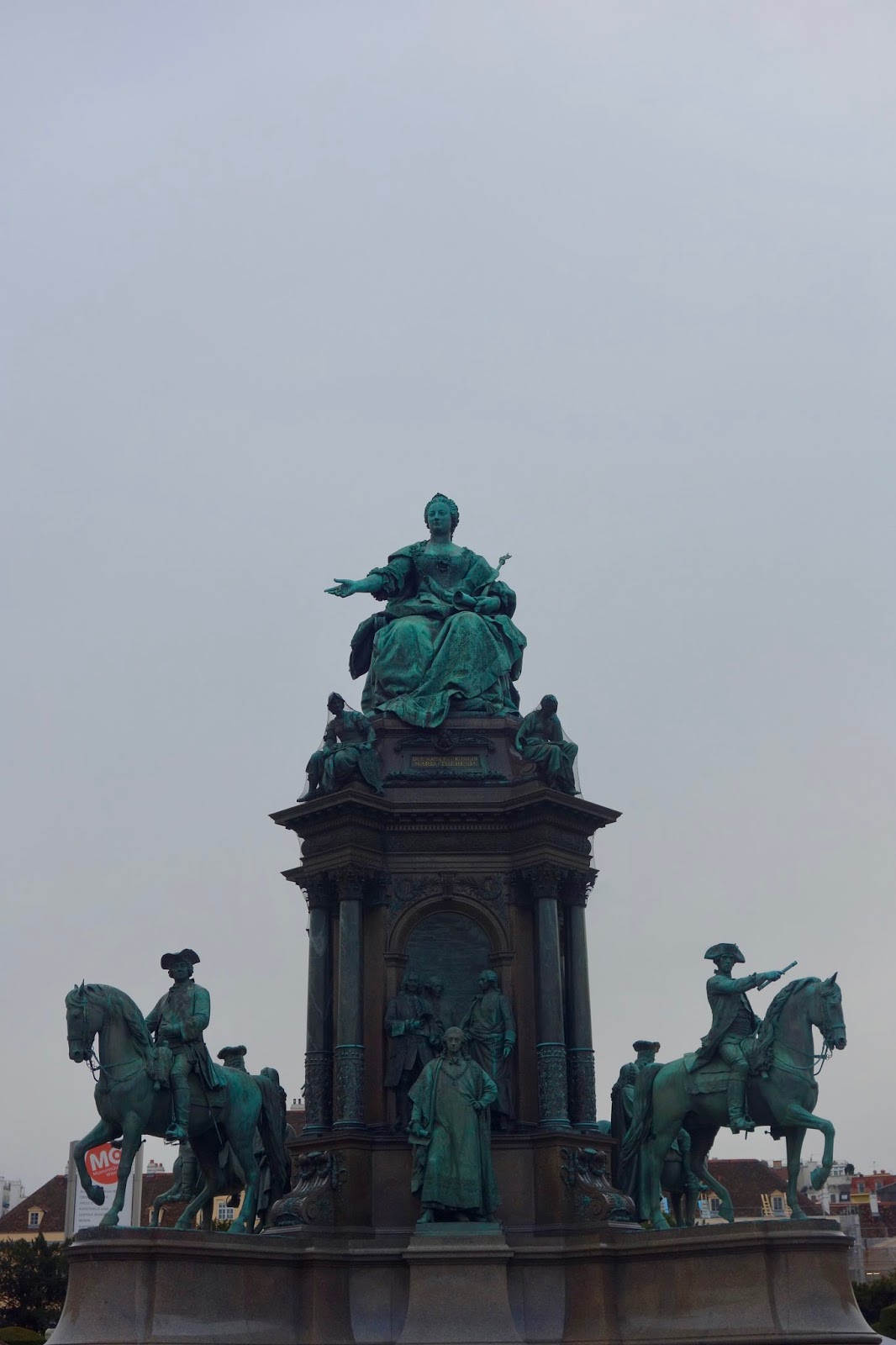
Maria Theresa presides outside the Kunst Historisches Museum, too.


Thanks to Hilary Mantel, I couldn't miss Hans Holbein's portrait of Anne Boleyn.  Vanessa Redgrave, Genevieve Bujold and Claire Foy all added considerable beauty to another queen who lost her head, for a different reason: she couldn't give birth to a single son (Marie Theresa sired five!).  Queening for women is a dangerous business.