When I left for northern Italy, the only sun I expected to see for the next two weeks would have been painted during the Renaissance. My first day in Trieste--literally a hop, skip and a jump from Slovenia--taught me once again to ignore long-term weather forecasts.

The hybrid city, claimed by several different powers over time, sits on Italy's northeastern Adriatic coast.

Neptune presided over fountains in three of the five cities I visited in northern Italy. Makes sense for a peninsular country!

Statues of people you've never heard of can teach you a lot about the complexities of local history. Although Nazario Sauro, a sailor, was born in the Austro-Hungarian Empire, he fervently believed in the unification of Italian-speaking regions and volunteered to fight against the Central Powers in World War I. Sauro was hanged for treason at the age of 35, after his ship wrecked off the coast of Croatia and he was captured.

Leopold I, however, a Holy Roman Emperor and a king of both Germany and Hungary, also continues to preside over Piazza della Borsa

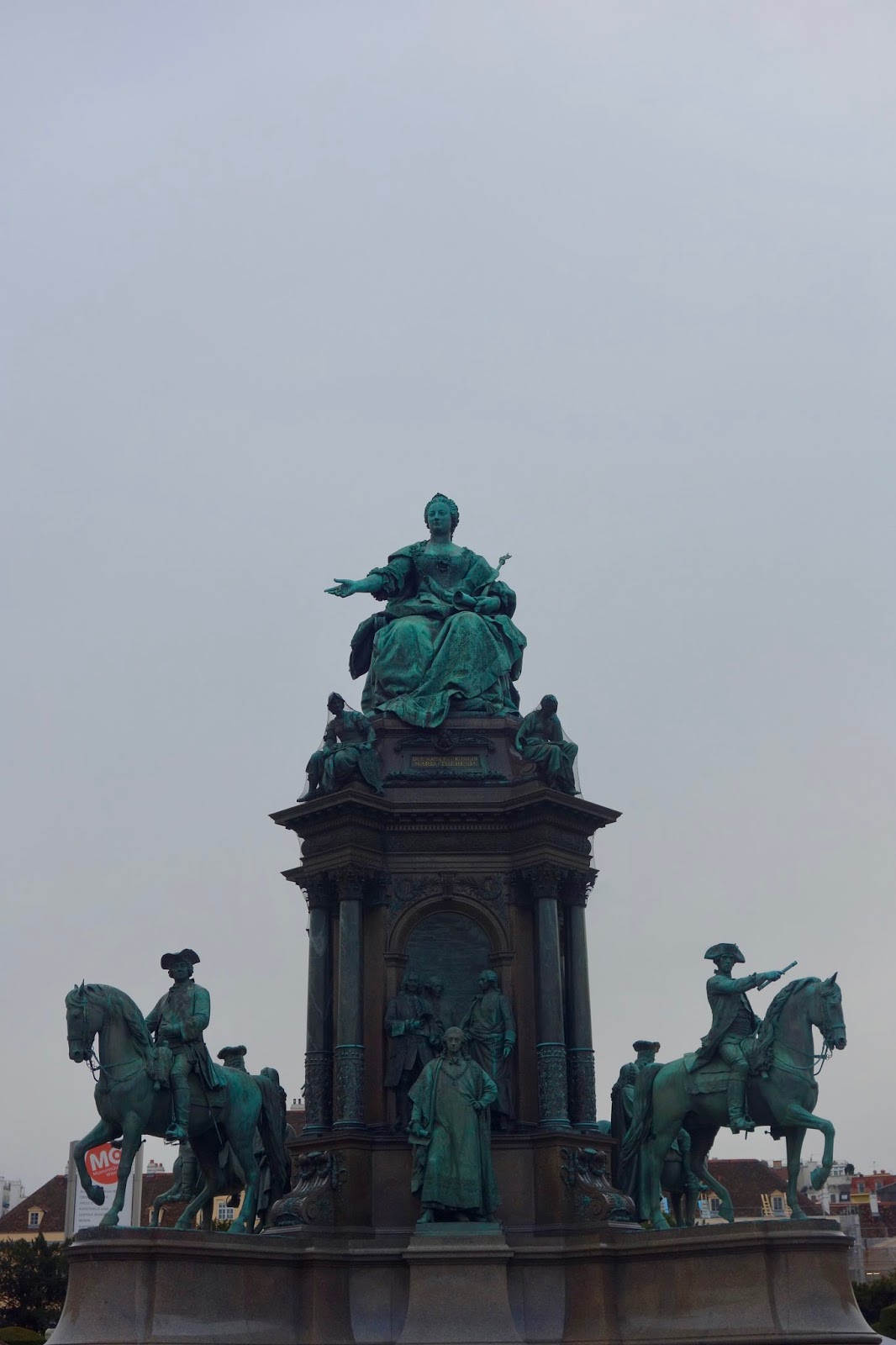
. . . and a giant silver coin near the (not so) Grand Canal celebrates Maria Theresa, an Austro Hungarian empress who established Trieste as a free port during her reign and brought commercial prosperity to the city.

A native explained to me that a left-wing faction of residents wants to re-establish Trieste as a "free territory." They also suspect that the country's current government intends to militarize the port in violation of a 1954 "memorandum of understanding" with Yugoslavia that returned Trieste to Italy. History is complicated!

Trieste's City Hall anchors the Piazza Unità d'Italia, said to the Europe's largest sea-front square. When Archduke Franz Ferdinand of the Austro Hungarian Empire and his wife were assassinated in Sarajevo, an event that precipitated World War I, their bodies were brought here. Benito Mussolini, Italy's fascist dictator during World War II, announced his anti-Semitic racial laws here, too. When Green Day performed in 2013, more than 10,000 fans attended.

Ignorance is bliss. I knew nothing of the square's history when I visited, focusing instead on the beauty and grandeur of the 19th century architecture.

Now here's a statue I could relate to without the help of Wikipedia. The small museum honoring Irish expatriate James Joyce was on my afternoon itinerary.

But first I had to catch the bus to the park above the Castello di Miramare, less than 20 kilometers northwest of the city.

Upon return, after my lunchtime siesta--and an opportunity to re-charge both my phone and a brand new battery pack, a travel hack almost as valuable as my Tumi luggage--I began another exploration of the very walkable city.

The hanging garlic is a reminder of who governs the city nowadays.

What I guessed to be a theater turned out to be the city's largest Catholic church. My attire--shorts-- prevented me from entering, something I would soon learn to factor into my daily planning.

Romans built this amphitheater sometime between the first and second centuries after the birth of Christ.


Late hours on Thursdays enabled me to check out the Civico Museo Revoltella, which occupies an imposing building, the former home of its patron.

You can't beat the views from the roof.

It was a pretty steep climb from the Revoltella up to the Trieste cathedral.

I wanted to watch the sun set over the gulf of Trieste from the fortress that sits atop San Giusto hill, next to the cathedral.

First I had to pass by these "automata," known as "Mikez and Jakez." The used to ring the bell that marked the hour from the clock atop City Hall in Piazza Unità d'Italia.

Here's the northeast view.

The fortress overlooks the Monument to the Fallen in the Great War, a fascist era memorial.

Darkness had fallen by the time I returned to my hotel, not far from the Grand Canal which empties into the gulf.

This fountain was commissioned to commemorate the 50th anniversary of Franz Josef's reign over the Austro-Hungarian empire. The bedraggled tritons (or mermen) have been carrying their load since 1897.

More Northern Italy
Trieste
Venice
Bologna
Florence