Tuesday, February 11, 2025

FLASHBACK: The Gates (Winter 2005)

The stars aligned twenty years ago when The Gates opened:  I lived nearby, I had a digital camera (the i-Phone was still two years in the future) and I was in love.  Christo and Jeanne-Claude provided New Yorkers with a unique public art project that turned Central Park into an orange-accented playpen, full of unabashed joy and wonder, just what the city needed in the long, dispiriting wake of the 9/11 terrorist attacks.
 
 
It took weeks and hundreds of laborers to stage The Gates.  I noticed this sign shortly after Christmas 2004. Christo and Jeanne-Claude first had come to my attention, vaguely, a decade earlier when DIFFA, an AIDS organization inspired by their environmental art work, had decorated the beach in Fire Island Pines with pink umbrellas for a memorable fund raiser I couldn't afford. 


Even a dyed-in-the-wool skeptic could see the planning had been meticulous, as it had been for the artists' wrapping of the Reichstag.  An exhibit I'd seen in Berlin documenting that event had blown me away three years earlier.


Delivery of the frames really began to heighten the sense of anticipation that had been building during a cold winter.


Florian and I biked to Central Park for the official unfurling on a Saturday morning.


Dozens of friendly young guides used tennis balls atop long poles to release the banners.  


They wore custom vests.


When I spotted a black limo on Park Drive, I shouted "It's them!" and we chased the vehicle like paparazzi to the top of Cherry Hill where Christo and the chain-smoking, flame-haired Jeanne-Claude held a brief press conference.


We had to ask ourselves: how could something like this--which required the approvals of the Bloomberg administration and the Central Park Conservancy--have gone so right?


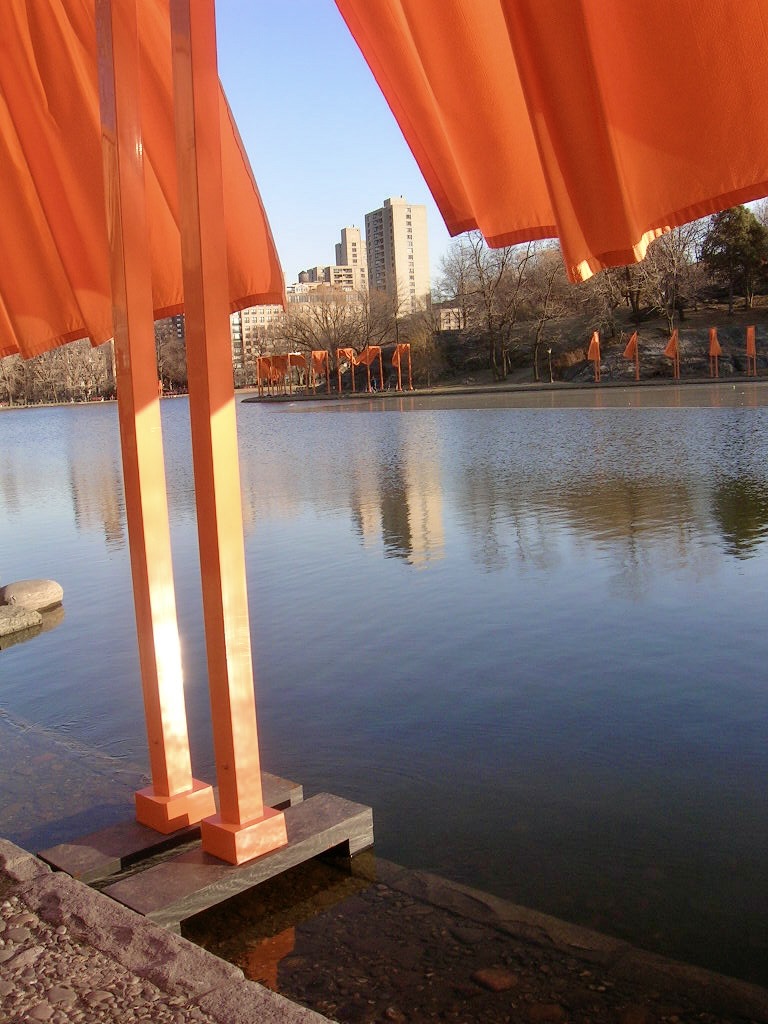

And then it snowed!


The tennis ball poles came in handy when the wind tangled the banners.


For a little more than two weeks, the ordinary became extraordinary.


Never ever was I a less jaded New Yorker.  Happy, happy days.

Wednesday, February 5, 2025

Knockout @ the Norton

Themed exhibitions, when well-curated well, can be a lot of fun.  "Strike Fast, Dance Lightly: Artists on Boxing" at the Norton is a knockout, and not just because it features a so-so silkscreen of "The Greatest" by my favorite artist.
 
Muhammad Ali by Andy Warhol (1978)
Linn, Paul, Sam, Chris and Christine liked it, too.  Few art museums in America have as photogenic an entrance as the Norton.


Meaningful interactions with museum security guards may be rare but Mike, named for a famous boxer, chatted knowledgeably about both the sport and the art.  "Some people ask if I modeled for this portrait when I tell them I've spent time in the ring," he joked.

"Seated Boxer" by Elliot Purse (2023)
Here's his favorite work in the show.  "The background is gold to help the artist convey the sense of triumph after a hard-won fight," noted Mike.

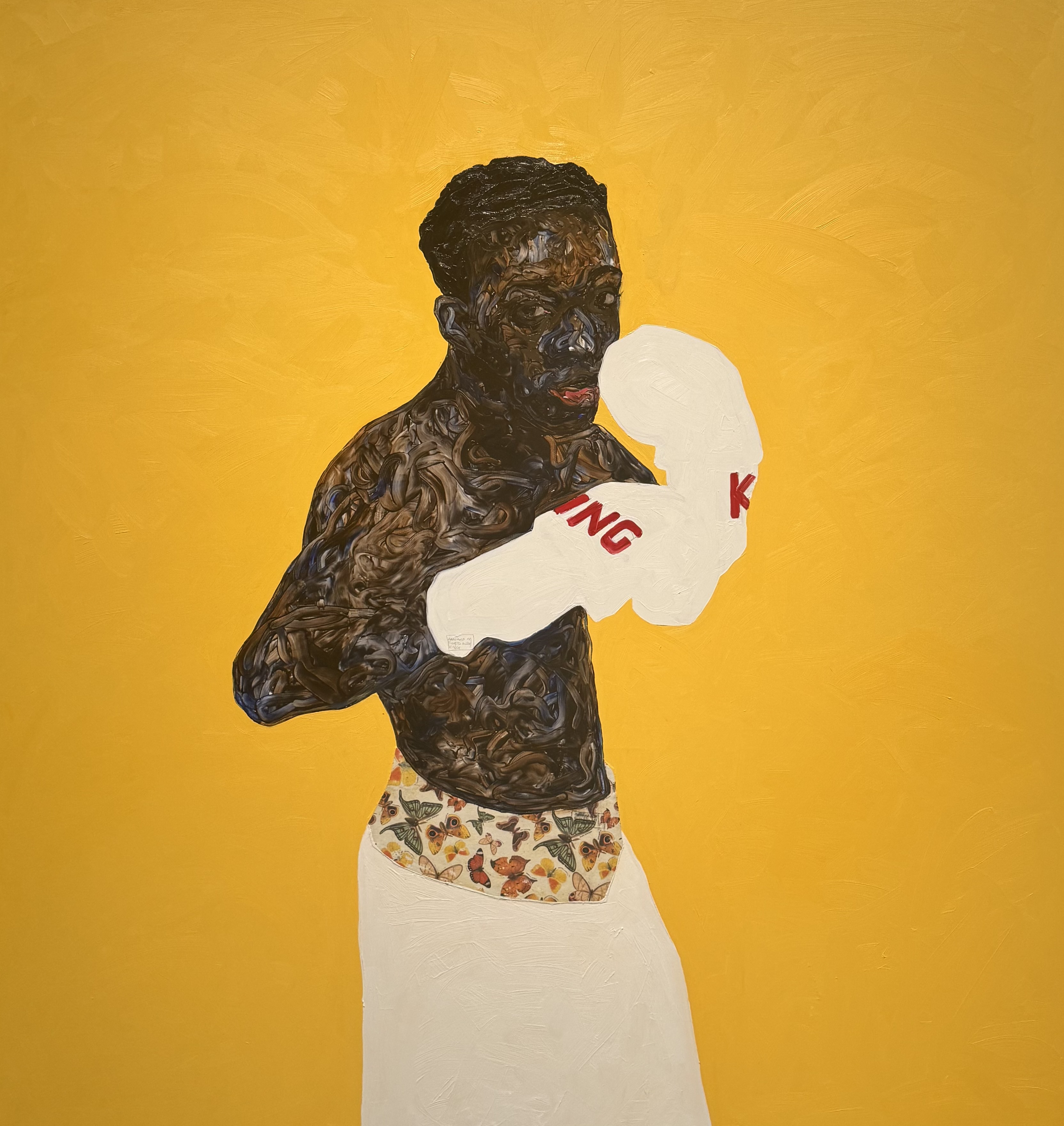
"King Gloves" by Amoako Boafo (2021)
Mike had met his namesake behind-the-scenes at a Super Bowl in Miami.  I had an encounter with Tyson, too, years before Mike was born when I worked at the ASPCA.  He and Robin Givens had come to the shelter for a pet when their turbulent marriage made the tabloids on a regular basis.  I tipped off the New York Post for a photo op to publicize the adoption.  It backfired when Tyson failed the screening.  I can't remember why.  Maybe his apartment didn't have screens on the windows or he travelled too much.
Mike Tyson with Dove by Michel Comte (1990)
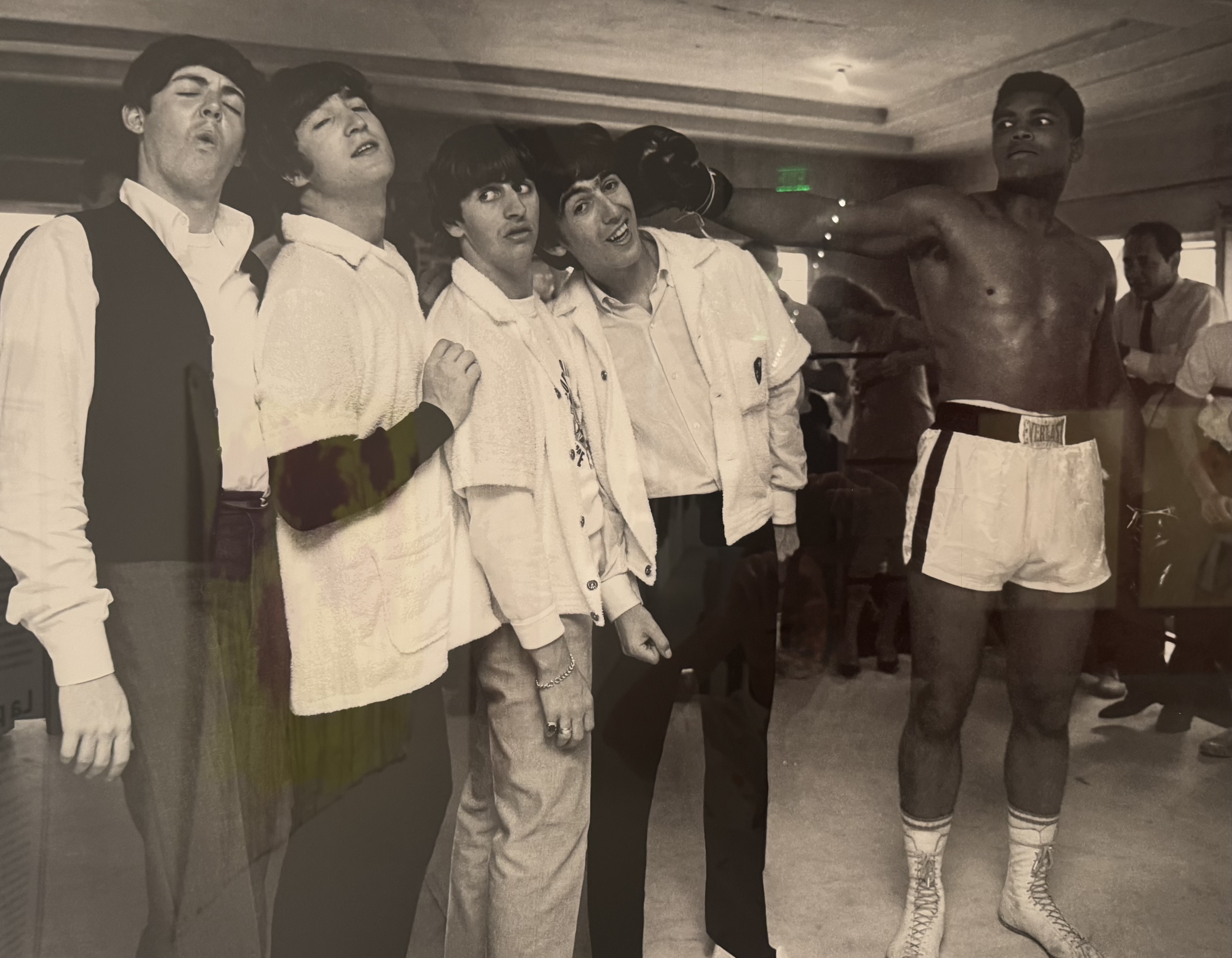
Muhammad Ali always has fascinated me.  Like Bob Dylan, he really knew how to give the media what they wanted even while manipulating them.  This now iconic Sixties photo exists only because Sonny Liston turned down a request by the Beatles, on their first tour of America, to pose with them at the 5th Street Gym in Miami Beach.  Then up and comer Cassius Clay, Ali was barely known to the rest of the world.

"Ali Hits George, Miami by Harry Benson (1964)
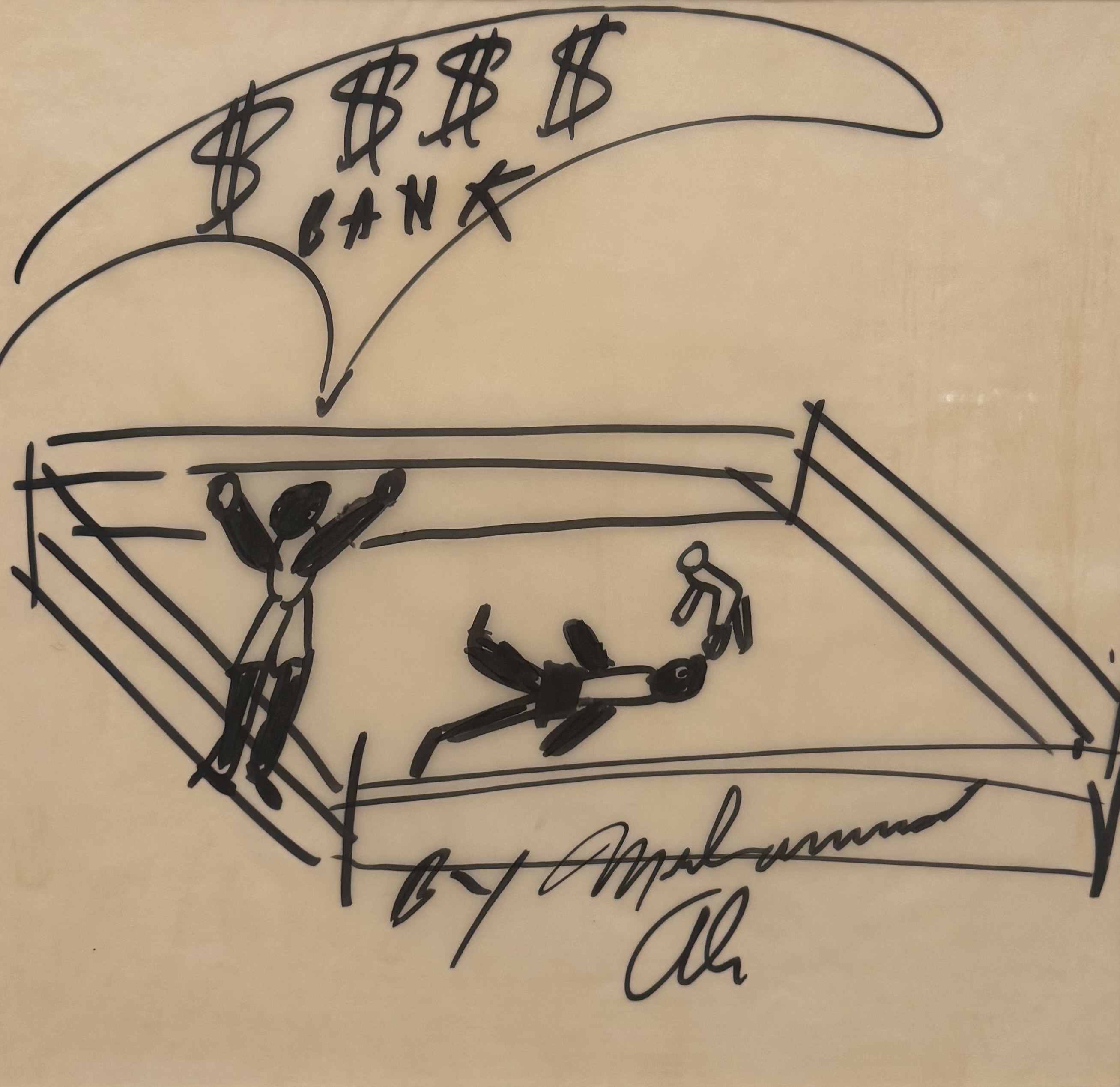
Who knew he could draw, too?

"Winning" (1967)
A rare view from inside the ring is a great metaphor for fame.

"The Crowd" (1967)
The show includes plenty of interesting artistic takes on boxing equipment such as head gear

"Light Blue Boxer" by Clotilde Jimenez (2020)
speed bags,

"Tough Love" by Myloan Dinh (2021)
and punching bags

"Skin Tight (Thug Life) I & II" by Glenn Ligon (1995)
Beaded Punching Bags by Jeffrey Gibson


. . . as well as gloves and other re-conceived ring attire.

"Like Home, Like Something" by Zoë Buckman  (2022)
"Blue Calcite Boxing Set" by Daniel Arsham (2016)
Sam put up his dukes.


It's always great to see the super-realistic work of John Ahearn & Rigoberto Torres who, for the most part, used Bronx residents as models long before people of color found greater representation in the art world.

Luis and John Kar (2003/2008)
It's probably not a stretch to observe that boxing offers curators an opportunity to include people of color in greater numbers than would other less violent athletic pursuits.  Last summer, for example, the Flag Art Foundation, a co-sponsor of this exhibit, celebrated swimmers.  Most were white.  It doesn't speak well of our culture at large.

"Champion" by Chase Hall (1993)
"Hit Man" by Jonas Wood (2012)
Even before I knew that Fletcher Martin had collaborated with Mexican muralist David Alfaro Siqueiros, I particularly liked this work.  Late in life, I've discovered that my taste runs more to social realism--especially Mexican--than almost any other genre. 

"Down for the Count" (1936 - 1937)
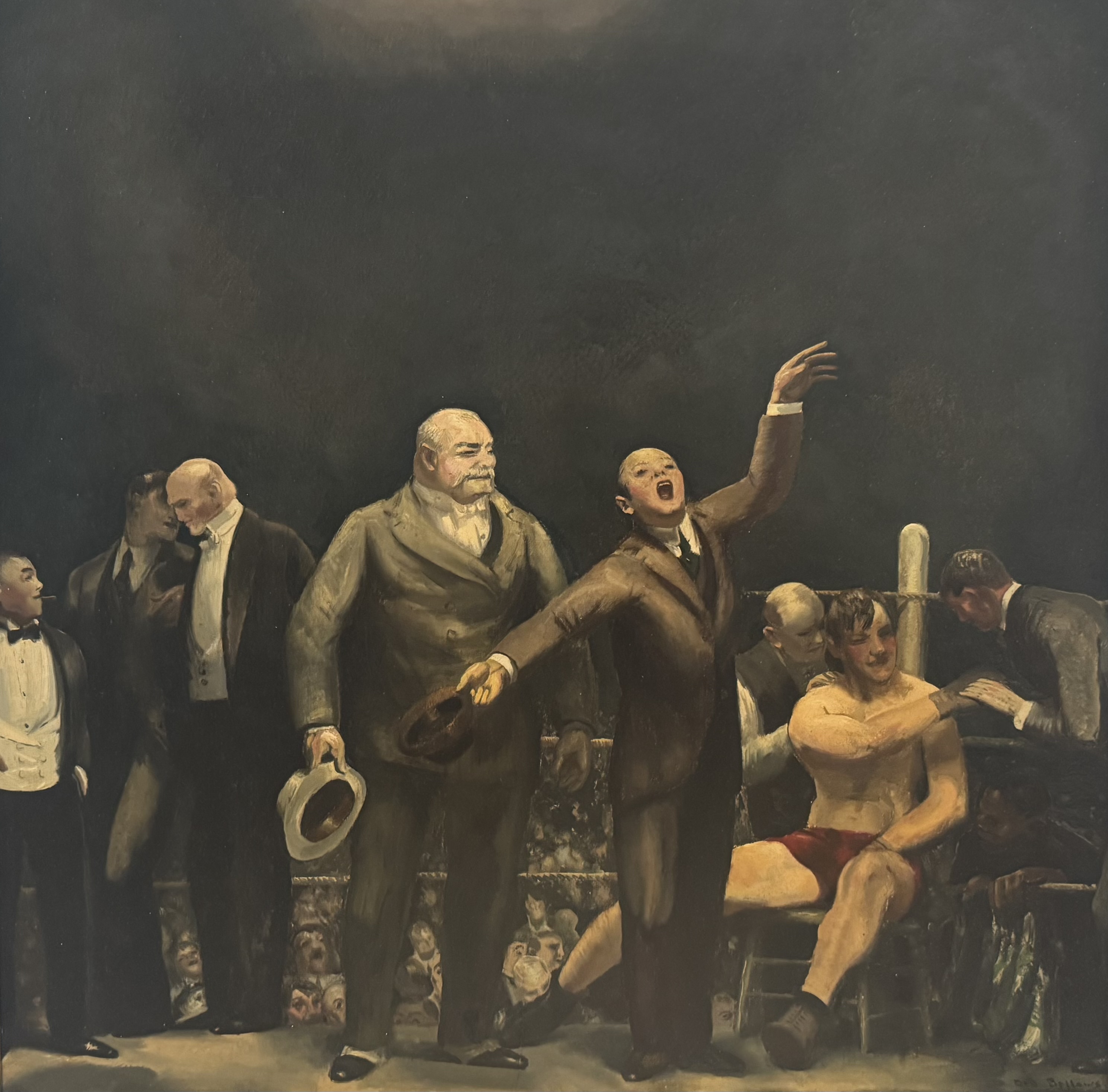
More than a hundred multi media works comprise the show.  This painting by George Bellows of the Boston Strong Boy is among the earliest.  The big man holding his hat was the last heavyweight champ to fight with his bare knuckles and the first to win a million bucks in prize fight.

Introducing John L. Sullivan (1923)
Both art and boxing have come a long way in the past century.

"The Boxer" by Vanessa German (2016)
A few artists evoked the sport's violence.

"Skeleton with Boxing Gloves and Crate" by Jeanne Silverthorne  (2012)
The New York Public Library introduced me to the work of Alison Saar, whose mother is also a famous artist.  She certainly isn't pulling her punches in this hard-hitting work.

"Black Lightning" (2012)
Still, you can't deny the bloodthirstiness of many spectators willing to pay top dollar to see men beat each other up.

"People's Choice" by Nari Ward (2018)
Although the Keith Haring sculpture wasn't in the "Gender and Sexuality" area of the exhibit, it elicited double-entendre vibes.

"Boxers" (1987-88)
Other artists explore the homoeroticism of boxing more directly.

"Boxers Under Lights" by Katharine Bradford (2018)
Hernan Bas cracks me up--noodle boys fighting each other with pillows in a bowed ring, feathers flying everywhere!  It wouldn't surprise me if the curator had commissioned this work after seeing the artist's hilarious show at the Bass.

"Conceptual artist #16 (Performance based; the founder and reigning champion
of a weekly pillow fight tournament)" (2023)
One gallery features female boxers, most of whom are as tough as you might expect.  Not this one.

"Gym Girl" by Amy Hill (2018)
Photobombing Andy and Jean-Michel was a lot more entertaining than sitting through The Collaboration on Broadway.

Andy Warhol & Jean-Michel Basquiat #143 by Michael Halsband (1985)
Another exhibit celebrated the work of Joaquín Sorolla y Bastida, an unfamiliar Spanish landscape artist and portraitist who reminded me a little of Winslow Homer.  All the paintings were borrowed from the Hispanic Society of America in New York City which loaned more of its collection to the Boca Raton Museum of Art.

"Beaching The Boat (Afternoon Light)" (1903)
"Beach of Valencia by Morning Light" (1908)
Sorolla's portraits often have been exhibited with those of John Singer Sargent.

"Elenita Dressed as a Menina" (1903)
The Norton's size is conducive to quick exploration and re-acquaintance.  It took me at least a minute or two to realize this guy--who looked out of of place compared to many of the Palm Beach residents who visit and support the museum--wasn't real.  A cigarette would have completed the illusion.

"Young Worker" by Duane Hanson (1976)
Black History Month is the perfect time to exhibit Faith Ringgold although I enjoy her work year round after seeing the New Museum's terrific retrospective in 2022.

"Moroccan Holiday: The French Collection Part II, #12 (1997)
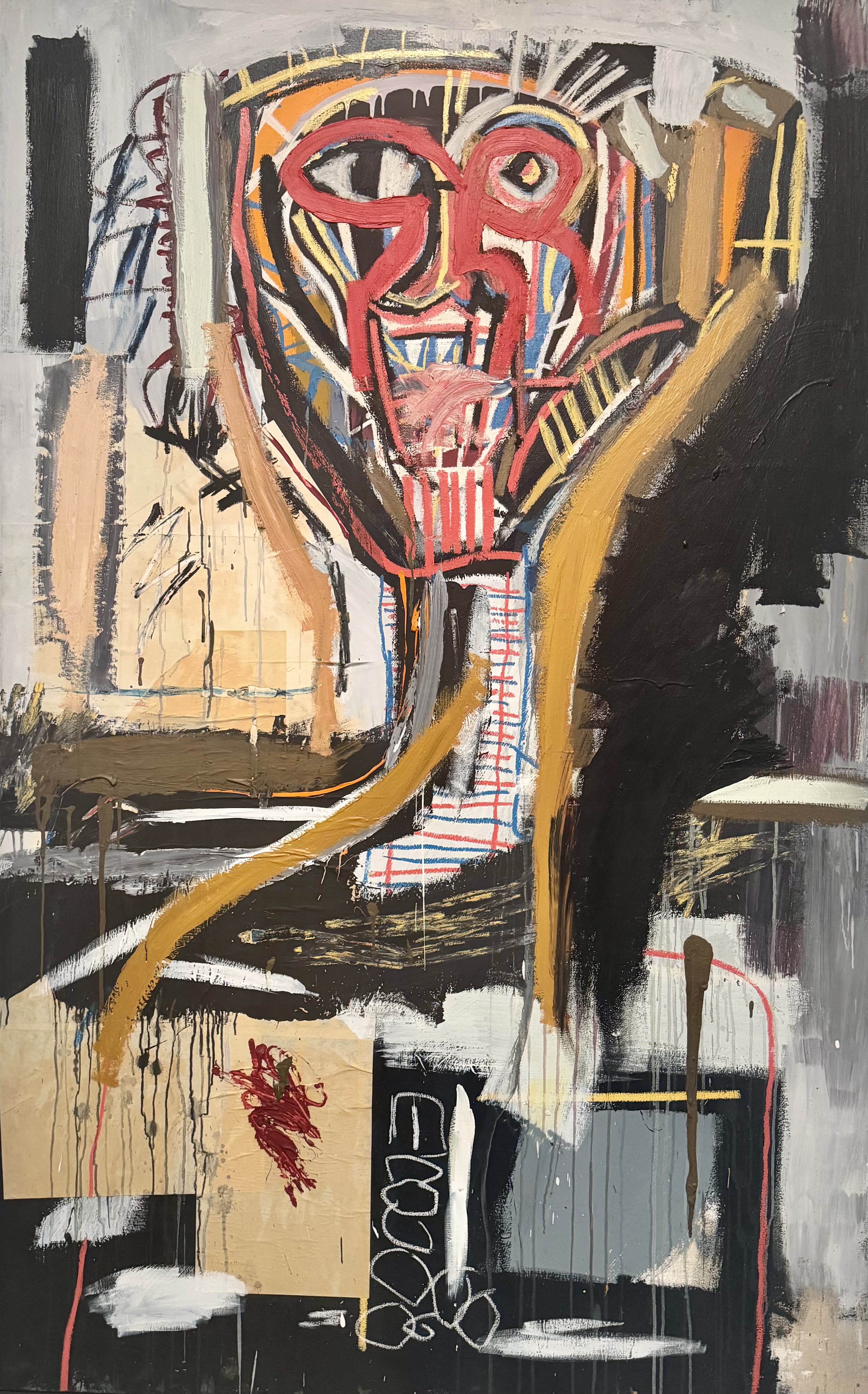
I'm no expert but I wonder if this huge Basquiat is real?  Didn't he use cardboard and found wood for most of his early paintings?  Blame my skepticism on the scandal at the Orlando Museum of Art.  The curator there died insisting the works he acquired were authentic, even after losing his job.

"Untitled (Prophet I)" (1981-82)
Jose Luis Cuevas is known for breaking away from the Mexican muralist tradition.  Too bad I was unfamiliar with this leading artist of the Generación de la Ruptura when I visited Mexico City.  There's an entire museum devoted to his often ill-tempered work.

"The Journey" (1969)
 Ernest Lawson belonged to the Ashcan School.  Many of the New York City-area neighborhoods he and other artists depicted are no longer impoverished.  The Hudson is a lot less polluted, too.

"Hoboken Water Front" (ca 1930)

Saturday, February 1, 2025

The Netanyahus (5+*) by Joshua Cohen


Somehow, I'd never heard of Joshua Cohen until The New Yorker published "My Camp," his highly nuanced short story about the response of a prize-winning, Jewish American author to the October 7 massacre.  I recommended it to every reader I knew well (and some I didn't, including a former colleague in the Bloomberg administration now responsible for the thankless task of running my alma mater). 

Of course, the title of Cohen's own, 2022 Pulitzer-prize winning novel isn't exactly a siren call:  The Netanyahus: An Account of a Minor and Ultimately Even Negligible Episode in the History of a Very Famous Family.  Who wants to spend more time with a power-mad, morally compromised, right-wing gas bag who already has already dominated the quagmire of Middle East politics longer than any other Israeli?

Little did I know that Bibi barely appears, except as a peeping tom tween, the middle child of his academic father, Benzion, who is seeking an appointment at at American college in upstate New York during the late 1950s.  The chair of the history department has assigned Ruben Blum, the only Jew on the faculty, to serve on a committee that will vet Netanyahu, a task he resents because his area of expertise is American taxation.  Believe it or not, slapstick hilarity ensues, particularly when Blum's in-laws visit and the Netanyahu family crashes with the beleaguered professor. This is one sensationally funny book, right up there with the best of Philip Roth.

The set-up, inspired by something that really happened, enables Cohen to depict several variations of American Judaism and to explore the history of Zionism in a way that elucidates current Israeli politics.  A shattering discussion about fairness that occurs between Ruben's father-in-law, a Holocaust survivor, and his idealistic granddaughter, who has written an earnest essay about the topic for her college application, left this conflicted peacenik nodding in agreement with the old man's thesis given the current state of our own country.  

There's no denying it:  people really are tribal, although Cohen himself remains firmly in the humanist camp.

Marianne Faithfull (1946-2025)


I bought Broken English for the title song, which broke big on WLIR-Radio in 1979 but "Why'd Ya Do It?" the final cut, still remains burned in my memory nearly 50 years later.  If my mother had been alive to hear it, she would have claimed Marianne Faithfull proved "women could be dirtier than men," a charge she also leveled at Jacqueline Susann.  The song resonated acutely at the time; I was in love with David, a "roommate" who cheated on me all the time, so I spat out my jealous rage in frequent turntable sing-alongs with Faithfull while vacuuming.  Her commandeering of a poem by Heathcote Williams is as shocking today as it was then.

But there was more than anger in her smoke-ravaged voice.  I was old enough to recall Faithfull's treacly version of boyfriend Mick Jagger's song, "As Tears Go By," from the Swingin' Sixties. On Broken English, she sounded NOTHING like that former convent girl, a kind of Twiggy with curves and a Hapsburg dynasty pedigree.  Even without the internet, you sensed that she'd come out on the other side of something terrible which apparently included heroin addiction (no surprise given her association with the Rolling Stones), divorce, miscarriage and living on the streets.  

In other words, Faithfull was ripe for making a comeback, one of my generation's first: the punk Judy Garland, if you will. Over a series of LPs she collaborated with a new generation of musicians, including Beck and Billy Corgan on this side of the pond, and even Angelo Badalamenti on a lushly orchestrated album.  Eventually, Faithfull morphed into a world-weary chanteuse with impeccable taste in music.  Her show at Irving Plaza in 2002 included "Song for Nico," a tribute to another pretty blond with a taste for smack that she co-wrote with Dave Stewart of the Eurythmics.  It's by far my favorite of her later works.

Yesterday is gone
There's just today
No tomorrow

Speaking of women with a taste for smack, let's not forget Anita Pallenberg, Faithfull's gal pal (or frenemy, given her affair with Mick during the filming of Performance?), the subject of a terrific documentary that includes home-movie footage of the two of them crossing the Atlantic in a freighter with the Glimmer Twins.  If you believe the producer (Anita's son with Keith Richards) his mother, not Marianne the was the muse for "You Can't Always Get What You Want," and "Sister Morphine," although Faithfull did finally earn a long-disputed writing credit on the latter. 

No matter the truth, Faithfull's comeback is testament to the impact that cleaning-up for good eventually had on her life.  Unlike Nico or Pallenberg, eight and four years older respectively, she managed to survive sex, drugs and rock 'n roll and enjoyed a second-act that lasted four decades.

More People I Loved: