Showing posts with label Berlin. Show all posts

Saturday, January 4, 2025

FLASHBACK: Berlin (Thanksgiving 2001)

I couldn't wait to get back to Berlin to see how much it had changed since 1963 when we drove there through East Germany from Heidelberg where my father was stationed.  It only took a photo op at Checkpoint Charlie to realize that I had been a witness to history, probably the first time I had been privy to such a feeling.


Dan and I flew into Tegel airport, where the Berlin airlift had taken place.  Chris was coming from Moscow once again for our second annual ABC trip.  The three of us shared a room for the last time, in a hotel not far from KaDeWe, which instantly became my favorite department store for its incredible array of men's wear.


Berlin Buddy Bears had just been introduced to symbolize German friendliness and optimism.


We hit the Pergamon, a showcase for classical art plundered from German archaeological digs, right away. I wore a pair of Army fatigues because I figured they would butch me up in the bars along with a skinhead haircut.


Chris and Dan stood at mock attention in front of the Reichstag, wrapped by Christo and Jeanne-Claude in 1995.  Chris does a killer German accent.


This time he didn't need to suggest going to the Jewish Museum, which had just opened. Daniel Libeskind's architecture--which included the Holocaust Tower, a structural element that made me feel as if I had stepped into a boxcar en route to a concentration camp, albeit a nearly empty one--had been acclaimed worldwide.  I reacted with a cold shiver unlike a small group of Germans . . . who laughed as they entered.  An extensive exhibit documenting bourgeois Jewish life in Germany prior to World War II informed and saddened in nearly equal measure.  Imagine if white supremacists in America managed to erase Black culture and you'll get an idea of the scale of the loss.  


The Garden of Exile, designed by Libeskind to evoke the unsteadiness and disorientation of Germans being forced to emigrate, is behind me.


The Berlin Cathedral--Germany's largest Protestant church--looms behind an enormous statue of Karl Marx and Friedrich Engels, the authors of The Communist Manifesto, in the former German Democratic Republic.  It became a popular tourist attraction after the re-unification of Germany in 1989.


Alexanderplatz was just a short walk away in the Mitte district.  The famous square is the setting for a classic German novel brilliantly adapted for German television by Rainier Werner Fassbinder in 1980.  After catching all 15 hours at the Museum of Modern Art, I wanted to experience in person what had been off-limits for much of my lifetime.


Chris returned to Moscow early.  After visiting the Deutsche Kinemathek, the incredible film museum, Dan and I headed to the Tor, a bathhouse near the Brandenberg Gate where I met Nanno.  When we asked him where to eat, he accompanied us to a local Turkish restaurant and invited us to his place in Schöneberg for brunch the next morning.  Nanno turned me on to Robbie Williams, for which I am forever grateful.  At the time, he clerked in a bookstore but eventually rose to the rank of publisher.


Nanno also called his sister, who worked at the Reichstag, to ensure us morning admission before our return flight the next day.  Set afire by the Nazis a month after Hitler won election (at least you-know-who has thus far spared the Capitol), its destruction represented the end of the Weimar Republic.  It's unclear if this engraved "W" refers to the German emperor at the time the building was constructed in the late 19th century, or the name of the republic.


Little did Nanno know his kindness could have gotten us arrested when he insisted we couldn't leave Berlin without seeing the historic government building from the inside. British starchitect Norman Foster (with a nudge) had added a glorious glass dome in the wake of re-unification just two years earlier, symbolizing a new era of transparency in German politics.


Ascending the spiraled walkway, from which the beautifully upholstered purple seats of the German parliament can be seen, gave me a juvenile idea (even at 38!).  I told Dan to remain on the middle level while I went below.  When I gave the signal, he held up his hand in a Nazi salute.  The result of the offensive photo op does not survive.  Three years later, when I recounted our hijinks to Florian, another native German friend, he was appalled.  "Are you crazy?" he shrieked.  "That's illegal!"


Need I add how much times have changed with the AfD poised to play a significant role in the German parliamentary system and at least two of the three most powerful people in American politics embracing the neo-Nazi party's right-wing agenda? 

More Berlin:

Berlin (2015)

More ABC Thanksgiving Travel:


*exceptions make the rule


Sunday, February 6, 2022

Black Deutschland (4*)


What's not to like?  Berlin, my favorite European city, filtered through a gay black intellectual's consciousness during the years before the Wall fell in what must be a deeply autobiographical novel.  Darryl Pinckney may be a little hard to follow at times as he alternates between Jed's African American upbringing in Chicago and his expatriate life in what he describes as "the involuntary island" and "the retirement community of the '68 generation" but picking your way through the deeper thickets of his prolifically critical mind often yields some of the sweetest berries.  

I particularly enjoyed hearing his father's pithy black maxims, who characterizes philandering like this:

He loved the flashlight more than he did the hearth.

And warns Jed not to flash his money around.

Don’t parade your mule in front of people who don’t have hamburger.

Pinckney employs black vernacular in more obvious ways, too.

Louis Armstrong’s new tailor asked him if he dressed left or right. Armstrong told him to leave room on both sides.  “I like for it to swang.”

I may have beat Jed to Potsdamer Platz by a couple of decades, but my vivid childhood memories lack his acute historical perception:

Ahead of us, by itself, out there in front, like the bull of the herd, getting ready to face the Wall, was a blackened building with a short tower.  It had been a brewery before the war.  It was the last building on Potsdamerplatz.  Everything else around it had been bombed, the ranges of brick and dust carted away by the famous rubble women, the women of Berlin who after the war cleaned up wreckage of their own infatuation with uniforms.

Like many gay men, Jed, who eventually finds shelter in a West Berlin commune, is also more clear-eyed than most about unspoken political dynamics.

To bring in soul brothers was a way of beefing up the male presence without antagonizing the considerable feminist faction in the house.

In the hierarchy of oppression, does gay trump black or vice versa?  Jed ventures this.

Maybe that was why I really lost it in a house meeting about the bookstore selling Eldridge Cleaver’s Soul on Ice, which to them was a classic from the black American revolution of the 1960s but to me had nasty things to say about gay black men wanting to have babies by white men and the rape of white women as Cleaver’s personal retribution for the Vietnam War.

But Jed's open to the perceptions of his Berliner friends, like Manfred,  his unreciprocated heterosexual crush, who grew up in a divided society.  Jed allows him to destroy a sacred cow even as he offhandedly acknowledges the natural fringe benefits of a communist existence.

East Berlin was so underlit that I could make out the Little Dipper.  It suited men like me that the unreal city was surrounded by a society with an inferiority complex.  Manfred said that Rosa Luxemburg would have been as nasty as any of them had she gained power.  Such people were best in their opposition.

Meanwhile, meditations on a chaotic, middle-class black family life and activism inform Pinckney's infatuation with white culture in an environment where his skin color is more asset than liability, despite his fondness for white wine and cocaine and failure to find love.

Wunderbar!


Tuesday, January 11, 2022

FLASHBACK: Berlin (1963)

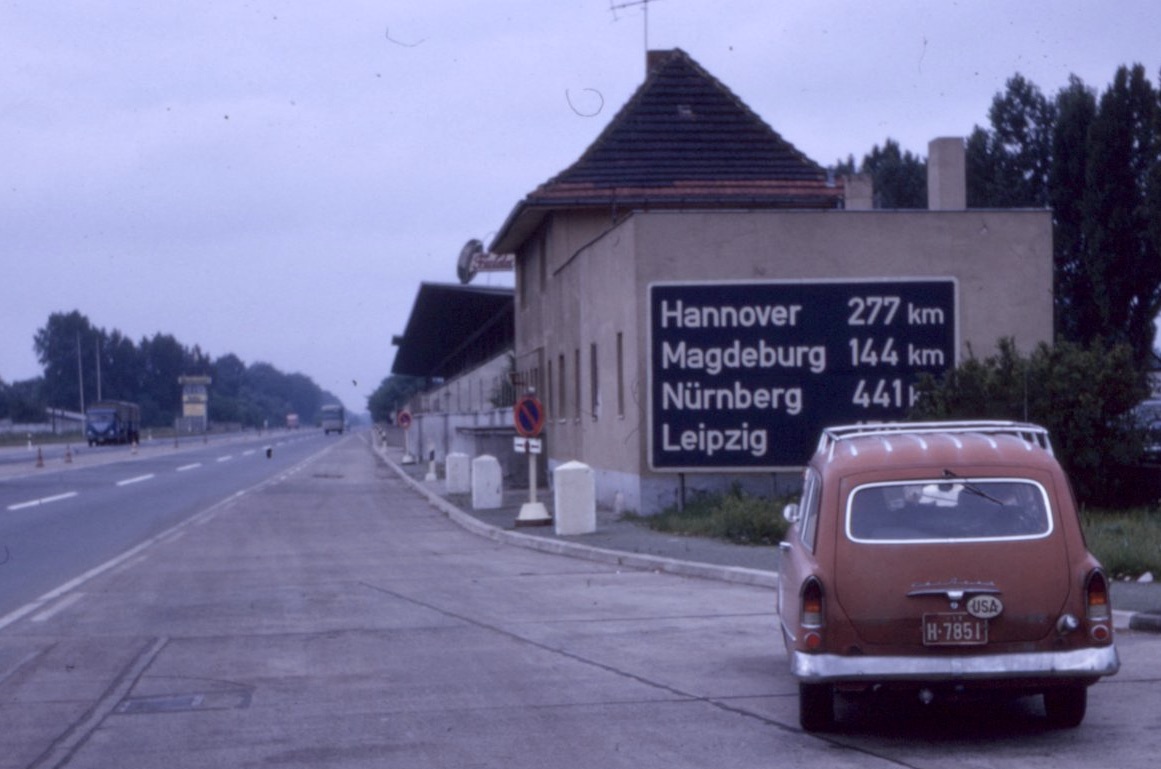
Not long after the Soviets erected the Berlin Wall, Ken filed the necessary paperwork to drive to the American sector.  We had to arrive at the city's border by a certain time. "Otherwise, the East German polizei will come after us," he explained.


The Berlin bear, still there today, greeted us on a nearly empty autobahn.


Of course Ken wanted to get as close as possible to the wall even though American soldiers with machine guns patrolled its length in Jeeps.


East German children gazed through the barbed wire.


West Germans memorialized those who were killed trying to escape the German Democratic Republic.


The Brandenburg Gate, which somehow survived Allied bombing during World War II, lay just behind the Wall.


Ken put me on his shoulders at Potsdamer Platz, now a glittering commercial center, to get a better view.


Rabbits hopped in the wasteland beyond.


Monday, March 30, 2015

Berlin


Florian lives in Moabit, part of the former West Berlin, in a cheap apartment with a balcony near the Birkenstrasse U-Bahn stop.  He pays just 380 euros a month, not including utilities.


Berlin scared me when I visited with my parents in 1962.  My father put me on his shoulders near Checkpoint Charlie to get a glimpse over the Wall.  I saw barbed wire, guards with rifles, rabbits and gray desolation.  The bear population certainly has increased since then.


I like the traffic light guys even more.


You can find them on all kinds of merchandise, including beach towels and welcome mats, at this store.  I bought a t-shirt.


Florian left me on my own while he went to his job as a physical therapist at a nearby rehabilitation hospital.  I headed out on foot and spotted this sign near the central train station.  It combines two of my favorite things in the world!


My walk took me across the Spree on a bridge guarded by griffins at both ends.


Bypassing several federal government buildings, I headed to the Tiergarten, an enormous park filled with incredible statues.  


Many of the statues commemorate Germany's cultural contributions to music and literature.


Some temporary, less appealing "art" bluntly addressed Germany's past.


Here's what you see when you look through the opening.  It's on a continuous loop.


Just across the street, off of Hannah Arendtstrasse, is the Memorial to the Murdered Jews of Europe.  It wasn't there the last time I visited Berlin, 12 years ago.  


Hundreds of gray concrete slabs are planted in the ground at uneven elevations creating a grid of cobblestoned alleys with nothing but the sky above.


The concept eluded me at first and I was more than a little shocked by the hilarity of children using the grid to play "hide and seek."  After deciding their game wasn't a bad metaphor for the Jewish experience in Nazi Germany, I spent hours in the chilly drizzle trying to capture an iconic image, never realizing that an information center lies beneath the memorial.


This series, culminating in "shhhh," is my favorite.


From this angle, the memorial resembles a cemetery.  More on the real things later.  I'm obsessed.


There are plenty of other things to see near the memorial, including another one that honors the gypsies murdered by the Nazis.


German flags fly above the Reichstag in the distance.


Heavily bombed during World War II, it now houses the Bundestag, the federal governing body.  Bullet-ridden walls and Soviet graffiti are preserved inside.  Would you believe Christo wrapped the entire building before British architect Norman Foster added the glass dome as part of a major renovation?

In 2003, Dan and I climbed up to the top of the dome.  When no one was looking, we thought it would be funny to raise our hands in a Nazi salute.  Little did we know we could have been arrested for committing a criminal act.


Government dissatisfaction exists everywhere in the world.


Angela Merkel, the German Chancellor and most powerful woman in the world, can walk to the Reichstag from her office across the Spree.


During my last visit to Berlin, the Brandenburg Gate was under renovation and wrapped in a giant advertisement for an internet company.


The new American Embassy is a stone's throw away.


Before re-unification, most East Germans with cars drove Trabants, or "Trabbis."  Although everybody makes fun of them today, that hasn't stopped tourism companies from offering Berlin safaris in colorfully painted models.  You can pedal a bicycle almost as fast.


I walked from Brandenburg Gate to the Victory Column or Siegessaulle along the Street of June 17, the western half of a huge boulevard that has seen a lot of history.  Paved since the end of the 18th century, Berliners celebrated Germany's declaration of war in August 1914 here.  Nazis lined the magnificent boulevard, bordered here by the Tiergarten on both sides, with flags during military parades.  Allied air forces landed on it after they defeated Hitler.


I climbed to the top of the Victory Column.


Everyone deserted the viewing platform when a storm blew in.


Berliners call the woman at the top Golden Lizzy.  She lived up to her nickname in the late afternoon sunlight, my first of the trip.


The walk back to Florian's took me past several butch statues and Bellevue, the German White House.


Moabit, on the other side of the Spree, looked serenely beautiful.  Graffiti is as unavoidable in Berlin as it was in New York during the 70s.


Cheap rents caused a youth quake in east Berlin after re-unification.  But now, gentrification is occurring in parts of west Berlin that have been overlooked since the Wall fell.  You know something's up when the art galleries start moving in.


Florian told me to look for the tall church steeple to help me find my way back to his apartment.  This lion was fiercer than any I had seen in Kenya last fall.  I'll bet he would have enjoyed some of the currywurst we had for dinner.