Friday, September 6, 2024

Museum of the Second World War

If I'd been better versed in the conflict's history, I might have realized why Poland's Museum of the Second World War--a "must-see" attraction according to every guide book--was located in Gdańsk:  it's where the Nazis launched their invasion of Poland in September 1939.  Unexpectedly, given the towering presence of the building, the permanent exhibit is completely underground.  It represents the past, according to the local architectural firm that designed it.


The museum does a thorough job of examining the conditions that led to the rise of the National Socialists in Germany and the anti-Semitism they propagated.  I'd never seen a bust of their leader.


This poster advertises a "documentary," produced under the auspices of Joseph Goebbels, that includes scenes shot by the German military in the Warsaw and Lodz ghettos.  It compares Jews to rats, as sources of contagion.


Poles who physically appeared to be Aryan could become citizens of the Third Reich provided they demonstrated their allegiance, such as through service in the armed forces.


The Nazis even recruited SS members in Norway.


A week before Hitler invaded Poland, he signed a non-aggression pact with Stalin, which included a plan to divvy up the Eastern European countries that lay between Germany and Russia.  


Although the plan remained secret until the Nuremberg trials, Stalin invaded Poland soon after the pact was signed under the pretext of--get this--protecting the sovereignty of Ukraine and Belarus.  The Emperors of Austria, Prussia and Russia had partitioned the Polish-Lithuanian Commonwealth in much the same way 150 years earlier.  If history doesn't always repeat, it certainly echoes.


The deeply Catholic Poles had good reason to fear a Soviet takeover.  An exhibit illustrates how the Soviets transformed "red corners" in Russian homes--traditionally an area where residents displayed their religious icons--into shrines honoring the Bolsheviks that became known as "little red corners" where politics supplanted prayer.


Nazi Germany used propaganda to exploit fears of communism across Eastern Europe, like this poster from Czechoslovakia depicting Prague's iconic castle with a tag line that sounds right out of a horror movie: "When they grab you, you will die."


While the museum primarily focuses on the Polish experience of the war, it also includes exhibits about the rise of fascism in Italy and Spain.

Il Duce
Spanish Civil War 
Another gallery looks at countries whose governments took the easy way out, like Vichy France.


There's even a section devoted to Japan.  General Hideki Tojo ordered the attack on Pearl Harbor, ending the neutrality of the United States on December 7, 1941, "a date which will live in infamy" according to President Franklin D. Roosevelt who, until then, had managed to ignore events in Europe.


The Japanese, like the Germans, inculcated warmongering at an early age.


One enormous gallery recreates a Warsaw street during the Nazi occupation.  


Here's what that same street looked like after the war.


Through a combination of exhibits like these, artifacts and extensive historic video footage, the museum does a superb job of recreating the almost unthinkable hardships of the war years.  It left me feeling extraordinarily fortunate never to have experienced anything remotely like them.


By 1944, as many half a million Poles had joined the resistance which supported pre-war government officials exiled in London.


The resistance brought its full force to bear during Operation Tempest, launched in 1944 as the Red Army advanced on Nazi forces occupying Poland.  The exiled government hoped to liberate the country from the Nazis and re-establish its pre-war borders, prior to the arrival of the Soviets.  The strategy failed; Nazi bombing mostly obliterated Warsaw after the Uprising and Stalin was able to grab Poland (and other Eastern Bloc countries) after the Yalta conference, which included a declaration that communists should be included in Poland's new government.   As a result, it remained under Soviet rule for four more decades, until the USSR collapsed.  


The museum also examines how some Poles risked their lives to save Jews from the Nazis including this baby girl, one of 2,500 children rescued through the efforts of Irena Sendler. The child's mother included a silver spoon engraved with her daughter's name and date of birth in the basket, concealed in a cartload of bricks, that took her from the Warsaw ghetto to the "Aryan side."  Elzbieta Ficowska--whose parents and grandparents died during the war--kept her lucky spoon all her life.


After spending more than three riveting hours in the museum, I discovered that it has been buffeted by political winds since its conception in 2008 as a local museum to commemorate Westerplatte, the nearby peninsula where the Poland tried to defend itself against the Nazi invasion.  

Under the leadership of Donald Tusk, a liberal prime minister (and native of Gdańsk) who eventually assumed the presidency of the European Council, the mission of the museum expanded to become a definitive depiction of World War II from the Polish point of view. But by the time the galleries finally opened in 2017, Poland had elected a right-wing government that seems to have spent as much time interfering with the curation of the museum as it did destroying the judiciary's independence.  

Elimination of any ambiguity about the fact that many Poles had collaborated with the Nazis was first and foremost on the agenda of the Law and Justice Party.  This led to an overemphasis on Polish resistance fighters and citizens who had harbored Jews, forcing the resignation of some academic curators and the re-training of guides.  Visitors keen to experience a more nuanced look at Polish behavior during the war found a jingoistic film in the final gallery particularly objectionable.

I don't recall seeing such a film, although I was pretty exhausted by the end of my visit, less than a year after Donald Tusk's re-election as Polish prime minister.  I can say that it left with me with the conviction that people who lived in Poland from 1939 to 1990 were dealt an awful blow by history.


Early Morning In Gdańsk

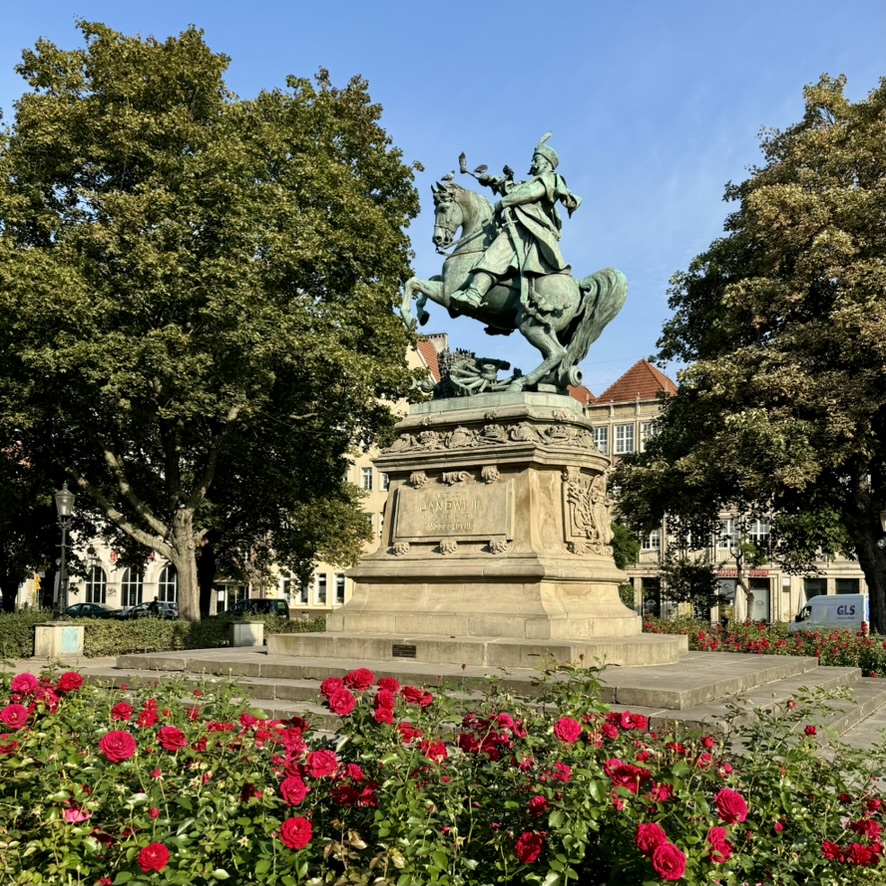
No doubt Jan Heweliusz is gazing up at the moon with his trusted quadrant.  He mapped lunar surfaces during the golden age of the Commonwealth of Poland and Lithuania, when it was one of Europe's largest and most populous countries. He also brewed beer.


There's a beautiful astronomical map on the back of the building near the statue.

 
Heweliusz benefitted from the patronage of four different Polish kings, including Jan III Sobieski, an elected monarch and war hero whose 22-year reign stabilized the commonwealth after years of turmoil. The king got on so well with Heweliusz that he exempted him from paying any beer taxes.

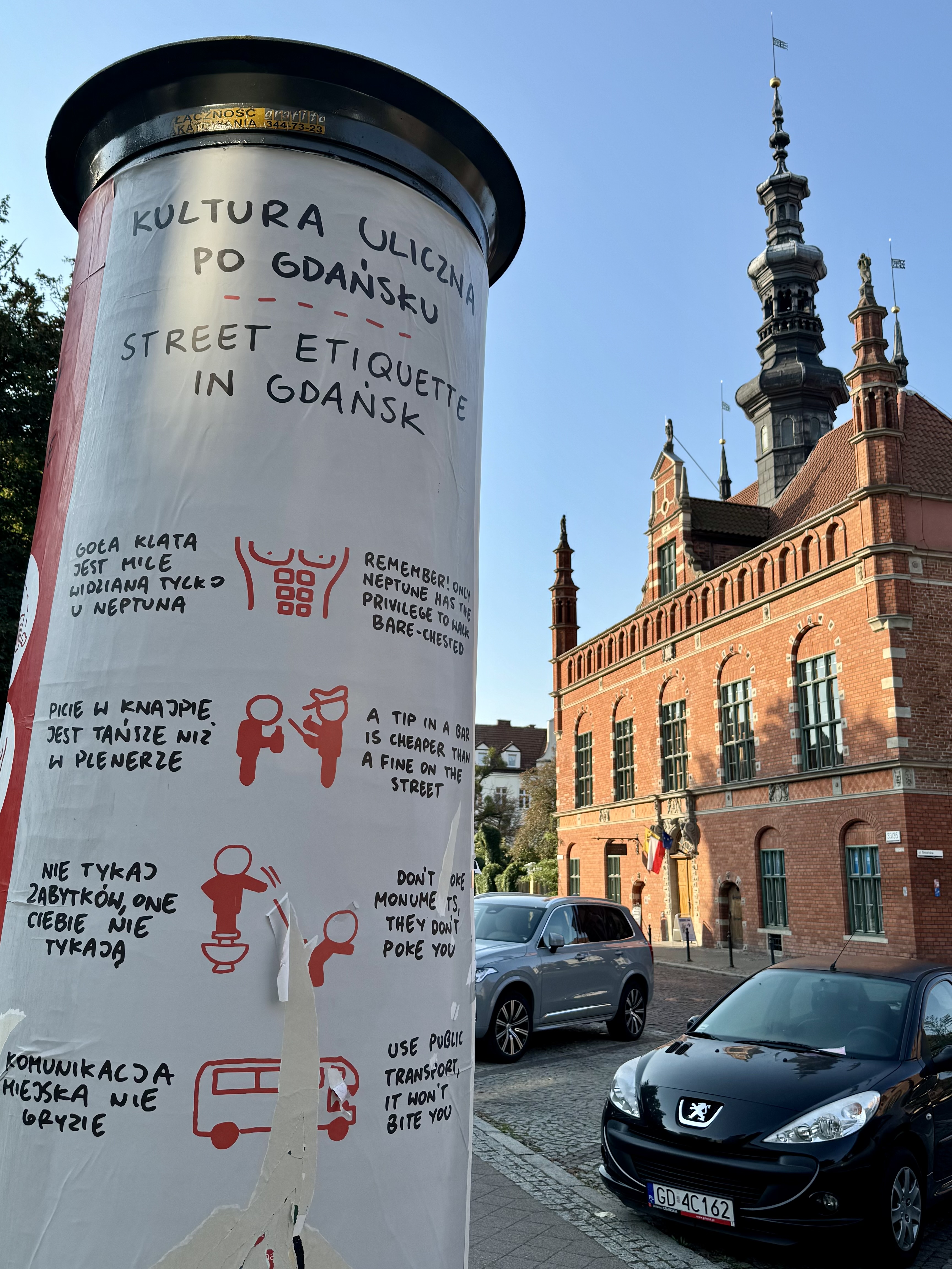
Although "Street Etiquette in Gdańsk" reminds visitors that "Only Neptune has the privilege to walk bare-chested," it says nothing about leaving locks behind on bridges.


We hit the Hala Targowa Market just as it was opening.


People line up early for their kielbasa.


The Royal Chapel sits near the spot where four historic quarters of old city (Wide, High, Fish and Ship) met, now marked by a fountain.


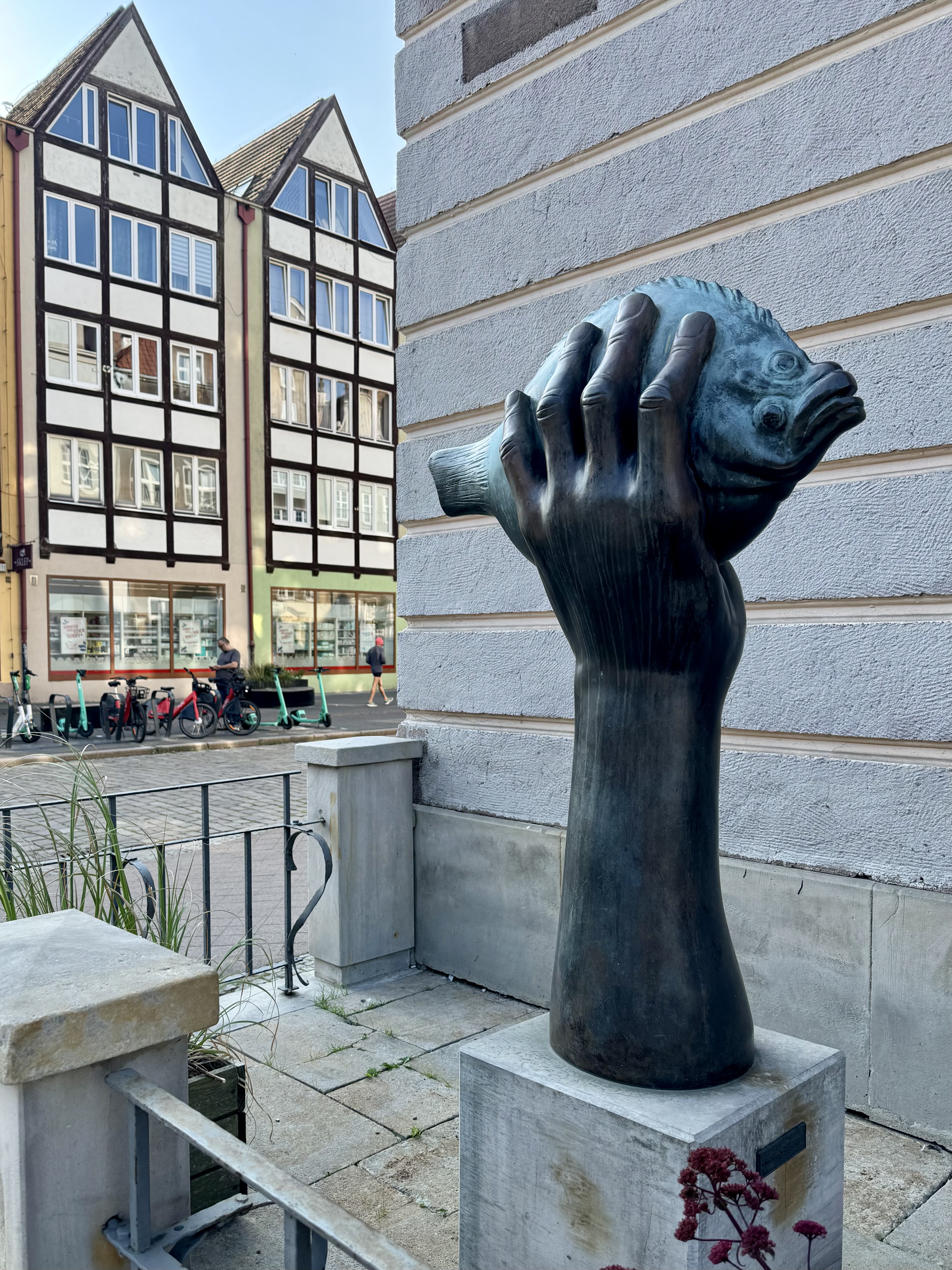
I'm guessing this sculpture identifies the Fish quarter.

Thursday, September 5, 2024

Baltic Jewel

You couldn't ask for a lovelier welcome to Poland than strolling around Gdańsk on a warm afternoon in early September.  We started with the Great Mill built by the Teutonic Knights in the mid-14th century.  It now houses the Amber Museum but for a couple of centuries the water mill ground more than 200 pounds of flour a day.


The Great Mill by P. Willer (1687)
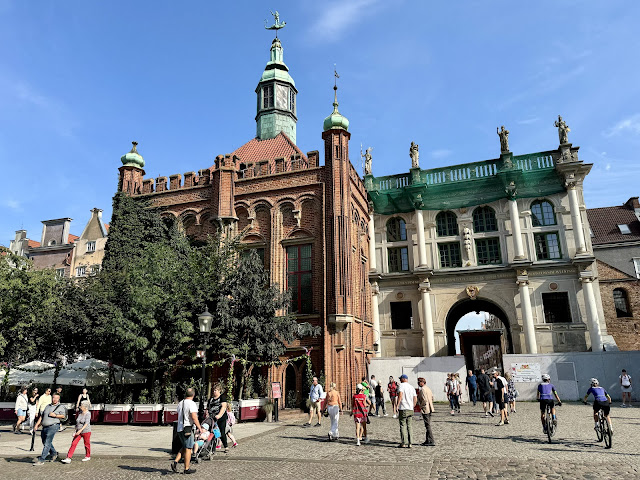
A walking tour recommended by the Lonely Planet began at the Upland Gate, through which Polish kings once entered the fortified city.


Allied and Soviet air raids left most of Gdańsk's landmarks in pieces after World War II.  The nearby Torture Museum & Prison Tower displayed a lot of random architectural motifs. 


When I told Florian, who's German, that I was going to Gdańsk, he reminded me that it used to be called Danzig and that it would be third city in the Hanseatic League I had visited, including Hamburg and Lubeck.  Think of the League as a Middle Ages sneak peek at globalization:  members embraced free trade in northern Europe for nearly three centuries, much of it before the discovery of America.  

Christine posed in front of the Millennial Tree, created in 1997 to celebrate the city's one-thousandth birthday.  That's a lot of history, much of it in dispute.  After Napoleon established it as a free city-state in 1807, Poland, Germany and the USSR have all claimed ownership.


The pretty reconstruction reminded me a lot of Dresden.


Great Armory
Main Town Hall
Artus Court & Neptune's Fountain
Mariacka Street
 
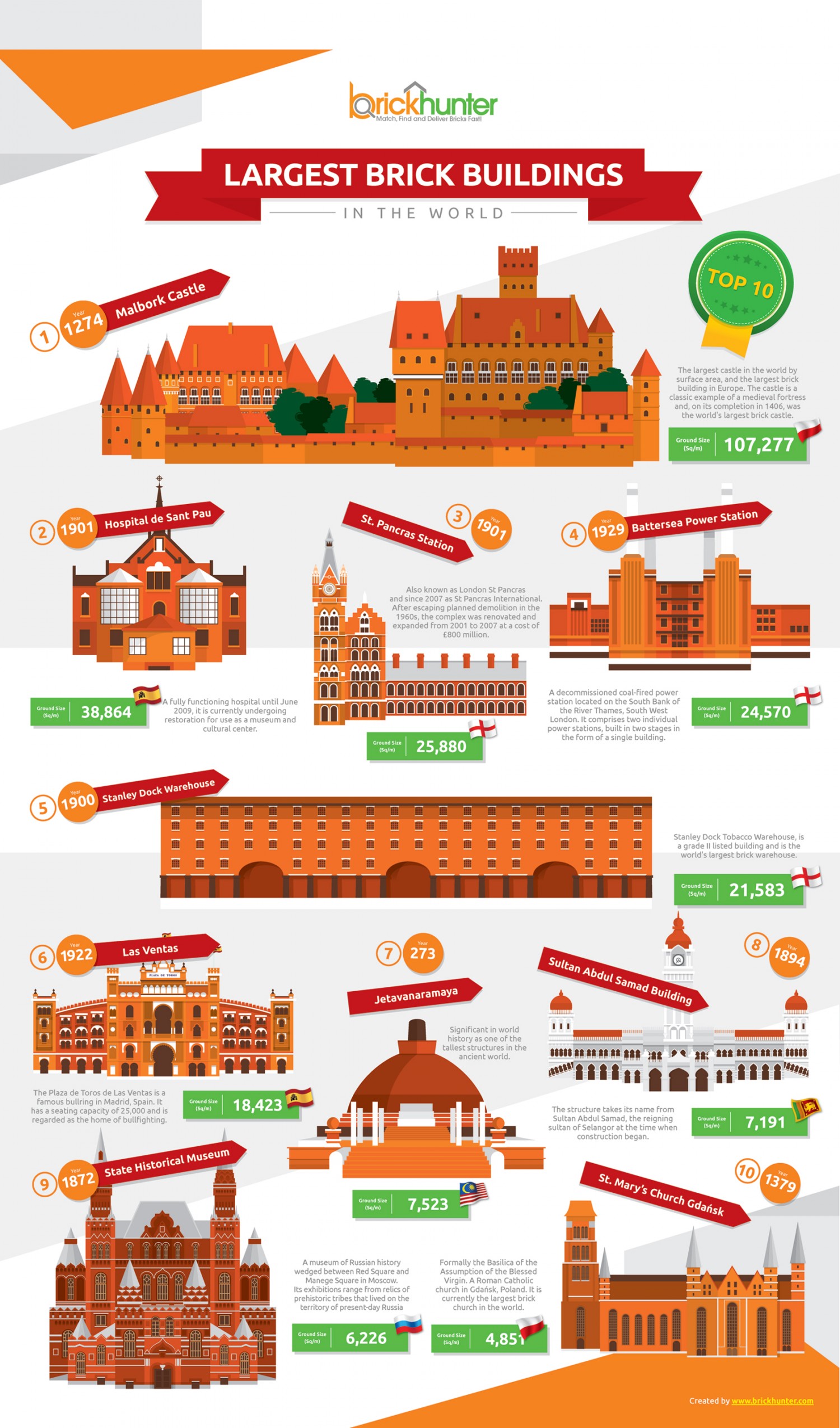
Somehow I forget to get a good photo of the Basilica of St. Mary's, the world's largest brick church.  Chalk it up to jet lag!

 
The ungepatchke interior combines traditional and modern elements.


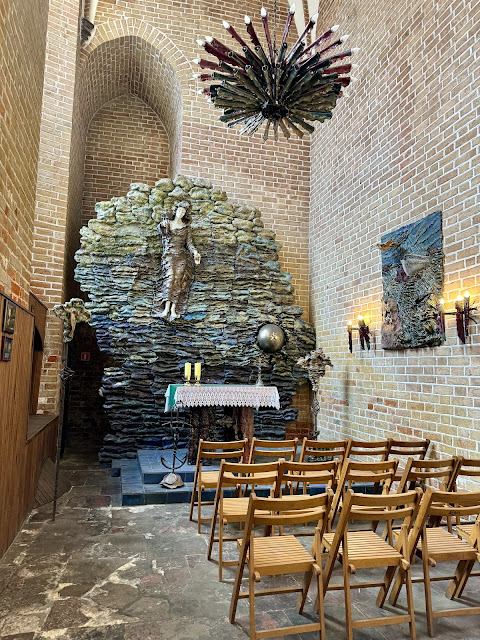
This memorial honors nearly 3,000 Polish priests who lost their lives during the German occupation in World War II.

 
I left Christine behind to climb to the top of the bell tower. 

 
You couldn't beat the wraparound views, almost to the Baltic Sea.


I thought 409 steps from top to bottom would give me bragging rights until I met a woman who had done it in heels!


More Poland


Gdansk:


Kraków:


Warsaw

Wednesday, September 4, 2024

Back To School

On the first day of the 2024 fall semester, pro-Palestinian demonstrators marched outside the gated entrance to Columbia at Broadway and 116th Street.  The university's first female president is long gone.


Columbia ID is required to enter the campus.  It's unclear how many of the demonstrators are students.  Many were masked, unlikely for health reasons.  Anonymity really enhances the courage of your convictions, don't you think?


Media commandeered an island across the street to fan the flames of the controversy over the Israeli response to a terrorist attack by Hamas that shows no sign of ending after nearly a year and thousands of lives lost on both sides.  Meanwhile, the campus itself was bustling with new students going to class and socializing with new friends on the lawns.


By the next afternoon, the demonstrators and the cameras had vanished.  Does this look like a campus in turmoil to you?


Monday, September 2, 2024

On Earth We're Briefly Gorgeous (4*)


My mind is too linear to appreciate poetry although I did once attempt to memorize the first section of The Waste Land because I found the language of T.S. Eliot so achingly beautiful. Which turns out to be a pretty good description of On Earth We're Briefly Gorgeous the remarkably generous coming-of-age novel by Ocean Vuong.

I am thinking of beauty again, how some things are hunted because we have deemed them beautiful. If, relative to the history of our planet, an individual life is so short, a blink of an eye, as they say, then to be gorgeous, even from the day you’re born to the day you die, is to be gorgeous only briefly . . . To be gorgeous, you must first be seen, but to be seen allows you to be hunted.

Despite good reviews, I'd avoided the book because I thought it would be too poetic until Gus Dapperton, of all people, introduced Chiffon to Vuong in "Sunrise" with lyrics that definitely bore repetition against a tear-inducing sonic back drop.

Here, on the edge of memory
When you are free only for the length of your name held in my mouth
And the dawn coming off the windows turns our hands blood-red
And we are children again
Running heart-first towards the end of laughter

And yes, Vuong adorns On Earth with jewel-like phrases (needles clicking down like the hands of smashed watches) but he's also telling two tragic love stories in this clearly autobiographical novel.  It takes the diffuse and meandering form of a letter the protagonist, Little Dog, is writing to Rose his deeply scarred mother (“Everything good is somewhere else, baby. I’m telling you. Everything.”). This is the second immigrant mama's boy book I've read recently, and Hombrecito suffers mightily in comparison because Vuong betrays little if any of that author's narcissism.  He vividly renders the horrors of his grandmother's life in war-torn Viet Nam but he also treats the American soldier who becomes his grandfather with both kindness and understanding.

Trevor, the first person who "sees" him, anchors the second love story.

I was seen—I who had seldom been seen by anyone. I who was taught, by you [his mother], to be invisible in order to be safe, who, in elementary school, was sent to the fifteen-minute time-out in the corner only to be found two hours later, when everyone was long gone and Mrs. Harding, eating lunch at her desk, peered over her macaroni salad and gasped. “My god! My god, I forgot you were still here! What are you still doing here?”

The setting for Trevor's and Little Dog's mutual exploration of their burgeoning sexual orientation--an unlikely tobacco field just outside of Hartford, Connecticut--enables Vuong to do for Latino farmworkers and white trash (He was only nine but had already mastered the dialect of damaged American fathers), what he also does for his Vietnamese forbears: to see THEM, as well as the mostly bleak, working class environment they share.  His mother hits the jackpot in the chemically toxic nail salon where she's practically enslaved when an elderly woman tips her a Benjamin after Rose successfully mimes massaging her phantom limb.

Particularly fond of animal metaphors (monkeys, Monarch butterflies, buffaloes and veal calves) to convey the near hopelessness of the life Little Dog eventually escapes, Vuong wanders a little too far from narrative at times.  That said, he still leaves readers with an intense appreciation for his resilience in the face of the severe trauma--both historical and personal--experienced by a sensitive and extraordinarily observant gay child of the Vietnamese diaspora.

Oh, and Vuong also writes as well as anyone I've ever read about gay sex, unflinchingly.

After he came, when he tried to hold me, his lips on my shoulder, I pushed him away, pulled my boxers on, and went to rinse my mouth.

Sometimes being offered tenderness feels like the very proof that you’ve been ruined.