Saturday, June 21, 2025

Summer Solstice

Fifty years ago last month, Tom and I graduated from college.  Although camera-shy Audrey is younger than both of us, she earned her B.A. three months earlier at Barnard.


Who better to spend the summer solstice with at their beautifully landscaped home in North Andover, MA?  Time doesn't go by quite so fast on the longest day of the year.


Zoltan, their son, was with us in spirit.  That's his childhood dino on the front step.  It occupied the same pride of place in Bernardsville, NJ, where he and Magda mostly grew up.


Tom spends a lot of time skimming the pool, especially when it's windy.  The water temperature hovered at a delightful 80 degrees, still cool enough to be refreshing.  Audrey gardens, a massive job.


I took a walk before the rest of gang arrived on Saturday.  The well-preserved Parson Barnard House was built in 1715.


It's located on Osgood Street, a name familiar from my quick tour of the Second Burial Ground.  


Zoltan had taken me to the First Burial Ground, a Revolutionary War cemetery, two years ago.


If you've ever caroled "O Little Town of Bethlehem," you've got Phillips Brooks, an Episcopal clergyman, to thank.  He towers above the town common.


Walking really helped me appreciate the beauty of the neighborhood.  Flowers bloomed everywhere.  


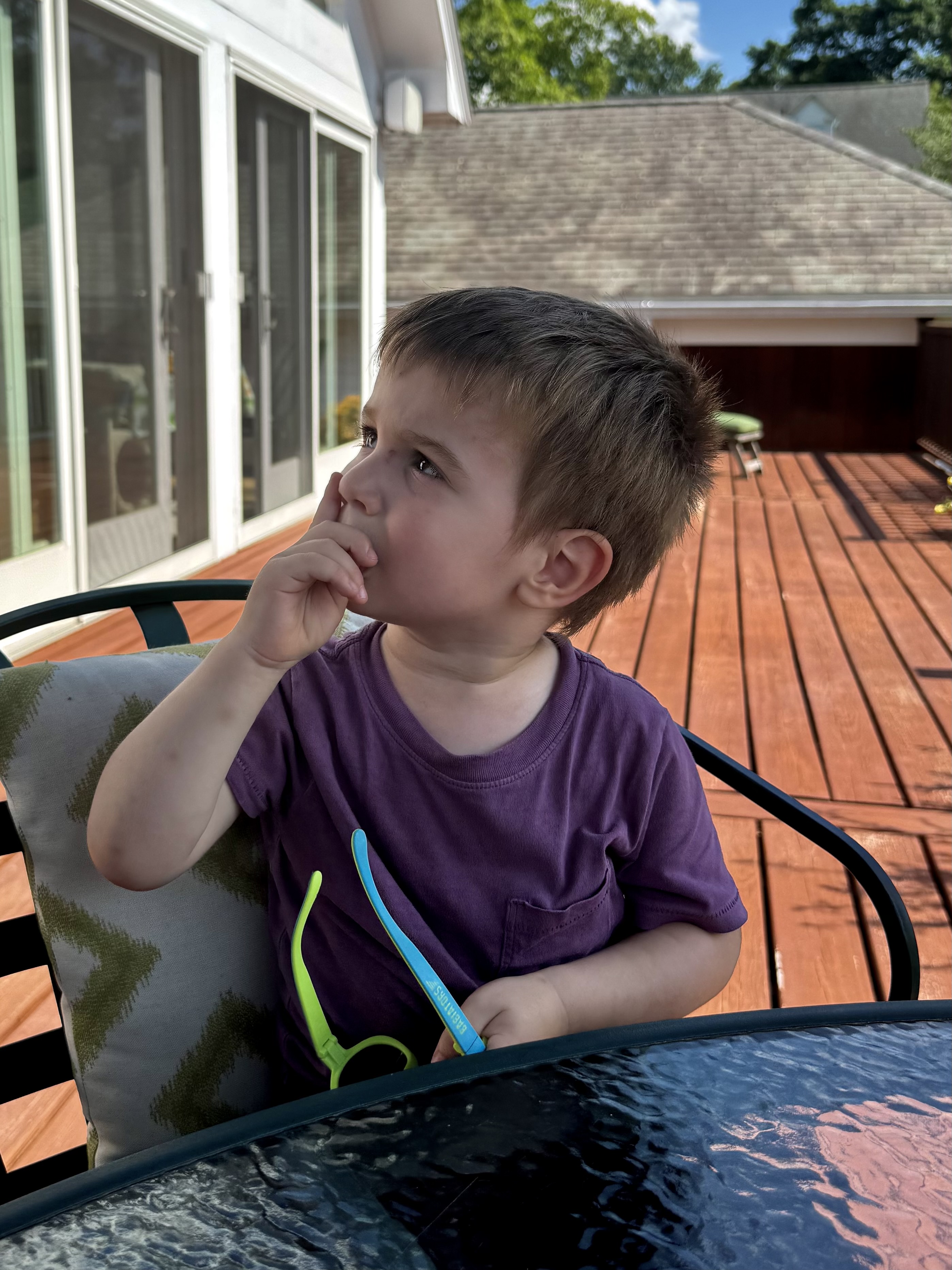
Magda, Joe and the D-Kids blew in like hurricane for their first pool day of the season.


Joe hit forty last year.  Magda still has 15 months before she reaches that milestone.  It appears she finally has left tanning behind.


Dagny turned seven earlier this month.

 
Della will be five in July


. . . and Desmond two the same month.


Magda dove into the pool with élan.


Della needed some coaxing from Audrey to jump.


Dagny did not.  She's loving an after-school swimming program at the Boys and Girls Club in Boston.


Meanwhile, the men of the Lazar family conformed to type.  Joe prepped the spic 'n span gas grill with some help from an IPA


 . . Desi adopted a wait-and-see attitude


. . . and Moofy loafed.  It turns out we share a prescription for meloxicam.


Audrey makes sure the D-Girls have a full complement of art supplies.  Della solved the Hermes Mystery at the Grooms' in between poking me with her pencil.


Dagny used her art work as a sun shield.


Apparently, Della shares her little brother's fascination with trucks.


Dagny loves decorating her Crocs.  Would you believe it costs $20 to plug up ten of those holes?


Before the day was done, I was back in Manhattan, dreading the forecast heatwave.  The days start getting shorter tomorrow.

Wednesday, June 18, 2025

Brief Encounter

Recovering from partial knee replacement surgery in April kept this snowbird later in Florida than usual.  I only had six weeks of spring in Manhattan.  It kicked off with a rush look at the not-quite-finished Harlem Oval followed by a visit to the New York Historical Society which seems to be emphasizing its art collection.

"In Appropriate #1" by Frank Buffalo Hyde (Onondaga/Nez Perce) (partial, 2013)
En route to Smash, I made the acquaintance of controversial black woman in Times Square

"Grounded in the Stars" by Thomas J. Price
. . . and marveled how Carrie has gone from the sides of buses in Sex and the City to giant billboards for the almost unwatchable reboot.  The show I sat that afternoon, however, was a hoot!  And just like that, Dead Outlaw closed after the Tony's, as did Smash.  Never in a million years would I have picked Maybe Happy Ending for "Best Musical," as if I needed yet another reminder the culture is no longer about me.


I had a hard time sitting through Floyd Collins at Lincoln Center and not only because of my worst knee pain since surgery.  Old Broadway houses have much more spacious seating than the cramped Vivian Beaumont.


It looks like there will be some hot summer nights under the giant disco ball above the plaza in front of the Metropolitan Opera.  But you'll be dancing silently with headphones so as not to disturb the neighbors.


En route to the dermatologist I checked out a Robert Motherwell exhibit at the New York Public Library.  The building at Fifth Avenue & 42nd Street attracts a much bigger crowd than it once did, perhaps because of the many and varied "Treasures" on display.

"Hermitage" (1975)
Cool, rainy weather meant not as much post-walk reading in the Ramble where wooden bridges were casting long shadows.

Gallery hopping took me from Chelsea to Lower Manhattan one afternoon.  Hudson Yards has utterly changed the midtown city scape

. . . although glorious and mundane structures of the past remain, repurposed


. . . or not.


I did a double take, too, for two reasons 1) the cheeky Pride month advertising at this weed store and 2) my first sighting of a legitimate bricks & mortar dealer.  Look for the green sticker with the QR code near the entrance to ensure proper licensing.  There's even one in my neighborhood, which will mean the end of infrequent importation of my chocolate edibles from Massachusetts.


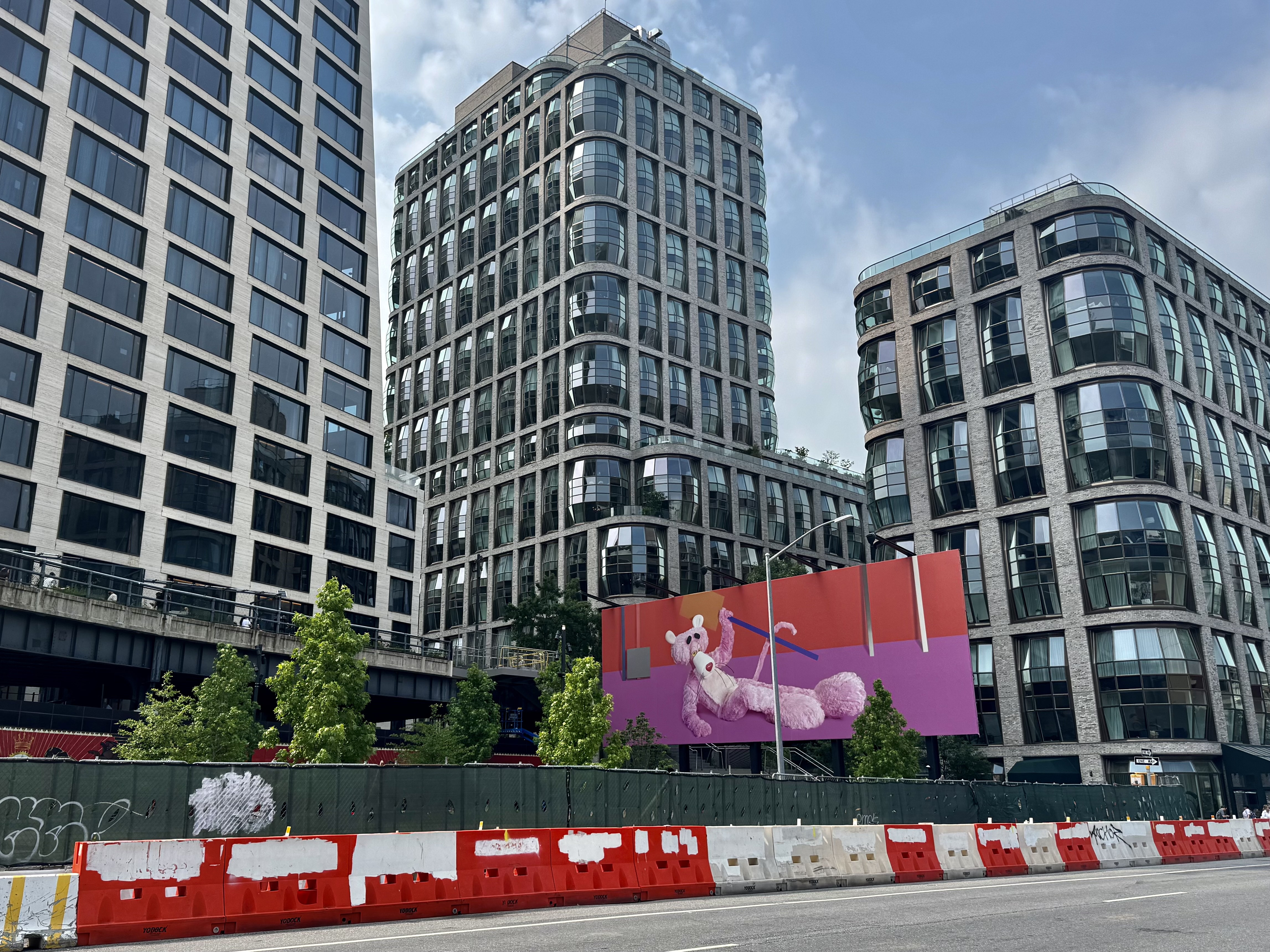
"Soft Power," the new High Line billboard, made my day, especially when I discovered that Alex Da Corte thinks the old Pink Panther embodies the new queer freedom, now under threat.   I've loved his work at the Met and the Whitney, too.


Scenes from the Village.


Weather permitting, the hippos can watch me do my physical therapy exercises on a nearby bench, with bees buzzing the hydrangeas above my head.  If not as convenient as my PT corner at the Folly, it's a lot more scenic.


Meanwhile, some friends had taken to the streets of New London to demonstrate against our nation's goose-step march towards monarchy.  I wish only that Randy's creativity hadn't forever tainted my only junk food, no matter how accurate the hair color comparison.  Will I ever be able to eat a Cheeto again without gagging?  And please note he's wearing a t-shirt that protests against the chaos agent's first administration.


Friday, June 13, 2025

Gallery Hopper Redux

Most of the gallery shows I had marked on my calendar while in Florida were about to close, so I saw four in a two-day period.  I saved the best--recent work by Salman Toor, whom I first encountered at the Whitney last fall--for last. 

"Ash Blonde" by Salman Toor (2024) 

The Human Situation


An April obituary for Marcia Marcus in the Times put the overlooked artist on my radar for the first time.  Lévy Gorvy Dayan cannily mounted a group show of her work with one of my favorite painters.  Quotes from the three women whose work is primarily represented greet visitors outside.

Self-Portrait (1979)
Figurative artists like Marcus, who was 97 when she died, didn't get a lot of love in her lifetime.  All I ask is that people look.

"Family II" (1970)
Just ask Alice Neel!  I paint my time using people as evidence.

"June" (1955)
She painted this provocative portrait more than 20 years before Demi Moore appeared on the cover of Vanity Fair in the same condition.

"Pregnant Nude" (1969)
"June Blum" (1972)
I wasn't familiar with Sylvia Sleigh, either.  A painting is a personal relationship.

"Legend:  Elaine Shipman" by Sylvia Sleigh (1974)
Of the three artists, Sleigh's work seems to be most powered by feminism.  Born in Wales a decade earlier than Marcus, she became a naturalized American and lived almost as long. Here, she paints a women's art collective. She's standing in the rear, second from the left. Imagine a man fading into the background!

"A.I.R. Group Portrait" by Sylvia Sleigh (1977-78)

Drift: Coming Home


Isaac White, who goes by "Drift," risked his life to take these extraordinary photographs exhibited at the Robert Mann Gallery where he was arrested and handcuffed the night the show opened.  It wasn't the first time.   Not-quite-as-brave NYPD officers used these background shots of the Empire State Building as evidence that he had trespassed.

"Don't Fear The Reaper" (2023)
Perfect Timing (2023)
Wright served his country for six years in the Army Special Forces.  He returned from a tour of duty in the Middle East with PTSD (if not vertigo!). 

"After the Storm" (2021)
Medical research supports his contention that his hobby is therapeutic. It certainly inspires awe.

"Foreshadowing" (2022)

Wish Maker


Salman Toor, a Pakistani artist, must be painting as fast as he can.  His recent, moody work fills two Luhring Augustine Galleries, with oil paintings in Chelsea and charcoal sketches in Tribeca. His homosexuality is evident in both, although more penises are visible in the latter.
 
"Skinny Boy" (2025)
You almost can hear a Grindr ping in this one.

"The Scroller" (2025)
"Cross Street" (2025)
"Daddy" (2024)
"Beach" (2023)

Wednesday, June 11, 2025

Sly Stone (1943-2025)


Let me tell you, Chiffon--the DJ name I eventually adopted--was NOT a funky teen.  My musical taste didn't get much blacker than The Supremes and The 5th Dimension until I heard "Dance to the Music" on the car radio in 1967.  Sly and the Family Stone followed up in rapid succession with a series of infectious, utterly original singles I'm pretty sure even my Sinatra-loving parents didn't dislike.

The group's appearance on the Ed Sullivan Show, a year later, sealed the deal.  At the time, I'm not sure I could have put a finger on why their joyous performance resonated so much beyond the catchiness of the music but I realize now, more than 50 years later, that it completely captured the best of Sixties youth culture in America with its mostly unheralded mix of black, white, male and female people grooving together, quite a contrast to what Walter Cronkite had been reporting on the CBS Evening News. For this epiphany, I have to thank Questlove, whose two recent documentaries, Summer of Soul and Sly Lives: The Burden of Black Genius, have been a most welcome resurrection of a man whose greatest hits collection was one of the first CDs I ever bought, back in the early 1980s.

Of course, Sly's drug use undid him, or at least propelled him into near obscurity in comparison to his heyday.  When I saw him sing "I Want To Take You Higher" in Michael Wadleigh's brilliant Woodstock documentary--literally the "high" point of the three-hour film--it (and the triple album soundtrack I added to my record collection) whet my appetite to try weed as much as anything else, although Sly's frenetic moves were more characteristic of a powdered substance that brought down a lot of white musicians, too.  Woodstock played at El Paso's Northgate Theater, where my mother and I had earlier seen "roadshow" performances of My Fair Lady and Hello, Dolly! which required advance tickets. I left for college a year later and smoked my first joint with Tom, another marijuana virgin, although by then, The Who, Led Zeppelin and Traffic provided our musical accompaniment.

Flash forward a decade:  I'm spending my lunch hour in the Periodical Room of the New York Public Library, where I worked at the time, catching up on the latest magazines.  An Esquire profile of Doris Day--who later became my female role model in the Pines--rumored that she and Sly had been an item.  It blew my mind but also explained what may have been a subconscious part of his early--and then verboten-- appeal: sexual attraction.  I mean just get a load of him in that crazy fringed vest and gold chains on the Sullivan show. 

Boom shakalaka indeed!


Saturday, June 7, 2025

Creation Lake (5*)


Just because Rachel Kushner leaves me feeling intellectually challenged doesn't mean I don't thoroughly enjoy her elucidation of various unexpected and unfamiliar topics.  These would include anthropology, French history and Polynesian navigation in Creation Lake, a peculiar but utterly compelling novel about a commune of left-wing activists trying to prevent the engineering of a mega basin.  Corporate interests want to irrigate factory-farmed corn crops in a rural area of southwestern France that Kushner dubs the Guyenne, displacing both the people and the cows that have populated it for centuries.

Sadie, the novel's clear-eyed narrator, comes off at first blush (although she never would blush) like a stone-cold bitch once employed by the American government to entrap domestic terrorists, collateral damage be damned.  I employ the sexist slur purposefully because Kushner's feminist agenda quickly emerges:  if a man were to use seduction unsuccessfully in service of his undercover work, surely he wouldn't be judged as harshly as this reader judged Sadie.  She views both men and the world through an occasionally comic but always withering lens:

It’s the same, whether you’re in a relationship with a man or pretending to be in one. They want you to listen when they tell you about their precious youth. And if they are my age, which Lucien is—we are both thirty-four—their younger boyhood, the innocent years, are the 1980s, and their teendom, the goodbye to innocence, is the 1990s, and whether in Europe or the US, it’s similar music and more or less the same movies that they want to trot out and reminisce over, from an era I personally consider culturally stagnant . . . With Lucien and boys like him—who will forever remain mere boys—there is no war nor suffering nor valor. There is only some bland girl, some banal pop song, a romantic comedy, an August vacation.

At the same time, Sadie also has breast implants because they serve her well as a tool of her trade.  She contains multitudes.

But the novel has a much bigger theme on its mind:  evolution, which of course encompasses the establishment and dominance of the patriarchy that women continue to confront on a daily basis.  Using her gender and her Americanness, Sadie easily infiltrates the commune, which calls itself Le Moulin.  While seeking evidence of destructive tactics, she hacks into their continuing e-mail correspondence with Bruno Lacombe, the rag-tag group's charismatic mentor.  By the end of the book, Sadie has fallen under his spectral spell, or to use one of Kushner's guiding metaphors, he has become her "north star" with knowledge he himself has acquired in the utter darkness of the same network of caves where early man once drew.  However, she does not let her increasing fascination get in the way of executing her murderous assignment, although another American does, with a contemptuous hubris that recalls Harvey Weinstein.

Bruno's guru-like appeal is evident early on in a discussion of his post-World War II childhood when, displaced from his family, members of the Resistance who have been killed by the Nazis, he is thrilled to discover the helmet and body of a dead German soldier, from which the adolescent boy catches lice, a tiny metaphor that carries well more than their combined body weight throughout the novel.  He describes this incident as a "screen memory."

I regard my childhood encounter with this enemy helmet, he said, as a stutter or shift in the axis of my existence, one that has been critical to who I am, and to what I have come to believe.

It reminded me very much of the importance I attribute to visiting a Holocaust museum in Paris with my father when I was a little younger than Bruno, although upon further elaboration a screen memory turns out to be something quite different.  Bruno explains that it actually "screens" the emotions he tamped down about the traumatic loss of his family, leaving me to question exactly what was behind mine.  Perhaps my mother's repeated hospitalizations which forced us to leave France, a place I loved. 

There's also an enjoyably "meta" aspect to Creation Lake which regularly sent me to Wikipedia to determine how much, if anything that Bruno writes about, is based in reality. Some is, some isn't.  Guy Debord, a Marxist radical and Bruno's nemesis, exists; Boris Nevsky, a Soviet anthropologist does not.  Although Kushner's description of the Cagots, a persecuted minority in France whose origins date back to 1000 BC, is accurate, she embellishes their history with mass public beheadings to give her narrative an added class frisson.  

It's almost as if Kushner is explicitly acknowledging the parallel between what both she and Sadie do extraordinarily well:  make-up shit that gets you where you need to go.

Sadie finds peace; Kushner landed on the short list for the Booker Prize.  Well-done wimmin!

Wednesday, June 4, 2025

Floyd Collins (3*)


Star power overcame any reluctance I had about going to a musical with a score by Adam Guettel, despite his lineage and success which at least must be partially attributed to nepotism.  A walk to the Vivian Beaumont listening to the original cast recording of Floyd Collins suggested my eagerness to see Jeremy Jordan, mostly immobile in dirty overalls but in pristine voice, had been a mistake.  Not a single song came closing to hooking me, although I reminded myself that I hadn't been a fan of Pacific Overtures, my first Sondheim musical, either.  Maybe I'll grow to love "How Glory Goes," or at least tolerate the vocalizing intended to evoke a cave's echoing but I doubt it.

What is it about celebrating old exploited white guys this season on Broadway?  Like Dead Outlaw (vastly more entertaining!), Floyd Collins, also an actual historical figure from the early 20th century, becomes famous for the tragedy that befalls him. Trapped in a cave for two weeks, he becomes a household name thanks to an interview with an intrepid newspaper reporter. The story, eventually broadcast all over the nation by the emergence of radio, lures thousands of Americans to congregate at the site in Kentucky, nearly fulfilling his dream in a final cruel irony.  Only the kidnapping of the Lindbergh baby got more ghoulish traction in the press.

But nothing--not a well constructed-book fleshed out with some believable social and family dynamics and superb direction (both by Tina Landau) or terrific performances (especially by the menschy Taylor Trensch as the cub reporter), not even a blindingly white number in heaven that frees Jordan from his chaise lounge--can save this tuneless show from becoming an ever-so-respectable snooze fest.  


Sunday, June 1, 2025

Dead Outlaw (4*)


Trust me, you've never seen anything quite like Dead Outlaw: a lively musical about a desiccated corpse based on a story that brings to mind a Grateful Dead lyric:  what a long strange strip it's been.

Thanks to the preservative properties of arsenic, Elmer Curdy, a hapless train robber dead by the age of thirty, had a busy afterlife with spells of hibernation that lasted long enough to take him from pay-per-view in an unpaid funeral parlor to a carnival sideshow, a cross country marathon promoting Route 66 and Hollywood.  Only after his arm broke off in a California amusement park did he finally find concrete-clad peace in the Oklahoma town where a posse had killed him--wait for it--66 years earlier!

Now, half a century later, Curdy, as embodied by the even-more-scary-alive-than-dead Andrew Durand, is still selling tickets, this time to a slightly more genteel audience in a Tony-nominated production on Broadway. If he's a little hard to warm up to in the lively first half, he brings down the house without moving a muscle in the second.  Band leader Jeb Brown narrates the unbelievable tale with an occasional reassurance, and a small cast, including several rollicking juke joint musicians, fills a dozen different supporting roles with uniform excellence.  Appropriate period costume and simple, evocative set design complete the trifecta of perfect production.  As Thomas Noguchi, Thom Sesma transforms the former "coroner to the stars" (I vividly recall his autopsy reports on Sharon Tate and Natalie Wood) into a Las Vegas crooner whose macabrely funny eleventh hour number increases the already abundant eclecticism of the score and lyrics by David Yazbek and Erik Della Penna.

No show about a dead guy should be this exhilarating particularly one that may leave more sensitive audience members asking what form Elmer Curdy's relentless exploitation will take in the next century.  The sadly deceased, leaving no estate or heirs, already has more than paid his dues in two.