Saturday, August 24, 2024

Vermont Quilting Bee

Actually, it was a contest, with the entries on display at the Billings Farm & Museum in Woodstock.  This took first prize.

"Road Trip" by Linda Diak 

But it wasn't my favorite. If only this one had been for sale.

"Tea Boys" by Verdel Grohman
Nothing like curling up under a little campy homoeroticism every chilly night.


And I don't just mean the cowboys.


"The time of COVID was so sad and demoralizing," said this quilter.  "I needed to find some humor in it somewhere."

"Covid---Achoo!" by Sandra Dadik
Covid inspired other people to take up the craft for the first time.  "I was sick of watching TV, eating and drinking," explained the man who quilted these umbrellas, who also worked as a docent at the museum.  Although the project took him nearly a year, he said many quilters can finish one in a month with the proper set-up.

"Dancing Umbrellas" by Tom Bivins

Jane Austen, who quilted with her mother and sister more than two centuries ago, inspired this homage with a coverlet that combined dozens of diamond-shaped fabric scraps.

"Jane's Quilt" by Karyn Lord
Even warmer than the real thing!

New Yorker Cover by Priscilla Leng
October 18, 2021 Print Edition
"Becky-More Than a Pretty Face" by Maria E. Waite
"Fizzle" by Meryl Goldfarb
Embroidered udders and tails make every cow unique in this quilt.

"Till The Cows Come Home" (detail) by Shawn Gonyaw
I loves me a peace sign.

"Sunflowers" by Marion Seasholtz

More Vermont:

Billings Farm & Museum

Although Thom and I had visited the "other" Woodstock in 2021, we missed the Billings Farm & Museum.  Magda & Joe are members, so I thought it would be mostly for kids.  Not so.  I particularly enjoyed the museum, which uses painted barn quilts as an exterior decorative motif.

"At Sea" by Anna Pauly (2024)
Petting zoos appeal to adults, too, something every parent knows.  Me, not so much.


The well-tramped sunflower maze blazed with bright color against pristine blue skies.  In Ocean Vuong's remarkable novel, On Earth We're Briefly Gorgeous, one character loves another just because of the way he looks at the looming members of the daisy family which have grown as high as 30 feet!


An organic farmer whose grandmother picked cotton as a young girl for five years and whose grandfather grew tobacco explained that tobacco is a natural pesticide.  "That's why smokers don't get attacked as much by mosquitoes."  Don't tell Altria.


A series of dioramas illustrated the old, hard way of life in Vermont.  I complain about having to crack open ice trays.  Imagine having to cut massive blocks from frozen lakes and transporting them via horse and wagon to cities and towns in winter.

This workshop reminded me a lot of my father's two-car garage in El Paso, with pegboard substituting for the windows.

We'd already toured a sugar house but the Billings Museum had a more extensive collection of syrup buckets and steel taps.

Early home decoration. reading instruction and even picnics--called nooners for working men--recall simpler times.


Apparently, animals used treadmills a century earlier than most people (aside from prisoners, by whom they were employed as a form of slave labor). Goats, sheep and large dogs helped churn butter


. . . while horses provided emergency power for machines that usually operated on wind or water.  Think of them as neighing generators.

More Vermont:

Sunday, August 18, 2024

Nothing Special


Enigmatic isn't a quality I usually find appealing in fiction, but Nicole Flattery has wrapped it in a mesmerizing package:  the story of a young woman assigned to transcribe the speed-fueled raps of Factory denizens that Andy Warhol eventually released, reputedly unedited, as a, A Novel in 1968.

Nothing Special also happens to be one of the few books I've ever read which passes the Bechdel test with flying colors:  it knowingly examines the complexities of female friendship and chronicles the evolution of a fraught mother/daughter relationship over time.  Of course a man is at the center of the story but Warhol's exclusive focus on creation and indifference to individual suffering makes him seem more god-like than male.  Whether the author finds him repulsive or admirable remains open to interpretation.

Born two years after Warhol's death in 1987, Flattery convincingly re-creates the early days of the Factory, before it became a revolving door for mundane celebrities rather than Superstars.  Although Mae, a native New Yorker, and Shelley, a faux runaway from California,  are the "nothing special" teenage girls of the title, their typing skills provide a passport to the new, exciting world of the 60s, when America was finally letting loose.  

What brought you here?’ [Mae] asked.

‘I couldn’t use my abilities where I’m from.’

‘Typing?’

[Shelley] smiled. ‘And listening. There’s not a single thing to listen to where I grew up. The life I would have had if I stayed there, it really filled me with terror. It made me feel like a freak. That’s the only way I can put it. So here seemed like a good idea. Everyone is on my level here.’ 

It turns out not quite.  The glow of being at the very center of things diminishes the longer they stick around and the closer they get to the end of their assignment.  Mae and Shelley, who both aspire to be Edie Sedgwick on some level, lose their innocence, if not their front-row seats shortly before Valerie Solanas shoots Warhol in the abdomen, killing the Factory's openness vibe forever.

On the couch, there would still be one or two people left over from the night before, looking like they had been spat out of a giant mouth.

The times change, along with the young women, and forecast the kind of posing that Warhol recognized would become a fundamental characteristic of human nature in a media-saturated world.

It was in these boys’ looks and lifestyles that I really saw the effect of their influence on the city – the leather, the smirks, the quiet aggression, the amused and cynical attitudes. All of it was second-hand. It was a way of being Ondine without being Ondine. You didn’t have to actually be a maniac, you could just wear the clothes.

As someone who routinely fantasized during adolescence about becoming a Factory flunkey, I got a truly vicarious thrill from reading Flattery's meditation on femininity and fame but put the novel down with a queasy feeling.  Be careful what you wish for, even in retrospect. Being nothing special ain't such a bad thing.


Thursday, August 15, 2024

Cultivating Dreams

Osmegeos means twins in Portuguese.  It's also how a pair of identical twins from Sao Paolo brands their candy-colored artwork.  

"The Dream Traveler" (2023)
Born in 1974, the twins have been expressing themselves in drawing ever since.  Subway graffiti has been a big influence on their style.  Boom boxes and animals frequently appear in their work.

"There'll Be Music Today" (2023)
Otavio and Gustavo Pandolfo started out as break dancers. "Curating Dreams," an installation at the Lehman Maupin Gallery, causes instant nostalgia with the recreation of a record store.


Music--playing from an actual turntable--draws you inside to peruse the LPs that likely would have had you shaking your booty at a disco in the 70s.  Some of their covers have been customized.


Doesn't this look like an altar to feeling good?


I didn't get the names of all the paintings exhibited but they looked as home on a gallery wall in Chelsea as they would have on the IRT forty years ago.


"The Sun Meeting The Moon" (2023)


Their paintings aren't always static.


I love the embedded dogs.  They're guileless, kinda like Osmegeos.

Detail from painting directly above

Wednesday, August 14, 2024

Avant Garde Psychiatry or Art Therapy?

Francesc Tosquelles, who fled his native Catalonia during the Spanish Civil War, introduced a kind of holistic psychiatry at an asylum in Vichy France that broke down hierarchal barriers among the staff, patients and neighboring communities.  Everyone had to take turns cleaning the toilets.

The hospital where he practiced at Saint-Alban provided refuge for political prisoners as well as treatment for people mentally ill people. Tosquelles encouraged creative expression in both groups through what became known as "institutional psychotherapy."  

These portraits of patients by Léon Schwarz-Abrys were exhibited after the war in Paris but viewers had difficulty determining if the artist had been a patient or a prisoner because the latter often deliberately blurred the lines between the two for reasons of self-preservation.  

"Senile Dementia" (ca 1943-44)
"Paranoid" (ca 1943-44)
"Delusional Hallucinated" (ca 1943-44)
The work produced at Saint-Albans attracted the attention of Jean Dubuffet whose art brut movement valued rawness over training, the id over the super ego. An exhibition at the American Folk Art Museum noodles on the role that Tosquelles played in facilitating greater recognition for "outsider" art barely acknowledging that the Nazis were occupying France at the time.

Auguste Forestier emerged as a singular talent.  

"The Wolf and the Lamb" (ca 1914)
A farm boy obsessed with trains, he de-railed one by putting pebbles on the track.  The incident led to his confinement at Saint-Alban at the age of 27 where he remained for the rest of his life.  The hospital nurtured his early artistic talent by providing a safe haven. Forestier's wooden, toy-like sculptures earned the admiration of Pablo Picasso in addition to Dubuffet, who added Forestier's work to his growing art brut collection.


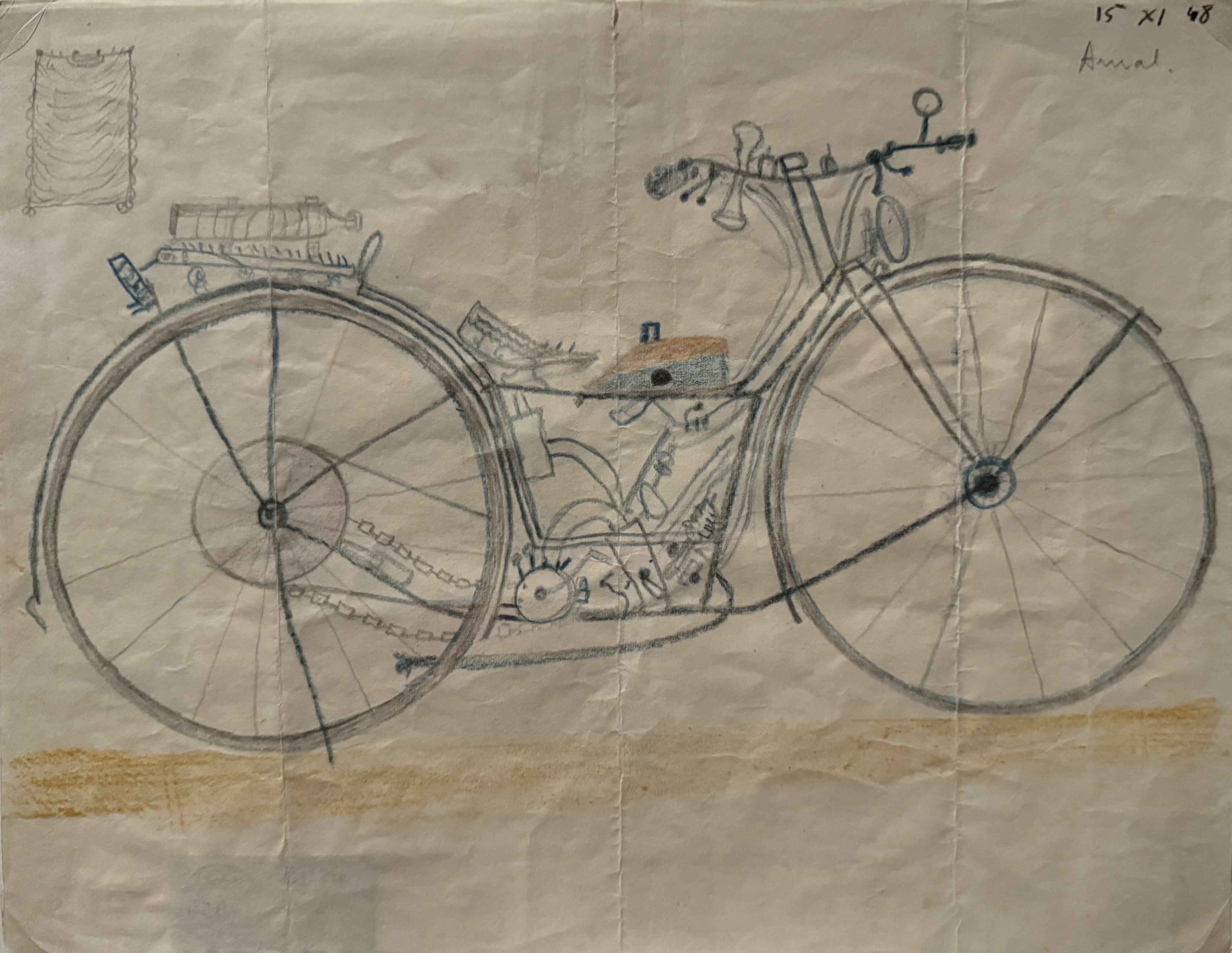
The exhibit includes works by patients from other psychiatric hospitals including a huge collage by Eugene Bedeaux, a former locomotive engineer.   Train obsession might even be considered an exhibition motif.  

"The Symbol of My Story, or Filiation of the Locomotive"  (detail, 1927-33)
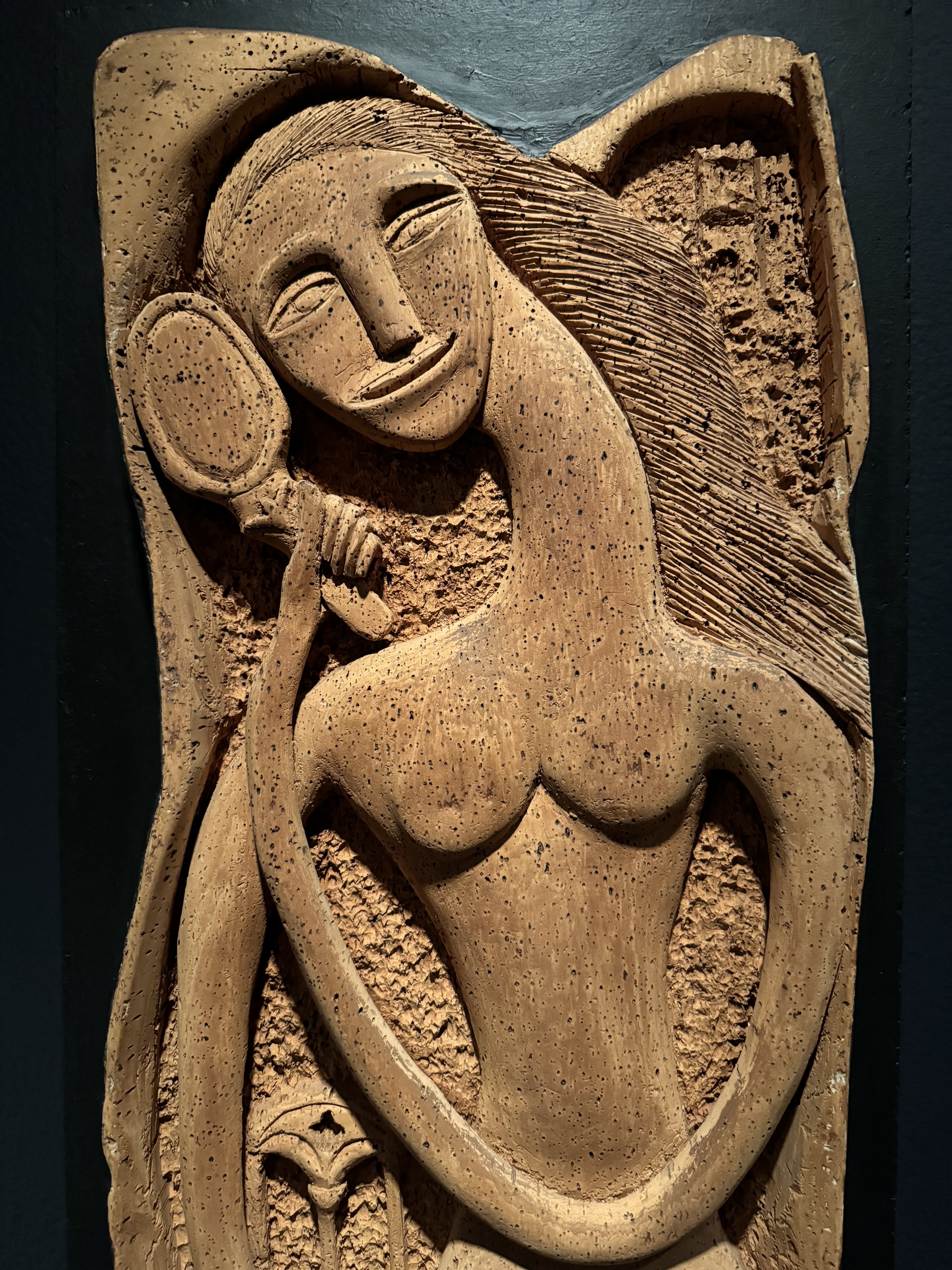
Other practitioners of institutional psychotherapy--who included Frantz Fanon--discussed with Dubuffet the idea that exiles or refugees might visualize their dislocation uniquely.  He recognized their insight when he discovered the haunting bas reliefs Joaquim Vincens Gironella carved to decorate the Parisian headquarters of his family's cork business.  Like Tosquelles, Gironella and his two brothers had been forced to leave Spain by the civil war.  


Dubuffet also used his own artistic talent to render individuals who created art brut in media other than painting and sculpture.  Antonin Artaud, institutionalized off and on for much of his life, introduced the world to the Theater of Cruelty.

Antonin Artaud with Tufts by Jean Dubuffet (1947)
Perhaps as a result of my ignorance of psychiatry's history, I found the exhibit--particularly the label text--heavy going.  Here's what the curators had to say about several scenes Benjamin Arneval drew from his childhood:  "Tosquelles's Saint-Alban colleague and later founder of La Borde clinic Dr. Jean Oury wrote an essay on Arneval and the latter's end-of-the-world cosmology. Oury was especially attentive to the emotional relationship that bound patients to their works. Preventing the separation of these works from the 'living whole' of the artist's immediate lifeworld was a task Oury considered 'an honest occupational therapy.'"   Huh?


The museum supplemented the traveling exhibit with works from its own collection, including a nightgown embroidered by a patient at Willard State Hospital.


My takeaway:  patients enjoy art therapy and some have styles distinctive enough to generate appreciation outside the institutions where they have been confined, particularly when their work is championed by others.