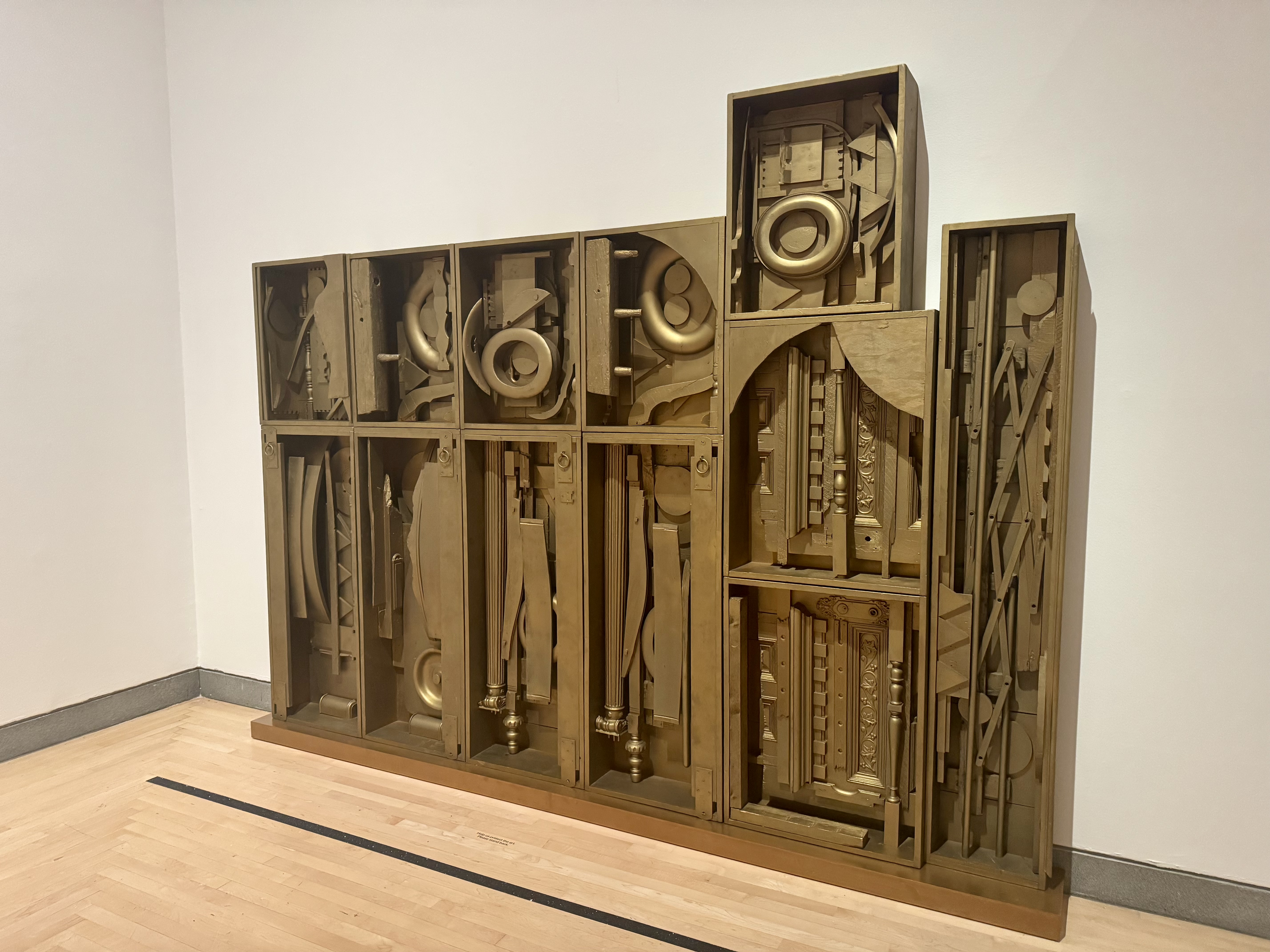
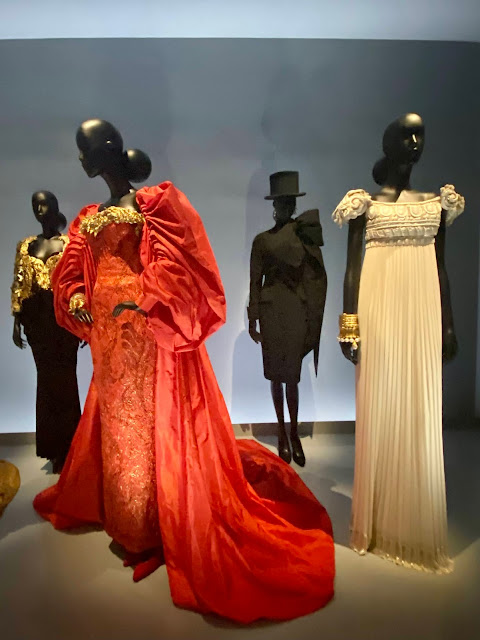
A title of a new exhibition at the Brooklyn Museum reminded me of a tacky variety show on TV during most of the 80s, but "Solid Gold" turned out to be a lot of fun.
Fashion dominates the show, probably no surprise given that Dior is a sponsor. But the curators have included other designers, too. Like this dress made for shakin'!
Fabric from Eames Collection by Anna Sui (detail, Fall/Winter 2007-8)
I can't say I spent a lot of time thinking about the organizing principle behind the items on display. The exhibit goes for the eye, not the brain, as demonstrated in this video which includes "Path To Nine" by Zadik Zadikan and "Gold Waves" by teamLab.
Mummy Portrait of a Man (partial, Egypt, ca 120-30)
More Dior dresses in a gallery called "Symmetry and Pattern" which evokes Versailles.
Silly me, I never knew that Henri Bendel designed dresses, not just sold them. His estate--which included more than 11,000 sketches by nearly 200 other designers--donated them to the Brooklyn Museum. "Solid Gold" features 45 of his own. It's unclear how many of them ever made it into production.
Catching up at the Met is always fun despite the summer crowds. This Surinamese immigrant, a model and musician who led bands in both Europe and America, couldn't be more dapper. It's my favorite work from The "Harlem Renaissance and Transatlantic Modernism" which includes a dozen artists unknown to me previously, a refrain that I sing more and more in these posts now that the museum world is finally making up for lost time and exhibiting works by marginalized groups, including women, far more frequently.
Louis Richard Drenthe/On The Terrace by Nola Hatterman (1930)
Howard University professor Alain Locke preached a simpatico gospel more than a century ago, urging African Americans to look to their own culture and past for edification and artistic inspiration.
Romare Bearden depicted an entire Harlem block in this remarkable painted collage.
"The Block" (detail, 1971)
The Costume Institute knows how to pack 'em in, that's for sure. Winding through a narrow white labyrinth, visitors to Sleeping Beauties: Reawakening Fashion sniff their way (yes, you read that right) through themed displays like this one for roses. Isaac Mizrahi is a more interesting dressmaker than memoirist, that's for sure.
"The Nightingale & the Rose" Necklace by Simon Costin (partial, 1989)
No swallows had to die to make this Alexander McQueen jacket and the Met's "Savage Beauty" exhibit didn't have to rely on olfactory tubes to draw enormous crowds.
This "Nautiloid" dress by Iris von Herpen from 2020 looked like no other.
Graffiti crudely scrawled by children on desks in the former Yugoslavia inspired "Abetare," the Met's Roof Garden Commission. Kosovar artist Petrit Halilaj lost not one but two homes in the regional war during the late 90s. The New Museum also has exhibited his work.
Petrit, who is gay, likened his childhood displacement to the feeling brought by the awakening of his sexual orientation.
The repetitive images he found in the graffiti--both artistic and expressive of pop culture (find Messi below)--brought him a sense of connection which he deftly conveys through his unusual and moving work, once you know his backstory.
But like all remarkable art, it can be appreciated simply for the joy it brings. I'm just surprised there aren't any penises!
An artist used tiny images of Marilyn Monroe to create the portrait above.
Dior established his eponymous brand in the 1940s but premature death prevented him from designing it for long. It's hard not to wonder what the man who revolutionized women's fashions with his "New Look" would make of some of the dresses sewn in his wake.
Dior, who created strong shapes and silhouettes after a fabric-starved World War II, once said "I have designed flower women."
Coco Chanel wasn't a fan. “Look how ridiculous these women are, wearing clothes by a man who doesn’t know women, never had one, and dreams of being one.” Meow!
I don't know, Audrey looked pretty good in this shot by Richard Avedon. Who knew Art Buchwald was such a bon vivant?
The exhibit devotes a gallery to fashion photography. Nobody shot clothes better than Avedon or Irving Penn.
To date, five designers have taken the reins at Dior. A very young Yves St. Laurent saved the house from financial ruin before France drafted him to fight in Algeria.
Yves St. Laurent (1957 - 1960)
Marc Bohan had the job the longest, nearly three decades. His early designs certainly reflect the 60s.
Maria Grazia Chiuri is the first woman to take the helm. A feminist who pals around with Judy Chicago whose art appears behind the dresses. The more I saw of her work, the more it grew on me. Maybe Coco had a point.
Maria Grazia Chiuri (2016 - present)
Another gallery evokes the House of Dior's love for 18th century glamor with gowns from all six designers.
Has there ever been a more cunning perfume bottle?
This panel evokes magazine nostalgia and the symbiotic relationship between fashion and commerce. I'm pretty sure I first became aware of Dior through Time or Life magazines. Carmel Snow at Harper's Bazaar coined the phrase "New Look." And advertiser Nieman Marcus was the first American department store to promote Dior by inviting him to Dallas to receive an award.
Each gallery seems more beautiful than the last.
Accessories get their own color-coordinated treatment.
There's even a mock atelier with mannequins in muslin climbing as high as a skyscraper in a mirrored gallery. Stunning!
But nothing quite prepares you for the Enchanted Garden which displays dozens of Dior's most prettiest "flowers" in an installation that will take your breath away. Stunning on steroids!
But wait. The exhibit isn't over yet. "Stars in Dior" matches up gowns with the celebrities who wore them on the red carpet.