Showing posts with label Holocaust. Show all posts

Saturday, July 11, 2026

This Storm Is What We Call Progress

Once you know Paul Klee was spoofing Il Duce--who already had consolidated his control over Italy--and the fascist fondness for erecting monuments in this work, it's hard not to flash on our fearless leader doing the same thing right now with his imperial building spree in the nation's capital.

"Monument in Progress" (1929)
Klee's arches, here equipped with humanizing feet, aren't as grand as Trump's and serve another purpose entirely: their diverse hues defy the conformity of the Nazi's Brownshirt color palette.

"Revolution of the Viaduct" (1937)
Despite his Christian heritage, the Nazis smeared the Swiss-born artist, who had taught at the Bauhaus for a decade, as a "Galician Jew," precipitating his return to his native country in 1933, the year Hitler came to power. 

Klee in his Bauhaus Studio (Weimar, Germany, 1924)
Trained as a musician, his mostly abstract work soon became a prime example of "degenerate art," as well as a chilling document of his final year in Germany when he created more than 500 paintings and drawings.  More than a few of their titles ring a contemporary bell.

"Outbreak of Fear" (1933)
Emigrating (1933)
After Klee returned to Switzerland, an autoimmune disease made it difficult for him to swallow, greatly reducing his productivity to just 25 works in 1936.  But as the situation in Europe worsened, Klee picked up the pace again with encouragement from Wassily Kandinsky, his former colleague at the Bauhaus, and Pablo Picasso.  This painting alludes to Hitler's infamous bombing of Guernica's civilians in northern Spain, which the latter artist depicted even more famously, if less colorfully.

"God of War" (1937)
Here, a drooling young member of the SS listens spellbound to Nazi propaganda on radio.  It might just as well be a podcast from the manosphere

"Voice from the Ether:
'And you will eat your fill!'" (1939)
. . . or fake news from another era.  As Johnny Rotten once sang, "anger is an energy." Klee finished more than 1,500 works in 1939, an annual record.  Most of the paintings and drawings on view in Paul Klee: Other Possible Worlds at the Jewish Museum are drawn from the late '30s, and have been little seen in the United States.  

"Oh! These Rumors!" (1939)
Klee's final burst of creativity included 29 angels, although they appear to be more avenging than guardian.

Angel Applicant (1939)
"Angelus Militans" (1940)
Thanks to Walter Benjamin, an early Klee angel became one of the artist's most iconic works.  The German Jewish philosopher bought "Angelus Novus" in 1921 and took the cherished print with him when, like Klee, he fled the Third Reich in 1933.  In his Theses on the Philosophy of History, Benjamin described "Angelus Novus" as 

looking as though he is about to move away from something he is fixedly contemplating. His eyes are staring, his mouth is open, his wings are spread. This is how one pictures the Angel of History. His face is turned toward the past. Where we perceive a chain of events, he sees one single catastrophe that keeps piling wreckage upon wreckage and hurls it in front of his feet. The angel would like to stay, awaken the dead, and make whole what has been smashed. But a storm is blowing from Paradise; it has got caught in his wings with such violence that the angel can no longer close them. The storm irresistibly propels him into the future to which his back is turned, while the pile of debris before him grows skyward. This storm is what we call progress.

Angelus Novus (1920)
In 1940, shortly after those words appeared in print, Benjamin committed suicide rather than face the likelihood of deportation to a concentration camp.  Klee had died three months earlier.  No doubt the forces of evil never looked more powerful to both men than in their final days. I know the feeling.

At the Jewish Museum, the Holocaust is always just around the corner, or maybe it just seems that way after a refresh of the works exhibited from the permanent collection.  By the time Alice Neel painted this protest organized by the Artist's Union to increase awareness of state-sanctioned anti-Semitic violence in Germany, both Klee and Benjamin already had scrammed.  Years after a critic blithely commented, "An interesting picture, but the sign is too obvious," Neel rebutted his myopic cluelessness:  "If they [the Roosevelt Administration] had noticed that sign, thousands of Jews might have been saved."

"Nazis Murder Jews" (1936)
Prior to dying in a Polish concentration camp at the age of 40, Czech artist Gertrud Kauders squirreled away the contents of her studio in the walls and ceiling of a friend's home not far from Prague.  Nearly 700 paintings and drawings were recovered during a 2018 renovation of the then abandoned property.  Her survivors donated her life's work to Jewish museums around the world, including this ahead-of-its-time homage to the female gaze painted sometime before 1939. 


This charm bracelet, fashioned in by a woman imprisoned in Theresienstadt, is a wonderful example of Jewish resilience as well as a quirky evocation of life in the camp.  Can you find the commode?


Israeli artist Mordecai Ardon studied architecture at the Bauhaus when Klee, a decade older, taught there.  He fled Germany in 1933, too, immigrating to Jerusalem when Palestine was under the administrative control of the British.  His work became more religious and figurative after the full horrors of the Holocaust became known.  This painting, which presumably references Berger-Belsen (where Anne Frank and her older sister died), is a collective portrait; according to exhibit label, "the number tattooed on the woman's forearm was assigned to multiple people in different camps."  I'm guessing that Ardon wasn't aware that the Nazis tattooed only prisoners at Auschwitz/Birkenau, something I learned for the first time after a visit in 2024

"Girl No. 109336" (1950)
(detail)
Reuven Rubin headed for Palestine even earlier than Ardon. The landscape probably reminded him of Old Testament stories he had heard in his native Romania, rendered here with hope and a modernist slant. Rubin eventually became Israel's first official representative to his former European homeland.

"Old Sycamore Trees" (1927)
Other galleries exhibit more contemporary works unrelated to the Holocaust, including a fascinating installation that juxtaposes Andy Warhol's work with two Jewish artists. Jonathan Horowitz supplemented "Ten Portraits of Jews of the Twentieth Century" with 92 additional Jews (yes, kids, both Marilyn and Liz converted!) silkscreened by Warhol to fashion digital wall paper of the tribe reaping the benefits of their 15 minutes.  Candice Breitz, who represented South Africa at the Vienna Biennale in 2017, shot "Profile," a video that captures the difficulty in pinning down an individual's identity.


Case in point: Oded Halahmy was born in Bhagdad, airlifted to Jerusalem with his orthodox Jewish family at the age of 13 because of increasing Iraqi anti-Semitism, and moved to Soho in 1971 where he has sculpted ever since.  
 

Despite having lived in France and Germany as a child--as well as studying both countries' languages in high school and college--I'm definitely more fluent in Yiddish!

"The Joys of Yiddish" by Mel Bochner (2012)
Andi LaVine Arnovitz put her grandmother's handmade wedding dress to good use with some help from the Jewish Women's Archive in 2023 and a laser cutter.

"What We Bring" (2023)
Her sculpture pays tribute to the material and intellectual assets wives bring to their marriages, protected by the Talmud protects even after divorce.  Sometimes my gaydar is like a heat-seeking missle: without searching or even knowing it at the time, I photographed Joan Rivers' name among the more than 2,600 that comprise the train.


The menorah display on an upper floor is not to be missed.  I bought a tiny one at Dachau shortly before I learned what had happened in Israel on October 7, 2023.


Wednesday, September 11, 2024

Auschwitz/Birkenau

Aside from one grim discovery, my trip to Auschwitz didn't teach me about the Holocaust I didn't already know.  But it did convey the almost incomprehensible scale of murder in ways that the other concentration camps I have visited (Buchenwald, Terezin and Dachau)  did not.  

My guide, a Polish woman in her mid-thirties who always preceded "Germans" with "Nazi," noted that as late as 1944--before the Nazi Germans destroyed evidence of their wholesale slaughter and gassing--as many as 9,000 Hungarian Jews were murdered every day during a two-month period. 

The Nazis also murdered 232,000 children at Auschwitz/Birkenau.  They weren't all Poles, although the majority were.  Italian fascists, part of the Axis powers, shipped this boy from Rhodes, an island they occupied in the Aegean Sea.


Jews from all over Europe were sent to Auschwitz via boxcars.  Those that came from farthest away had no idea where they were going or what would happen to them.  Many perished on the journey.


The German Nazis did the Poles a future favor when they changed the name of the small town where the murders took place.  I bought a train ticket for Oświęcim and walked to the Auschwitz memorial using tiny, barely noticeable directional signs, which was quite a different experience than following the autobahn signs to Dachau, a city with the same name as the infamous camp outside Munich.


Visitors left behind their tour language stickers on a telephone pole near the entrance.  


"Work will set you free."


Auschwitz was once a military barracks.  Its brick buildings and orderly layout don't reveal, at first glance, their malign purpose during World War II. 


Until you see the barbed wire and guard towers.


The exhibits inside leave no doubt about the atrocities committed by the Nazi Germans.   Portraits of Polish prisoners line the long walls of one barracks.  Auschwitz was the only camp that tattooed its inmates; inmates with tattoos liberated from other camps had been transferred.


Another barracks is filled with shoes worn by gassed Jews.  Their valuable possessions were stored by Polish prisoners in warehouses they called "Canada" because friends and family members who had emigrated there described it as a land of plenty.


Primo Levi endured a pitiless "selection process" that instantly condemned the weak and vulnerable to the gas chamber.


I wasn't aware that the Nazi Germans gassed Jews in underground chambers at Birkenau, where the vast majority of murders occurred.  They dropped pellets of Zyklon B (seen below at left) through holes in the roof.  Death by suffocation typically took ten minutes.   Imagine spending your final moments with hundreds of other writhing human beings pressed close, screaming in confused agony.


Empty cannisters of Zyklon B, developed by scientists at Auschwitz by using prisoners as guinea pigs, again remind visitors of the Holocaust's scale.


Inmates who survived the selection process but disobeyed orders were summarily shot in front of this wall.  Blue-striped fabric, previously used for their uniforms, now flies as a memorial flag.


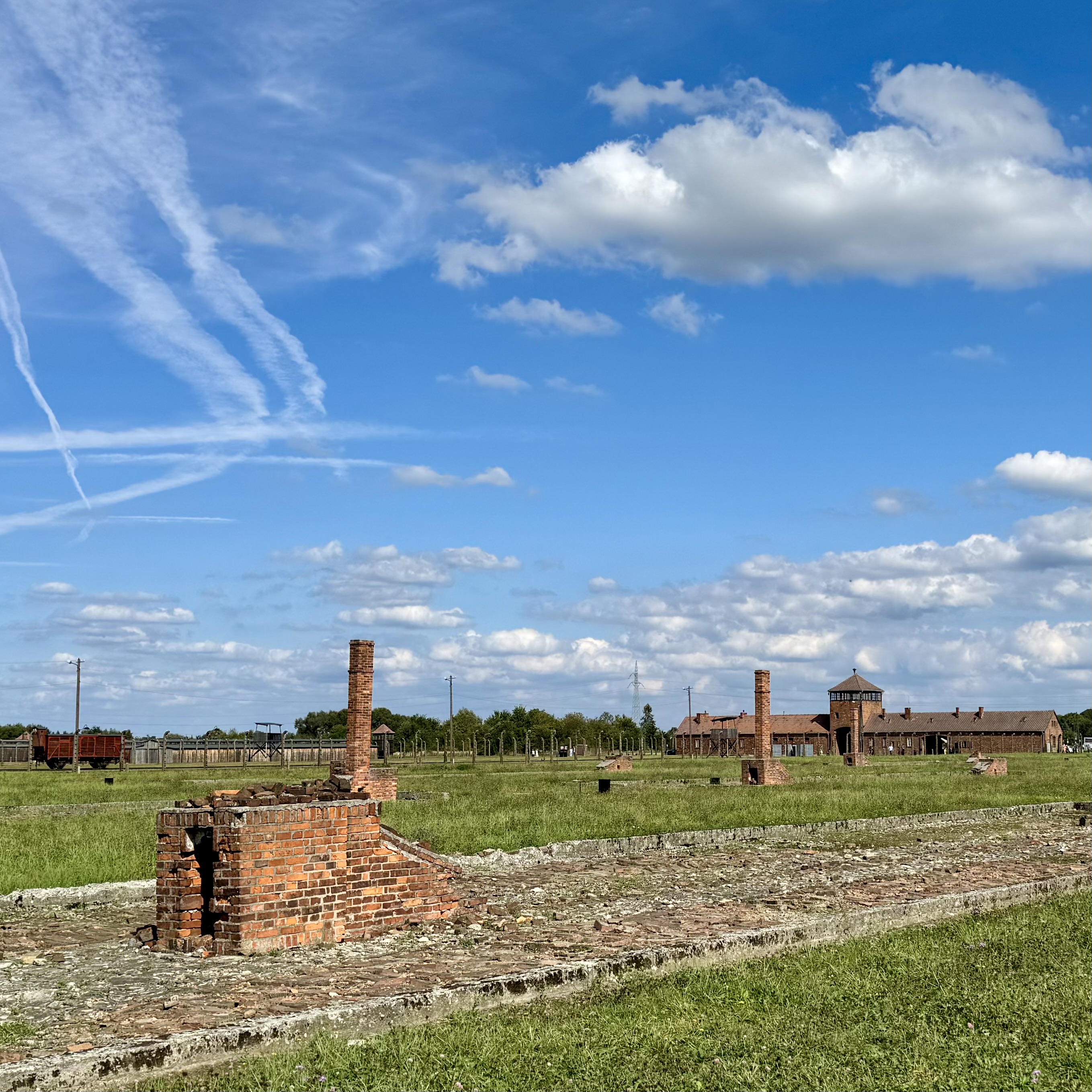
The crematorium, constructed away from the barracks, rises above a grassy knoll.


A bus took us to Birkenau, a ten-minute ride away.  We drove past the river seen in Zone of Interest, where the Nazi commandant and his children bathe until he notices human remains in the water.  Boxcars entered the enclosed camp here.


Here was the end of the line for more than a million people, 90% of whom were Jews.


"Selections" for the gas chambers typically occurred as soon as people stepped out of the boxcars.


Blueprints for the "final solution" are exhibited at the POLIN Museum of the History of Polish Jews.

Gas Chamber
Crematoria
A memorial to the dead sits across from the rail terminus with brass plaques conveying the same message in 23 languages.  It reads, in part:  For ever let this place be a cry of despair and a warning to humanity . . .


Although most of the camp's structures at Birkenau have been destroyed, the eerie ten-minute walk from the memorial back to the entrance gives visitors plenty of time to contemplate the horrors of the place.  


Even if you don't make the trip to Auschwitz, it's unavoidable in Poland's other museums. A poster warning inmates that lice can be deadly at the Museum of the Second World War suggests the Nazi's tin ear for irony.


It also displays the annual self-portraits of woman who survived several years of confinement.

1942
1945
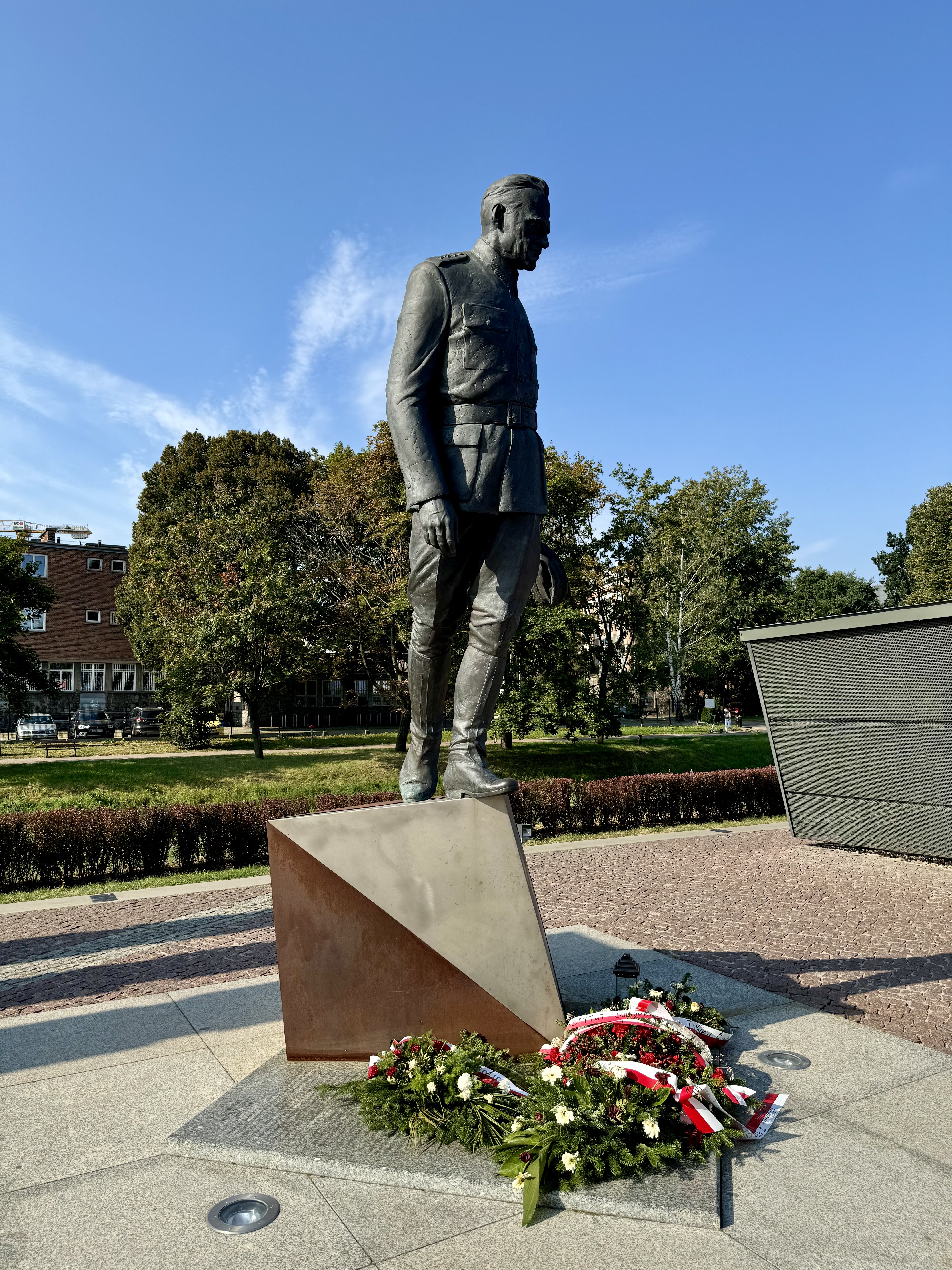
A statue of Witold Pilecki greets visitors to the museum in Gdańsk. 


Not only did the Polish cavalry officer allow himself to be captured by the Nazis in 1940 so he could see what they were up to inside Auschwitz, he formed a resistance group among the inmates and eventually became one of the few people ever to have escaped.   


Imprisoned again by the Nazis for his participation in the Warsaw Uprising--this time for six months in Bavaria--Pilecki returned to Poland after the Allies liberated him in 1945.  He then worked to undermine the Soviets whom he also had battled two decades earlier during the Polish-Soviet War. In 1948, they executed Pilecki--a man of many identities--for his espionage activities.  Subsequent Soviet political oppression kept Polish scholars from publishing accounts of his life for decades.  

One hopes the country's need for a war hero to counter the perception that many Poles collaborated with the Nazis did not result in a biography more mythical than factual.