Friday, December 1, 2023

Gallery Hopper

Art galleries always have intimidated me. Do I really belong here if I have no intention of buying anything?  But that insecurity didn't prevent me from checking out a couple of shows in Lower Manhattan and on the Upper East Side, as different as their locations.

Jonathan Lyndon Chase:  his beard is soft, my hands are empty

Chase, a young Philly artist, explores black queer identity in both public and private spaces:  the barber shop and the living room.


Tracy Emin:  Lovers Grave

Once a revolutionary British artist, Emin, now 60, teaches drawing at the Royal Academy of Arts but her latest work hasn't lost its feminist sting.


Daguerrotypes Don't Demean

As an undergraduate at Columbia, I took a "History of Photography" course that required reviewing a contemporary exhibition.  I chose "New Japanese Photography" at the Museum of Modern Art and wrote about how it made me question the necessity of dropping atomic bombs on Hiroshima and Nagasaki to end World War II after seeing contemporary photos that documented the effects of that strategy on the civilian population 30 years later.  My passion earned me a rare "A."  

"Unnamed Figures: Black Presence and Absence in the Early American North" at the American Folk Art Museum provided a similar epiphany when I learned that mid-19th century African Americans with change to spare were a huge market for newly created commercial photography studios.  For most, it was their first opportunity to have their likenesses depicted in a realistic, non-racist way.  Beaumont Newhall declined to make that point in The History of Photography, published by the MoMA in 1964 and the Bible of my college course.  I just double-checked.  Yep, I've still got the book.


Of course, there were early exceptions like Phyllis Wheatley and later, Frederick Douglass, both of whom were famous enough to receive respectful treatment.  This etching of Wheatley illustrated an edition of her 18th-century poetry.
 

For the most part, African Americans were missing from the folk art of the era or depicted in positions of subjugation which is more obvious in some works than others.  The youth of these two finely dressed subjects in Maryland disguises their relationship until you read the painting's title.

"Charles Calvert & Once-Known Enslaved Attendant by John Hesselius (1761)
One Connecticut slave-holder chose to include her nursemaid in a needlepoint that depicts her lifespan, suggesting that relationship was among the most important in her life and probably continued into adulthood.

"The First, Second, and Last Scene of Mortality" by Pudence Punderson (ca 1776-1783)
A line engraving illustrates the population of a prison in Connecticut which, at the time, had more people enslaved than any other state in New England.  The artist, who may have been a prisoner himself, depicts the faces of white inmates in some detail while the black men are defined strictly by their color.  The whites, however, vastly outnumber the blacks in this pre-13th-amendment environment.

"A Prospective View of Old Newgate, Connecticut's State Prison by Richard Brunton (ca 1799)
Although New York State had abolished slavery by the time this work was painted, notice that the casual strollers all are white and the laborers black.


Racists often have decorated their homes with "lawn jockeys" but the intent behind this unpainted limestone sculpture from the early 19th century is more ambiguous given the dignity of his features.


That ambiguity is missing in these 19th century works.

Minstrel Show Diorama
A comic-book like album of twelve drawings illustrates an upwardly mobile black family after earning their freedom from Mrs. Pontefract but the artist's style jeers more than it admires.


Kara Walker appropriated the original title of the painting below to comment on racist art in Darkytown Rebellion.

Town Scene (formerly known  as "Darkytown") by Unknown Artist (ca 1860-1880)
"Marvels of My Own Inventiveness," another exhibit at the museum provided some welcome relief with works created by contemporary black artists.

Untitled by Leonard Daley (ca 1990s)
Untitled (I LURN ABCD) by Mary T. Smith (ca 1975-1989)
Untitled (HEAR) by Mary T. Smith (partial, ca 1980)

Sunday, November 26, 2023

Bicoastal Thanksgiving

We celebrated an unusual Thanksgiving in South Boston this year, Desmond's first.  He'll be throwing peace signs with the rest of us in no time.  Tom and Audrey were on the West Coast for the holiday to cheer Zoltan on during his first marathon.


I took Amtrak from Moynihan Station, a pleasant journey that almost has become routine. You get the best views of Manhattan sitting on the left side of the train going north through Queens, past the Robert F. Kennedy Bridge and over Randall's Island.


Brightly sunlit infrastructure and shadows made the on-time arrival in Boston interesting, too.


Magda and Joe had a full agenda planned for Friday.  We began at the Museum of Science with a shortened presentation of the Polar Express in 4-D.  The chairs shook, ice melted on our faces and the chemical scent of chocolate wafted through the room.  But the sweet Christmas message provided the best special effect of all: it left even the adults a little weepy.


Our glasses reminded me of a similar holiday experience in 2009, before Magda married and started her own family.  We went to see Avatar on Christmas Day.


You won't find a more pleasant place to spend indoor time with your children than the enormous museum.


A bed of nails didn't phase Dagny.


Every young family needs a portrait with a T-rex!  But it raises a question:  where's Desi?


After a yummy leftovers lunch we headed to Mount Auburn Cemetery in Cambridge.  Magda does know how to make her guncle happy!


Joe, Della and I climbed to the top of Washington Tower, which memorializes the father of our country but looks like a chessboard piece.


Magda, Dagny and Della waited 62 feet below.


It turns out that the hilly cemetery is the perfect place to ride a scooter.


Two days later, on Sunday, fleet-footed Zoltan--aka Boland Kutya or Crazy Dog--finished in the top 10% of all Seattle Marathon runners.  His time: 3:21:40, with an average pace of just under 8 minutes per mile.  Well done!  

Friday, November 24, 2023

Mount Auburn Cemetery

Friends know I'm a ghoul.  That's why Magda suggested we go to Mount Auburn Cemetery less than a month after Christine took me to the Congressional Cemetery.


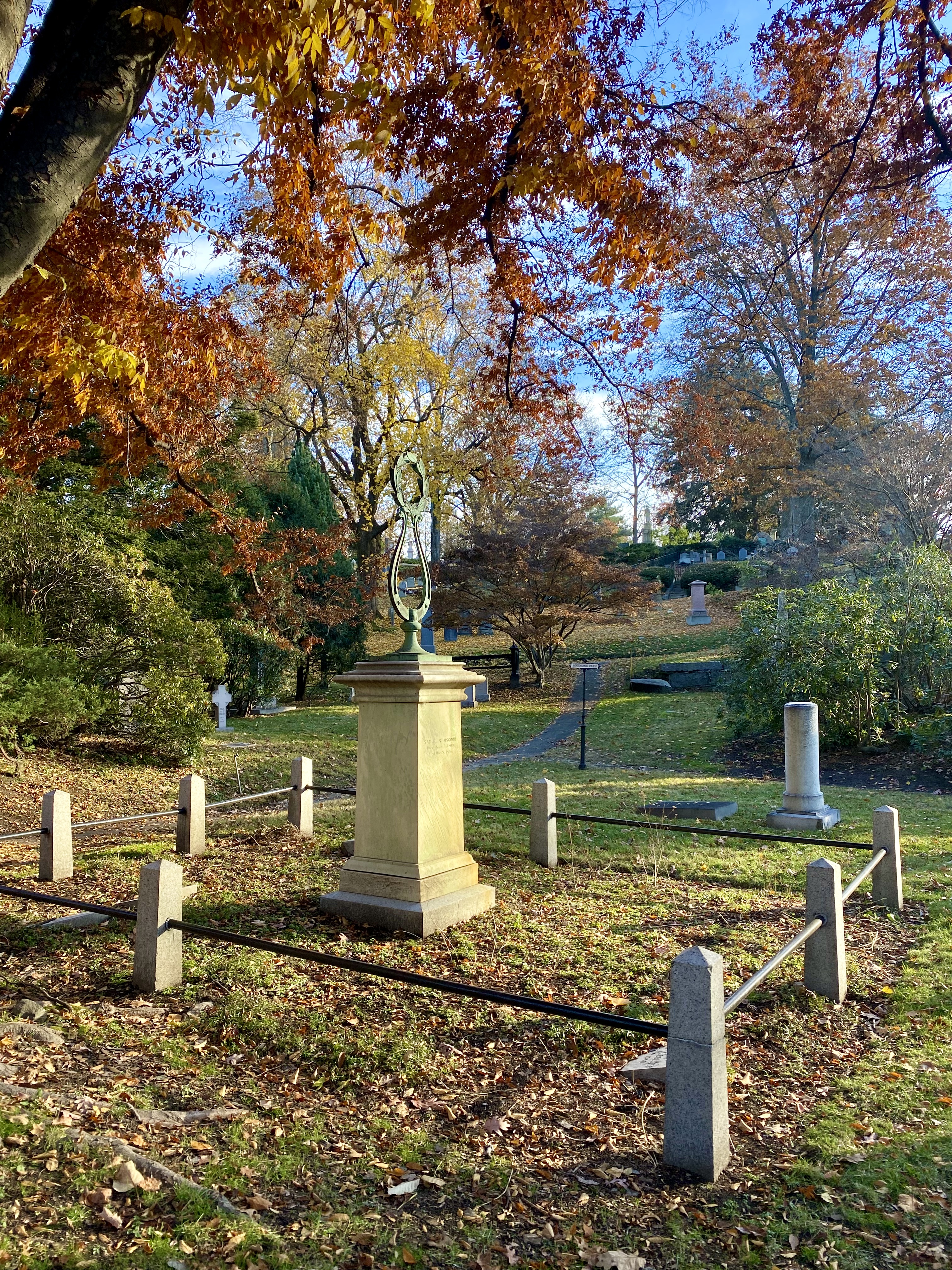
Mount Auburn, which straddles the border between Cambridge and Watertown, Massachusetts, is America's first garden cemetery.  With a gently rolling pastoral landscape that changes with the season, it initially functioned as much as a park as a burial ground. The Bigelow Chapel, above, and the Washington Tower, as well as many of the most interesting tombstones and monuments were constructed in the mid-19th century by Boston's elite class.  Graveyards were for poor people.


The well-signed cemetery--one of its distinctive features--reminded me f I had been born a girl, my parents would have named me Holly.  Otherwise known as Jeff's non-binary path.


Family plots vary significantly in size.  Nearly 100,000 people have been interred at Mount Auburn which remains open for new burials.


James B. Jacobs died at age nineteen.  This ornate tombstone eternalizes his loving family's grief.  "At morn, we know not what the eve may bring.  And dearest treasures take the earliest wing."  Peter Bent Brigham, his rich, single uncle paid for it; investments from his estate, provided seed money for Mass General Brigham, today the nation's largest research hospital.  You have to wonder if his nephew's premature death motivated Brigham's charity.


Martin Millmore, an Irish immigrant who sculpted the American Sphinx, died young, too, at the age of 39.  His work commemorates the Civil War in no uncertain terms.  


American Union Preserved
African Slavery Destroyed
By the Uprising of a Great People
By the Blood of Fallen Heroes


Tuesday, November 21, 2023

The New Earth (3*)


I didn’t “get” Jorge Luis Borges in college and I don’t get him now.  In fact, I blame him for the extreme authorial self-consciousness that adds nothing but a highbrow academic veneer to an almost compelling novel overflowing with enough themes to power several.  That said, Jess Row‘s dissection of  a dysfunctional Upper West Side family reminds me of Jonathan Franzen, high praise indeed.

Bering Wilcox, the youngest daughter of a Midwestern attorney and a Jewish climate change doomsayer, has been killed by Israeli Defense Forces while volunteering as a peace activist in Palestine.  Here’s what her brother Patrick, a Buddhist monk who eventually becomes a tech savant, has to say at her memorial service in Jerusalem:

“She would have been fascinated by all of you, in this room,” he said. “Which is so much like the rooms we grew up in in New York. Probably some of you are from New York, you know what I’m talking about. She would have wanted to ask you the same questions she always asked: how can people live comfortably, how can they enjoy their many creature comforts, and let’s face it, there are so many of them, in a world like this? Particularly so very close to the face of the other. Pressed up close to the fence. That’s what she said to me about Jerusalem: pressed up close to the fence, pretending it isn’t there. She found it fascinating.”

That, in a nutshell, is precisely why I chose to pick up The New Earth when the 75-year-old crisis in the Middle East blew up yet again in early March. 

By the way, the novel begins with the attempted suicide of Bering’s father, whose miserable marriage to Naomi has endured in spite of the fact that she cheated on Sandy before and after giving birth to Patrick during their hippie period in Vermont.  Oh, and Naomi is biracial, a secret she keeps from her children.  There’s more:  Winter, the baby of the family, is an immigration attorney living with Zeno, an undocumented Mexican with a life-threatening allergy whose mother was an indigenous revolutionary.  And did I mention that Bering seduced Patrick who . . . 

Yep, it’s a LOT!

But you have to love a novelist who imagines a character who worries that his suicide might be tainted by a connection to the 2016 presidential election:

To tie your death forever to that heaping steaming shitpile of a Roy Cohn acolyte and wannabe Capone, that blond pompadour with the bloated cheeks, pinched squinty eyes, who was a New York joke thirty years ago, going from bankruptcy to bankruptcy with nothing but a gold-plated name stamped on everything within reach?

And while Row’s political solution to the interminable battle between Jews and Arabs over Palestine seems untenable—co-existing together in a single state with constitutional protections for minority-population Jews, a la South Africa—he does nail the dilemma of people like me who suffer a low-grade of depression regarding matters over which they have no control.  Here’s Patrick again, the guilty conscience of the book, when it looks as if his future brother-in-law will die before Winter gives birth to their twins:

He wants to say something about the shadow of vulnerability. A.k.a. the shadow of history. To live, as ostensibly white Americans, outside that shadow. Naomi would say, outside of that shadow but within the larger shadow, the death of the planet as we know it. But are you really, on any scale, are you immune from the violence of the state and its formations, its manipulations, its supremacist cancers. You are not. And not just because you happen to have a hyperactive conscience. Is it a form of bad faith not to admit that as a result of your upbringing you often feel you live outside any shadow at all, and you deserve to live that way. Or is it just unattractive, uncool, to keep on admitting it, to hedge everything you say with caveats that sound like apologies. Now the term for it is virtue signaling. This is the crux of their lives, apparently. It explains everything and everyone they’ve become, what they’ve survived and not survived. A politics of in/vulnerability. It seems so nineties to put it that way, with the slash. So what. I’m a child of the nineties. What thou lovest remains.

There’s a lot to admire in The New Earth despite its dazzling pretentiousness but it lost a star when Row appended a straightforward timeline of events to the end, as if he thought we might need clarification.  Instead of patronizing his readers, he might have simply jettisoned the crap and written a pot-boiling best seller.  He's certainly got the talent for it.

Sunday, November 19, 2023

Hell With Jesus (4*)


Although I've lived in New York since 1971, I've never gone to the LaMama Experimental Theater Club on the Lower East Side.  Playwright Harvey Fierstein got his start there.  But an intriguing review of Hell With Jesus/Top 40 convinced me it was time.

I can't say that I wasn't warned about audience participation.  At one point, I turned to Thom and asked "WHAT was I thinking?"  But the morning after some acute uneasiness, home alone in the safety of 47 Pianos, my attitude has softened considerably.  Ivo Dimchev, a way-out-there gay Bulgarian performance artist who offered to sing privately in people's homes during the pandemic as a way to reduce isolation, fostered a sense of community with his absurd and often sexual requests to the audience.  Of course, inviting everyone on stage for a selfie while he croons, persuasively (video above), elicited the most participation but through all my discomfort I giggled repeatedly, admired his voice and those of his last-minute supporting cast, and applauded the men and women who bravely took the stage with him.  In short, however briefly (just shy of two hours) I felt like part of a very small community worlds away from the daily horrors relentlessly amplified by the media.

Bravo to Ivo and his provocative, sure-to-go viral questions--both political and not--that he poses to his talented actors (Cassondra James's voice really is like butter) and the audience:  "Would you rather be in hell with Jesus or heaven with Trump?"  "Do you prefer dirty dishes to a dirty cock?" (Xavier Smith pragmatically chose the latter, because it requires less work) "Would you rather be happy, rich or a genius?  Conversation starters you can use in any environment, except perhaps work.

As E.M. Forster (likely spinning in his grave) wrote so long ago in much different times:  "only connect."  Ivo certainly does even if I didn't have the balls to join him!

Saturday, November 18, 2023

The Life and Times of Little Richard (4*)


Charles White's book--part biography and part oral history--has sat on my bookshelves since 1983, when I got a free copy from Crown Publishers, where I worked at the time.  But it wasn't until the death of Richard Penniman in 2020 that I really began paying attention to "the quasar of rock," less because of his classic hits than more recent video clips of his outrageous personality.  My favorite talk show quote: "I'm not conceited, I'm convinced!"

White lovingly makes the case that Little Richard invented the archetypal rock 'n roll persona with incredible talent, energy, charisma and faaaaaaabulous costumes. He also accepts without comment the man's tortured pin balling between the two poles in his life:  homosexuality--expressed through what he himself called "the devil's music"--and religion (the book ends with a kind of greatest hits sermon memorable only for its homophobic venom).  Astonishingly, Little Richard, through sheer force of personality and drive, remained in the spotlight almost four more decades after the book's publication without ever permanently hitching himself to either pole.

But this half-a-life bio still leaves readers absolutely certain of four things:  1) audiences LOVED him; 2) dozens of major artists are forever indebted to him; 3) the music business screwed him; and 4) no other pop artist ever has spoken on the record so explicitly, and perhaps damagingly, about his sex life.  

The Life and Times of Little Richard also adds another stop on my fantasy cultural time machine:  the night in 1962 when the Beatles opened for the (gay!) father of rock 'n roll at Hamburg's Star Club.  Or maybe one of the nights when Jimi Hendrix played in his band.  I can't decide.