Wednesday, August 14, 2024

Avant Garde Psychiatry or Art Therapy?

Francesc Tosquelles, who fled his native Catalonia during the Spanish Civil War, introduced a kind of holistic psychiatry at an asylum in Vichy France that broke down hierarchal barriers among the staff, patients and neighboring communities.  Everyone had to take turns cleaning the toilets.

The hospital where he practiced at Saint-Alban provided refuge for political prisoners as well as treatment for people mentally ill people. Tosquelles encouraged creative expression in both groups through what became known as "institutional psychotherapy."  

These portraits of patients by Léon Schwarz-Abrys were exhibited after the war in Paris but viewers had difficulty determining if the artist had been a patient or a prisoner because the latter often deliberately blurred the lines between the two for reasons of self-preservation.  

"Senile Dementia" (ca 1943-44)
"Paranoid" (ca 1943-44)
"Delusional Hallucinated" (ca 1943-44)
The work produced at Saint-Albans attracted the attention of Jean Dubuffet whose art brut movement valued rawness over training, the id over the super ego. An exhibition at the American Folk Art Museum noodles on the role that Tosquelles played in facilitating greater recognition for "outsider" art barely acknowledging that the Nazis were occupying France at the time.

Auguste Forestier emerged as a singular talent.  

"The Wolf and the Lamb" (ca 1914)
A farm boy obsessed with trains, he de-railed one by putting pebbles on the track.  The incident led to his confinement at Saint-Alban at the age of 27 where he remained for the rest of his life.  The hospital nurtured his early artistic talent by providing a safe haven. Forestier's wooden, toy-like sculptures earned the admiration of Pablo Picasso in addition to Dubuffet, who added Forestier's work to his growing art brut collection.


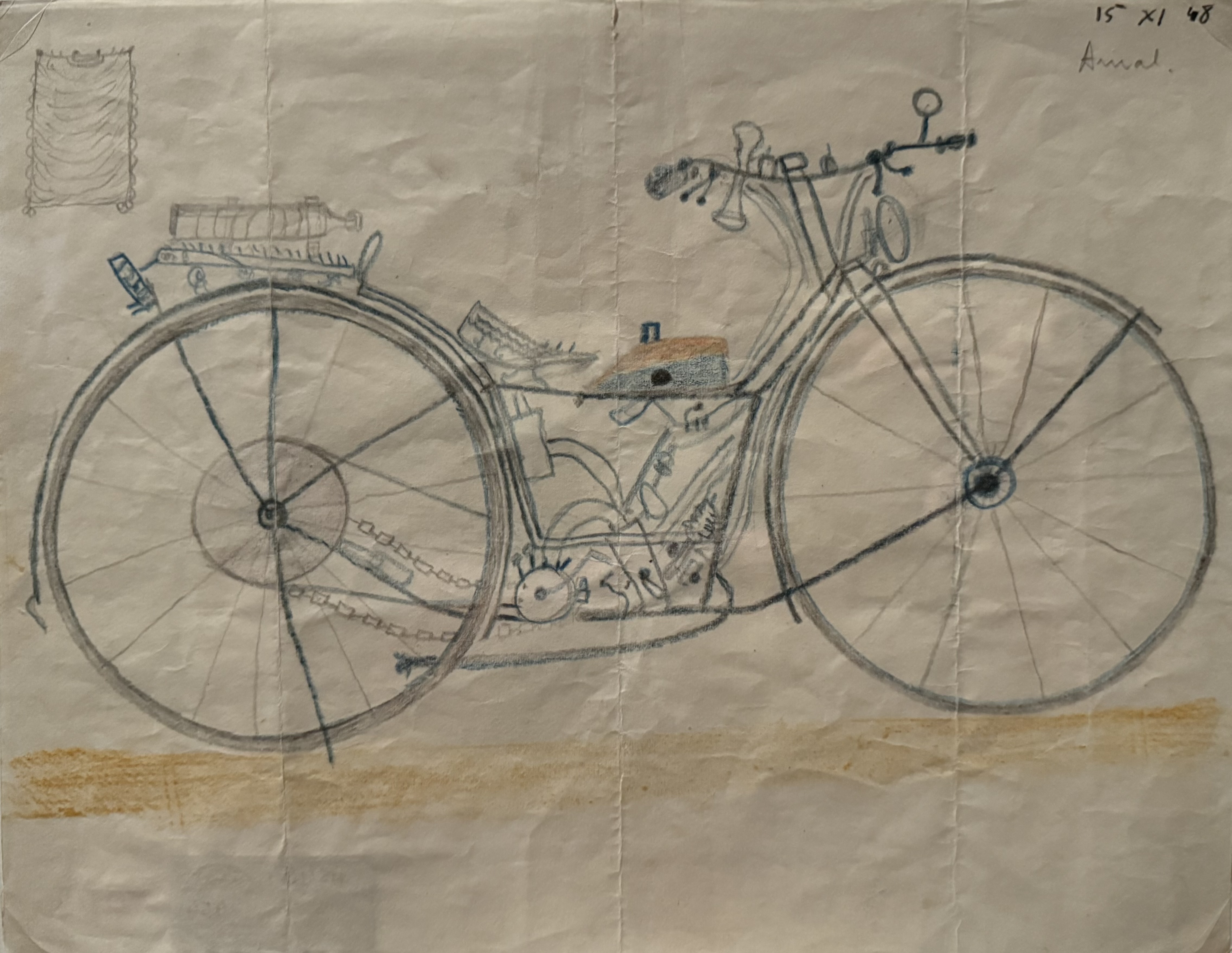
The exhibit includes works by patients from other psychiatric hospitals including a huge collage by Eugene Bedeaux, a former locomotive engineer.   Train obsession might even be considered an exhibition motif.  

"The Symbol of My Story, or Filiation of the Locomotive"  (detail, 1927-33)
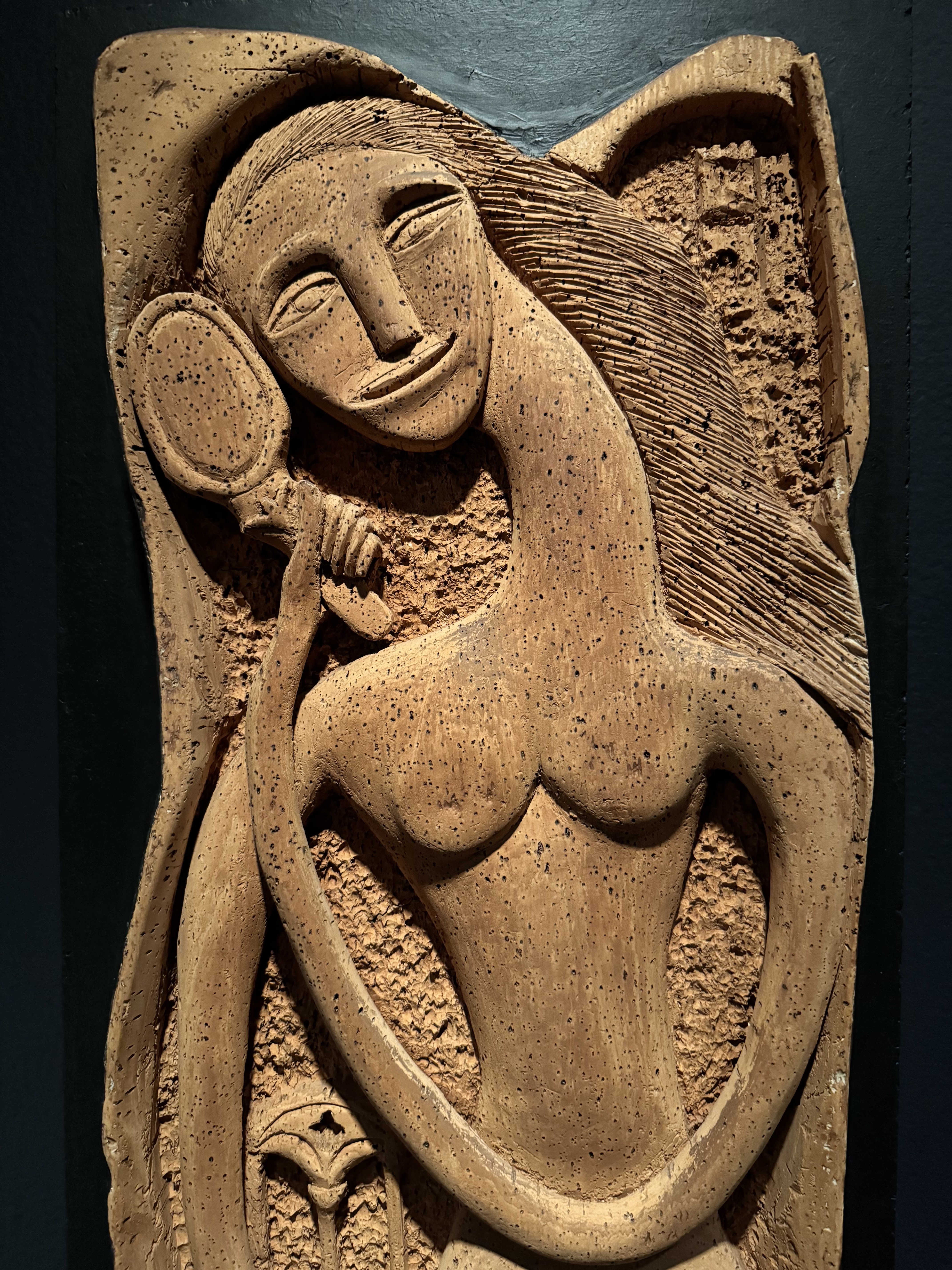
Other practitioners of institutional psychotherapy--who included Frantz Fanon--discussed with Dubuffet the idea that exiles or refugees might visualize their dislocation uniquely.  He recognized their insight when he discovered the haunting bas reliefs Joaquim Vincens Gironella carved to decorate the Parisian headquarters of his family's cork business.  Like Tosquelles, Gironella and his two brothers had been forced to leave Spain by the civil war.  


Dubuffet also used his own artistic talent to render individuals who created art brut in media other than painting and sculpture.  Antonin Artaud, institutionalized off and on for much of his life, introduced the world to the Theater of Cruelty.

Antonin Artaud with Tufts by Jean Dubuffet (1947)
Perhaps as a result of my ignorance of psychiatry's history, I found the exhibit--particularly the label text--heavy going.  Here's what the curators had to say about several scenes Benjamin Arneval drew from his childhood:  "Tosquelles's Saint-Alban colleague and later founder of La Borde clinic Dr. Jean Oury wrote an essay on Arneval and the latter's end-of-the-world cosmology. Oury was especially attentive to the emotional relationship that bound patients to their works. Preventing the separation of these works from the 'living whole' of the artist's immediate lifeworld was a task Oury considered 'an honest occupational therapy.'"   Huh?


The museum supplemented the traveling exhibit with works from its own collection, including a nightgown embroidered by a patient at Willard State Hospital.


My takeaway:  patients enjoy art therapy and some have styles distinctive enough to generate appreciation outside the institutions where they have been confined, particularly when their work is championed by others.


Gena Rowlands (1930 - 2024)


Photo by Bruce Weber (1992)


You let a woman beat you, hunh?  You little . . . tiny nothing!  Punk!

Gena Rowlands delivered those lines, convincingly, pointing a pistol at a man on a subway while holding a kid.  Yeah, I know she was a terrific actress but I never cared much for the films she made with her husband, John Cassavetes.  They brought her Oscar nominations for A Woman Under The Influence (1974) and Gloria (1980), both well past her Hollywood prime, and were indicative of what independent filmmaking--even then--could do for a woman who took her career seriously.

No, what I loved about Gena--who danced at the Truman White House!--was her incomparable look, infused with warmth, vulnerability and even toughness when the role required.  As my father might have said, a beautiful broad, indeed.  

Sunday, August 11, 2024

Hombrecito (3*)


I had hoped a queer coming-of-age story from a Latin American immigrant's perspective would be more enlightening than Hombrecito.   The first part of the book, which takes place in Ibague, a Columbian city of about half a million people, does offer an uncommon perspective, as the narrator, who shares the author's first name, describes his mother's temporary disappearance and his older half-brother's haphazard caretaking. Ransom-based kidnappings, after all, don't pose a threat for most American kids.  Santiago Jose Sanchez also captures the trauma of the family's abrupt move to Miami and convincingly uses a camping trip in the Florida's Everglades to illustrate what only can be his alter-ego's desperate search for a paternal figure.  

But once Santiago reaches adolescence and consummates his relationship with Leo, his Venezuelan boyfriend, the book becomes an exercise in self-pity that could have written by anyone who grew up online.  Sanchez includes this jarring fast forward about the mostly virtual relationship between the very different young men as their paths diverge, with Santiago ending up in New York City as a young man:

This was before I knew how far into his life I would sink; before I knew the darkness in his heart, his explosive immigrant rage; before our first breakup; before the years of fucking each other’s boyfriends as if for sport; before the clubs and the beaches; before the times between cars and under highways; before I was no stranger to his mother’s unfurnished apartment, to her habit of locking herself in her bedroom with Venezuelan calling cards while Leo and I snuck boys, friends, and drugs in through the front door; before the summer I came back from a visit to Colombia with a nose job; before I left Miami and visited to find he had a new best friend every few months; before Leo visited me at college with a new nose of his own, and then in New York City; before I lost him in a bathhouse one night and didn’t find him until the next day, all the good parts of him burnt up; before I ended up trying meth with him one night to see why he loved it; and before we only talked about being horny, desperate faggots, too afraid to talk about anything besides the holes in our lives because we both knew that only in our loneliness and want we were still alike.

Santiago fares much better than Leo, at least from an educational perspective, although Sanchez completely ignores Santiago's years in the Ivy League, arguably when his character's immigrant background would have been thrown into greatest relief.  We do learn that Santiago met his current roommate at Yale but Anais, woefully underwritten, exists only for the contrast she provides with Leo who identifies her as a "chinita."

It annoyed me how quick he was to dismiss her, but I also knew what he meant: Anais had gone to a Montessori, then private school, then Yale; her life had always been on the right track, both her parents guiding her toward the success they had already found in America. This was the difference between us I tried to ignore, because it was easier to focus on how we were similar, to get closer to her, to become her family. That was exactly how she loved me, like family, I said to Leo, feeling like I was drawing some line in the ground between him and Anais. I had come to depend on being in proximity of a life that seemed, at least from the outside, a little easier than mine. College had taught me to do that.

What Yale didn't teach Santiago how to do is support himself after graduation.  Instead, he repeats a pattern established by his mother, a well-educated woman forced to wait tables in order to feed her children after she arrives in America.  Their life only improves once she becomes a paid companion to a rich white woman with cancer but neither job leaves her any time to spend with her sons. Santiago becomes a waiter, too, but also turns to prostitution for reasons that are as much pathological as economic. 

He frowned at his hand on my chest. He was like any white man. He thought he could see me and understand me because there was never anything in front of him that was outside of his understanding. But what he couldn’t see was himself; and he wouldn’t be able to, I thought, not until he could see the way I saw him—something he would never be able to do. He was telling himself he wanted to take care of me. That he was a good man for wanting to love me. It made me miss my mother; it made me want to hurt him.

By now, it has become clear to the (white) reader that Hombrecito is less about the immigrant experience than Sanchez's exploration of how the absence of Santiago's parents during childhood wounded his psyche, seen through the passive aggressive lens of identity politics. Santiago, after all, can't even correct the men when they pronounce his name San Diego; how can he ever expect them to see him when he refuses to stand up for himself? 

In the end, Hombrecito, becomes the story of just another momma's boy, one that has been told many, many times before. 


Saturday, August 10, 2024

An Atlas of Es Devlin

If you were lucky enough to have seen U2 inaugurate the Sphere in Las Vegas last year, you may have seen some of these projections.


They were created by the British-born Es Devlin, in a studio like this, reimagined for the usually sleepy Cooper Hewitt Museum.  She designs sets for concerts and other stage productions as well as immersive art installations.   


David would have LOVED her work.  And he probably would not have believed just how sophisticated set design has gotten over the last three decades.


Unlike many artists, Devlin collaborates with a wide variety of individuals, including musicians, directors, costumers and choreographers, and depends on a crew of hundreds to implement their vision.  She thanks them all in this dynamic display which opens like the aperture of a camera.

Examples of her early art work hang in one gallery.  You don't really see what's coming.  At all!


My familiarity with Devlin was limited to the Broadway production of The Lehmann Trilogy, "The Forest of Us" at Superblue in Miami and "Your Voices" at Lincoln Center.  So I was pretty excited to learn that she had designed the sets for the Pet Shop Boys' "Fundamental" and "Electric" world tours


. . . as well as the enormous mask that appeared on stage for The Weeknd's 2018 Coachella concert


. . . and the tongue slide for Miley Cyrus' "Bangerz" tour.  From soup to nuts, as they say!

Adele, Beyonce and Lady Gaga have hired her, too.  Now I wish I'd seen 'em all and about a hundred of Devlin's other amazing projects, many of which can be glimpsed in this video. Sign me up for the cult!

Thursday, August 1, 2024

The Fab Four and Old Tokyo in Brooklyn

Add shutterbug to the list of Paul McCartney's many creative pursuits.  "Eye of the Storm 1963-64" at the Brooklyn Museum exhibits many of the mostly black & white photos he took at the height of Beatlemania.


In Paris, John and George tried on some native chapeaus.


When the "Ed Sullivan Show" beckoned in New York City, Paul, just 21, found the time to sightsee in Manhattan. 


It isn't entirely clear how he managed to get in more than a few of the shots on display.


I love this picture, taken at Idlewild Airport in 1964.  The fans screamed so loudly that at least one of the baggage handlers (seated @ bottom center) plugged his ears.  As I looked around the gallery at the Brooklyn Museum I realized that some of the women were old enough to have been screaming their heads off.  The photo has added resonance because my mother and I had flown into Idlewild a year or two earlier, en route to France.  My aunt and uncle picked us up in their white Thunderbird convertible.  I have no idea how we all fit.


A week after their whirlwind tour of New York, the Beatles played a second "Ed Sullivan" gig live from Miami Beach and vacationed at the recently demolished Deauville Hotel.  For the exhibit, Paul created and scored a wonderful slideshow that includes plenty of camaraderie captured on Kodachrome.


By the time Paul took this photo, John's shotgun marriage to Cynthia Powell, an artist, was no longer a secret.  They must have left Julian back in England.  John stayed with Cynthia, who died in 2015, until he met Yoko.


From the icky expression on his face, it's clear this Beatle didn't enjoy angling.


Paul aimed his Pentax at other people, too, including Brian Epstein who managed the Beatles until his death from an accidental overdose not long after they released Sgt. Pepper's Lonely Hearts Club Band.  Apparently, the world's most famous band didn't give a shit about his homosexuality; he and John had a particularly close relationship.  Epstein also styled their signature mop top look.


I once found myself on a delayed flight from Montreal to New York City with the French Elvis (left).  When it came time to board the plane, Johnny Hallyday lined up just like everyone else.


I wasn't aware that Tokyo used to be called Edo.  The name changed a few years after the city was freshly mapped (partial view) in 1859.  


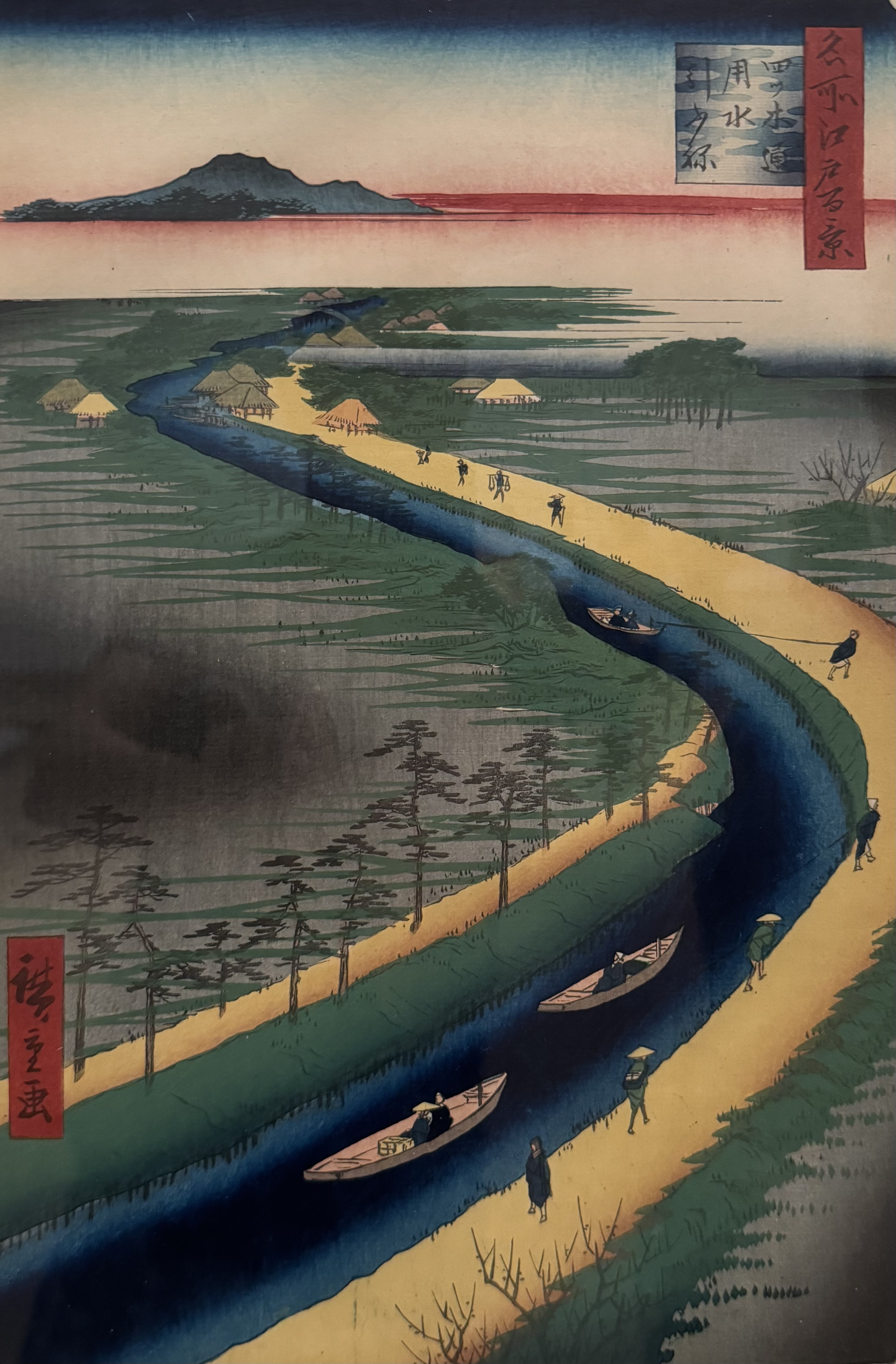
Around the same time, Hiroshige completed his "One Hundred Famous Views" of Edo. Actually, 118 views.  The woodblock prints were initially published and released in serialized form from 1856-1859.  

"The City Flourishing, Tanabata Festival" 
Hiroshige died in 1858 during the serialization.  His apprentice (and son-in-law) took over production, but the prints remain the last gasp of ukiyo-e, a Japanese genre of art that hugely influenced the European Impressionists.  

"Horikiri Iris Garden"
The Brooklyn Museum acquired a bound set in 1930.  They gathered dust on a library shelf for more than three decades, perhaps one of the reasons the color still looks so vibrant now that the curatorial staff has set the individual prints free.  This marks the first time in a quarter-century they have been exhibited in their entirety.

"Ayase River and Kanegafuchi" 
I was eager to see them because they remind me of watercolors my mother brought back from Japan for her parents and sister.  Framed in bamboo they hung in both households, always making me wonder why we didn't have any in our own.

"Meguro Drum Bridge and Sunset Hill"
The museum supplemented the exhibit with items from its extensive collection of Asian Art.


It's hard to connect these pastoral scenes with the city's 20th century history.  During World War II, the United States destroyed 16 square miles of the Tokyo, killing an estimated 100,000 residents.  It remains the worst bombing raid in human history.

"View of Nihonbashi Töri 1-chome"
"Towboats along the Yotsugi-döri Canal"
"Armor-Hanging Pine, Hakkeizaka"
"Minowa, Kanasugi, Mikawashima" 

The exhibit also includes enlarged reproductions of the views by Takashi Murakami.  Bigger isn't always better; in fact, they look a little garish.  I much rather would have seen the copies Van Gogh made of Hiroshige.

"Suido Bridge and Surugadal" 
Hiroshige's 100 Famous Views of Edo: Japonisme Reconsidered (2024)

Tuesday, July 30, 2024

IM: A Memoir (3*)


Fashion generally only interests me by the time it gets to a museum, as was the case with 90s It Boy Isaac Mizrahi.  Somehow, I missed Unzipped even though the documentary was directed by Mizrahi's first serious boyfriend, the man behind the incomparable Madonna: Truth or Dare.  But when I finally encountered the designer's retrospective at the Jewish Museum in 2016, I thrilled to his idiosyncratic use of color, creativity and costume.

I certainly didn't thrill to IM, his less-than-dishy memoir.  On the one hand, it's an undeniably well-written account of his fascinating career, with early stints at both Perry Ellis and Calvin Klein, and oh-so-discreet descriptions of his interactions with divas, including Liza and Audrey.  On the other, it's also a narcissistic catalog of his neuroses, insecurity and insomnia with too many pages devoted to his childhood and endless attacks on the insular culture that spawned him.  Did Mizrahi ever have any fun?  No wonder Stephen Sondheim "ex-communicated" him.  Get over yourself, honey!
Even more disturbing, his faith in the occult led him to abandon the unique talent so clearly evident at the Jewish Museum for a less than stellar stint in show biz.  The book ends with the fulfillment Mizrahi derives from performing his cabaret show, admittedly a lot less taxing than producing a new clothing line every season.  Instead of the Syrian Jews who clapped for his garage puppet shows and impersonations of Barbra, he now basks in the applause of a sophisticated audience at the Cafe Carlyle.

I guess he just couldn't cut it in the real world.  What a loss.  

Open Throat (4*)


If this amusing, lyrically written environmental parable, recently adapted for live performance at Little Island, had been longer than 40 pages, I might not have read it.  That would have been my loss.  Henry Hoke convincingly inhabits the consciousness of a California mountain lion whose territory includes hikers and a homeless encampment.  He learns all he needs to know about contemporary life by eavesdropping on the former.

is new york where I have to go

from what people say it sounds like everyone there is coming here and that’s why everything is changing or why everything costs too much now or why all the good things about ellay are disappearing

I want to do the opposite I want to go to a place where I won’t be hated

where there are therapists running around everywhere like deer and I can just find one and catch it and pin it down

store it somewhere safe and visit it once a week 

Did I mention the mountain lion is discreetly gay?  He falls in love with a kill sharer who gets killed crossing the freeway, evocatively described like this:

the long death up close and in focus was even harder to take with its lights and speeding murderous cars never stopping on their hell ride to the right and to the left 

The mountain lion even buddies up with fag-hag-in-training who calls him heckit and takes him on a joyride to disnee before the book turns deadly serious, pointing a finger at the kind of heterosexual male behavior that threatens our planet far more than any animal predator.