Monday, March 4, 2024

B&W FLASHBACK: Bottom Line Nights (late 1970s)

In its heyday, the Bottom Line was my favorite venue for live music.  Bruce Springsteen played there shortly before Time magazine put him on the cover, but Lou Reed always was more my man.  At least until I read the Will Hermes biography.

I guess I must have tried to see Bryan Ferry, too.  It was never to be.  My mother's death in 1975 meant I couldn't join Tom and Audrey for a Roxy Music show at the Academy of Music.

The club's owners didn't care if you took photographs and the place, which served food, was small enough that you could get some pretty good shots, although mine always seemed to be slightly out of focus.  I was an enthusiastic amateur at best.

Audrey often accompanied me to shows before she landed a job in the music industry.


I'd like to think we caught David Johansen's first solo run in 1978 but I can't be sure.  There's a live recording.  While still in college, we lined up to see the New York Dolls at the Mercer Arts Center but never got in.  Here's Johansen harmonizing with former bandmate Sylvain Sylvain.

Sylvain Sylvain must have performed in support of his first solo album, too.  Time seems to be particularly unkind to rock 'n rollers.  Syl checked out in 2021, balding, overweight and bloated.


I can't identify this musician even though he's in sharper focus than the rest!


Few queer musicians were out in those days but Tom Robinson was an exception.  "Glad to Be Gay" became an anthem for British poofs.  The former boy-next-door now identifies as bisexual although he once wrote a song about cruising toilets called "Can't Keep Away," which hasn't lost any of its shock value.


I continued attending Bottom Line shows sans camera until the early 1980s. Garland Jeffries, Dolly Parton, Tim Curry and Patti Smith were among the artists I saw perform.   I missed my camera most when an energetic Patti jumped from the stage to a table before squirting catsup on a surprised patron.  When he protested, the punk priestess snarled "Stop whining, I'll pay for your dry cleaning!"  Those were the days!

B&W FLASHBACK: Dave's Pier Portfolio (1978)

Manhattan's decaying industrial waterfront on the Upper West Side provided a resonant backdrop for photographing Dave shortly after we met, before life in New York City morphed him into David.  Although it wasn't as busy as the notorious piers in Lower Manhattan, we both cruised there like Boy Scouts seeking merit badges in the demimonde.  


Remnants of the railroad yard--including an abandoned YMCA--offered semi-private trysting places.


At 24, Dave had attitude and sexual confidence to spare.


We called these photos his "Hot Shots."  When paying tribute to him on Instagram's AIDS Memorial, I used one.  My sexy camel has been gone 30 years.


This photo reminds me of the night Paul first took us dancing at the Saint. A shaft of spot light illuminated Dave similarly as he stood on risers in the balcony.  Years later, I encountered a Roman statue with the same expression.  It inspired the title of my first blog, "Chasing Rapture."  


Bulldozers had begun clearing the dangerous area, haltingly.  Thanks to Mayor Bloomberg, it's now beautiful parkland and occasional sculpture garden.


Dave was WAY out of my league in terms of sex appeal.  That probably contributed to my survival.

In A Strange Room (4*)


I'll admit I expected something more explicitly gay than this trio of novellas, linked by a character who shares the name of the Booker Prize-winning author, after the New York Times cited In a Strange Room as an antecedent to the black queer literature now flourishing in Africa.  It's an oblique work, narrated by the same reticent South African man in the first and third persons, sometimes in the same sentence, as he aimlessly roams the world.  But Damon Galgut's piercing insights about travel more than compensate for his book's absence of plot.

Between them there is an excitement made partly from fear, they are committed to a situation of which the outcome is unknown, travel and love have this much in common. 

*  *  *  *  *

A journey is a gesture inscribed in space, it vanishes even as it’s made. You go from one place to another place, and on to somewhere else again, and already behind you there is no trace that you were ever there. The roads you went down yesterday are full of different people now, none of them knows who you are. In the room you slept in last night a stranger lies in the bed. Dust covers over your footprints, the marks of your fingers are wiped off the door, from the floor and table the bits and pieces of evidence that you might have dropped are swept up and thrown away and they never come back again. The very air closes behind you like water and soon your presence, which felt so weighty and permanent, has completely gone. Things happen once only and are never repeated, never return. Except in memory.

Based on my own writing experience, I'm guessing Galgut kept journals as a young man, and has focused on the key landmarks of his self-discovery.  In neither "The Follower" nor "The Lover" does Galgut consummate his crushes on European companions as white as he but as foreign as the places they visit.  These sections seem to be his personalized take on an idea that Carson McCullers explored so  in The Ballad of the Sad Cafe:

First of all, love is a joint experience between two persons — but the fact that it is a joint experience does not mean that it is a similar experience to the two people involved. There are the lover and the beloved, but these two come from different countries. Often the beloved is only a stimulus for all the stored-up love which had lain quiet within the lover for a long time hitherto. And somehow every lover knows this. He feels in his soul that his love is a solitary thing. He comes to know a new, strange loneliness and it is this knowledge which makes him suffer. So there is only one thing for the lover to do. He must house his love within himself as best he can; he must create for himself a whole new inward world — a world intense and strange, complete in himself. Let it be added here that this lover about whom we speak need not necessarily be a young man saving for a wedding ring — this lover can be man, woman, child, or indeed any human creature on this earth.

Now, the beloved can also be of any description. The most outlandish people can be the stimulus for love. A man may be a doddering great-grandfather and still love only a strange girl he saw in the streets of Cheehaw one afternoon two decades past. The preacher may love a fallen woman. The beloved may be treacherous, greasy-headed, and given to evil habits. Yes, and the lover may see this as clearly as anyone else — but that does not affect the evolution of his love one whit. A most mediocre person can be the object of a love which is wild, extravagant, and beautiful as the poison lilies of the swamp. A good man may be the stimulus for a love both violent and debased, or a jabbering madman may bring about in the soul of someone a tender and simple idyll. Therefore, the value and quality of any love is determined solely by the lover himself.

It is for this reason that most of us would rather love than be loved. Almost everyone wants to be the lover. And the curt truth is that, in a deep secret way, the state of being beloved is intolerable to many. The beloved fears and hates the lover, and with the best of reasons. For the lover is forever trying to strip bare his beloved. The lover craves any possible relation with the beloved, even if this experience can cause him only pain.

While Galgut experiences explores both roles in the book's first two sections, tragic circumstances in last force him to make a choice. With the stakes so much higher, the narrative explodes, and the boy who has been using travel to escape his repressed and mostly chaste life finally becomes a man--a lover--when his best friend and the horrors of the Indian health care system test his commitment to another person.

Sunday, March 3, 2024

B&W FLASHBACK: Dog Canyon Idyll (1978)

Because you had to know where to look, taking Barb to Dog Canyon reminded me of Gone Away Lake, my favorite book as a child.  Unmapped, it was due east of Highway 54, the road that crossed the border into New Mexico, about ninety minutes away from the neighborhood where we went to high school.  I had discovered it a decade earlier on a weekend off-road drive with my father.

Once again, Dad's wheels provided the transportation on an unmarked gravel track through arid scrub to the foothills of the Sacramento Mountains with the tape deck blasting Led Zeppelin.  I'm not sure Barb ever had heard "Stairway to Heaven" at the right volume.  That blue and gray Pendleton shirt still keeps me warm.


We hiked a mile or two to what really felt like an oasis, even in the mild March sun.


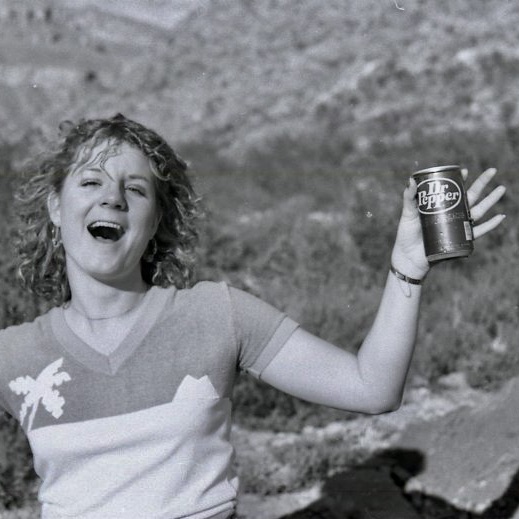
A skull-like rock formation offered a great framing opportunity.  The photo of Barb that begins this entry remains one of my favorite portraits.  It almost captures her joie de vivre.


We couldn't believe we found water in the desert.  "It must be snowmelt," I explained.


Time for an outdoor shower, probably my first!


We slaked our thirst with a Dr. Pepper from the ice chest afterwards.  It took a scanner and a computer to enlarge most of these photos for the first time nearly five decades later.  I've never been back.


B&W FLASHBACK: Why I Hate Winter (1978)

I can't recall how cold it was in January of 1978, but I do remember the Village Voice, then New York's weekly voice of the counterculture, sponsoring "Why I Hate Winter," a photography contest.  Why not illustrate how bundling up to keep warm made it difficult to use the toilet?  Paul, always game for a lark, agreed to model in my tiny studio apartment on West 70th Street.


His pornstache grimace may have conveyed more constipation than urgency . . .


My bathroom, directly behind the galley kitchen, was barely larger than a closet.


The Clash was legitimizing punk, Eastern Airlines still flew to warmer climes and Charlie Chaplin had just died.  I thought shameless product placement would lead to a prize.  It didn't.

Today, Paul has no recollection of our failed collaboration, perhaps because modeling was so much less labor intensive than taking pictures nearly half a century ago.  First, the black and white film--newspapers didn't print color then--had to be purchased, inserted and wound into my Yashica camera before choosing the right shooting speed & exposure. Second, the film had to be developed,  the contact sheet reviewed and the best photos chosen for enlargement.  Finally, the envelope had to be stuffed with a cover letter, addressed, stamped and mailed.  And it took weeks for the Voice to announce the results.

My "Why I Hate Winter" concept would have worked so much better on TikTok.

Saturday, February 24, 2024

Lake Worth's Big Weekend

The crowds keep getting bigger at Lake Worth's annual Street Painting Festival, now 30 years old.  I went to my first in 2018.  Has the art gotten less charming or am I just more habituated? In any case, only a few works struck my fancy, including this ghoulish take on a Van Gogh self-portrait.


This woman worked from a photograph of "Portrait of a Young Spanish Woman" by Anton Ebert, a 19th-century Czech painter.  I wonder if a beach towel inspired her?


Many participants were still applying finishing touches on the final morning of the weekend event.


Evvy told me Black Star is her favorite Bowie album.  While it turned the Thin White Duke's death into critically-acclaimed performance art, I can't help but feel sorry for anyone who didn't first fall in love with Ziggy, as I did, more than 50 years ago.


The woman who painted this musician wore a "Yes, It's Me, I'm the Problem" t-shirt.  From an artistic perspective I'd have to agree.  Meow.


The younger folks at the festival probably didn't recognize this celebrity.  Neither did I at first.  Bad old gay!


Local businesses and firms sponsor the artists.  Betty Resch, an attorney, is Lake Worth's current mayor.  She's running again in a tightly contested election next month.  If there's a message, here I'm not sure what it says but I'd probably vote for her if I was eligible.


Street food options were a lot more varied this year.  Christine told me that Oceano Kitchen, Lake Worth's new foodie destination and long our favorite restaurant in its old Lantana location, was hawking $18 pomegranate margaritas on Saturday, an option unavailable on Sunday, perhaps because they misjudged the market.


No doubt glorious weather increased the turnout this year.


Surprisingly, if you were looking for serenity on a Sunday morning, you could find it at the Children's Meadow.


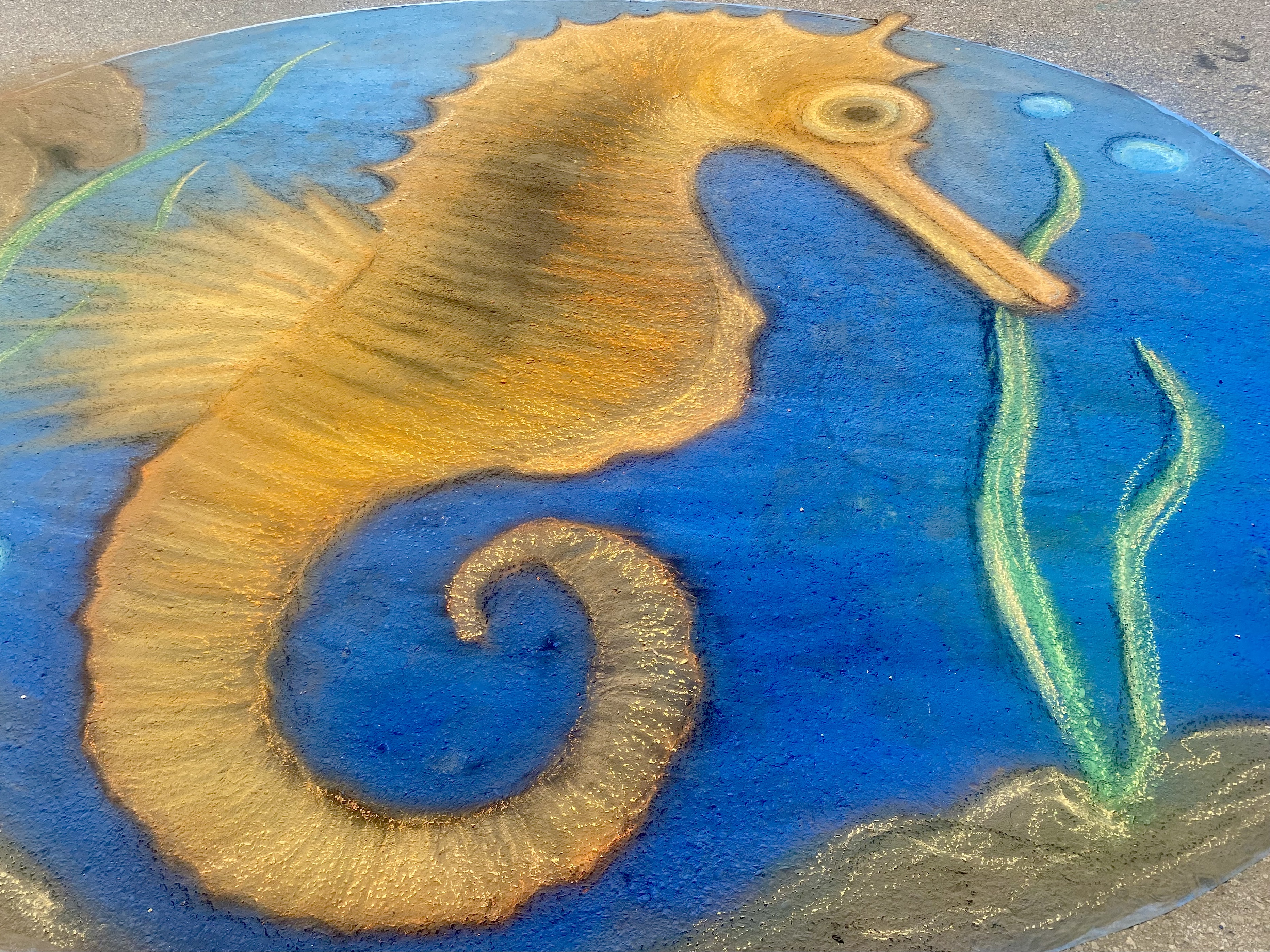
I'm a sucker for seahorses and flamingoes.


And nothing like patriotism with a pretty face to soften up my anti-nationalist instincts.